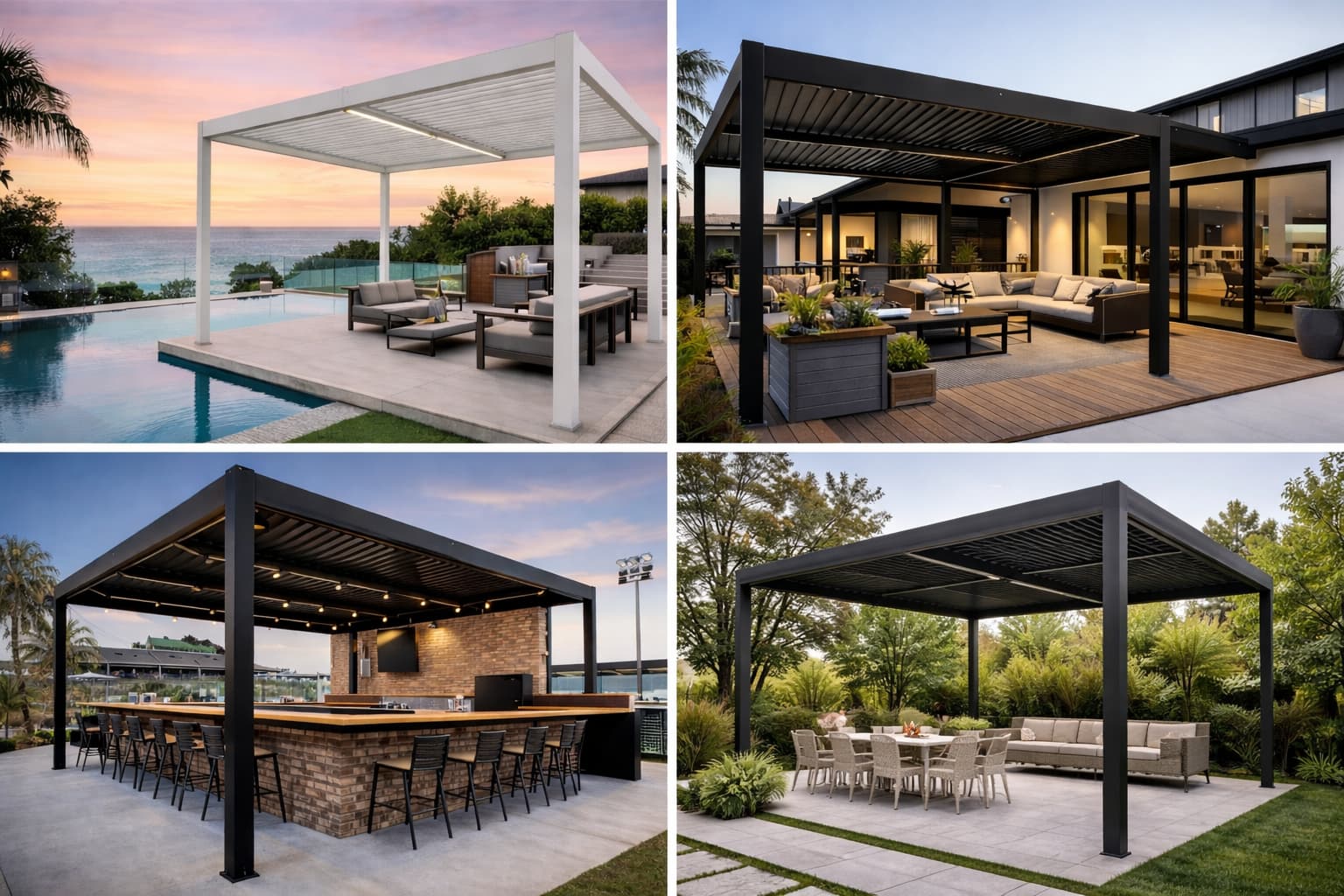
Description
When buyers compare louvre kitsets, attention usually goes to:
• Beam size
• Blade profile
• Wind rating
• Motor options
But one of the most critical — and most overlooked — elements of any aluminium louvre pergola system is the hardware:
Screws, brackets, and structural fittings.
In New Zealand conditions — especially coastal, humid, and high-wind environments — the grade of stainless steel used in fittings can significantly affect long-term durability, appearance, and structural performance.
In engineered outdoor systems, the strength is in the connections.
The Typical Hardware Setup in Entry-Level Louvre Kitsets
Many price-driven or entry-level systems use:
• 6063 aluminium structural framing
• Galvanised steel screws
• Stainless Steel 201 brackets and fittings
This combination keeps upfront pricing competitive.
However, not all stainless steel performs equally in exposed outdoor environments.
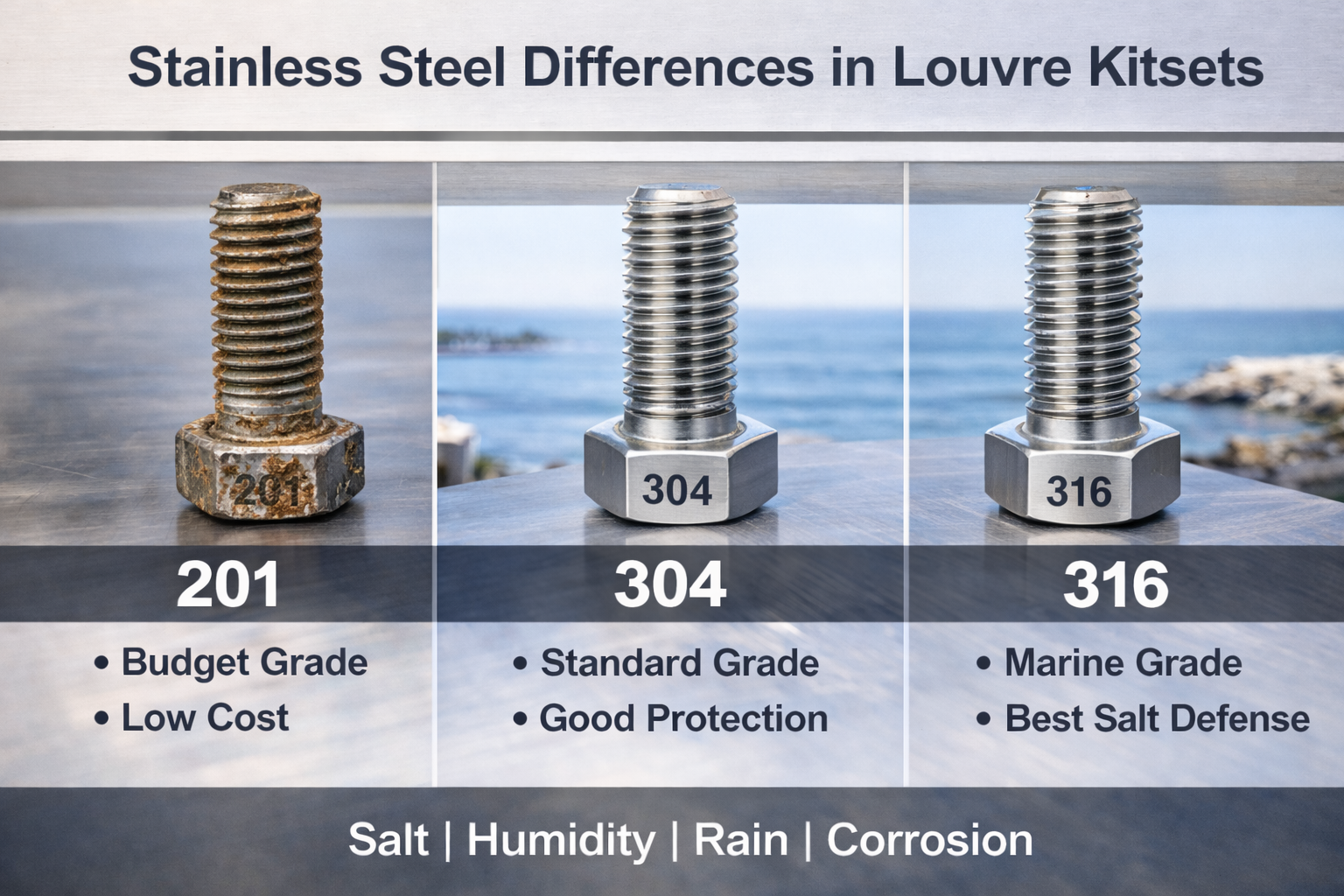
Understanding the difference between 201, 304, and 316 stainless steel is essential when selecting a long-term outdoor louvre system in NZ.
What Is Stainless Steel 201?
Stainless Steel 201 is a lower-cost stainless alloy.
It contains:
• Lower nickel content
• Higher manganese
• Reduced corrosion resistance compared to 304 or 316
It is technically stainless steel — but it is not marine-grade and is not designed for aggressive environments.
Where Stainless 201 Is Sometimes Used
• Inland residential installations
• Covered areas
• Dry climates
• Budget-focused builds
Where Stainless 201 Struggles in NZ Conditions
• Coastal properties
• High humidity regions
• Salt air exposure
• Poolside installations
Over time, 201 fittings can:
• Develop tea staining
• Show surface rust
• Corrode faster than higher grades
• Cause staining around aluminium connection points
In New Zealand’s mix of rain, UV exposure, humidity, and coastal salt, 201 is typically a cost-driven material choice rather than a longevity-driven one.
Stainless Steel 304 – The Architectural Baseline
Stainless Steel 304 is widely recognised as the architectural standard.
Its higher nickel content significantly improves corrosion resistance and long-term outdoor performance.
Benefits of 304 Stainless Steel
• Strong corrosion resistance
• Long service life
• Reliable performance in most NZ climates
• Better moisture resistance
• Lower maintenance requirements
• Cleaner long-term appearance
For most New Zealand regions — Auckland, Waikato, Wellington, inland South Island — 304 should be considered the minimum recommended standard, not an upgrade.
When specifying a permanent motorised louvre pergola system, 304 fasteners provide durability aligned with long-term structural expectations.
Stainless Steel 316 – Marine Grade Protection
Stainless Steel 316 contains molybdenum, which dramatically increases resistance to chlorides (salt exposure).
This makes it ideal for:
• Coastal homes
• Beachfront properties
• Pacific Island installations
• Poolside applications
• Hospitality venues near the ocean
316 is commonly referred to as marine-grade stainless steel.
In areas such as Mount Maunganui, Coromandel, Tauranga waterfront, Gold Coast, or Fiji, 316 is not over-specifying — it is correct engineering.
What About Galvanised Screws?
Galvanised steel screws are zinc-coated to resist corrosion.
They may be suitable for:
• Dry inland environments
• Budget installations
• Temporary structures
However:
• Once the zinc coating is compromised, corrosion begins
• Coastal exposure significantly reduces lifespan
• Mixed-metal connections can increase galvanic corrosion risk
Upgrading to full stainless 304 or 316 fasteners improves durability and reduces long-term maintenance in exposed environments.
Why Hardware Grade Matters in Louvre Systems
Louvre systems are dynamic, load-bearing outdoor structures. They:
• Rotate and move
• Handle wind loads
• Drain water internally
• Expand and contract with temperature
• Transfer stress through connection points
The screws and brackets are not cosmetic components.
They are structural.
Lower-grade hardware can:
• Corrode at high-load connection points
• Cause visible streaking on aluminium beams
• Reduce long-term structural integrity
• Shorten the system’s lifespan
Higher-grade stainless steel:
• Maintains structural strength longer
• Prevents premature corrosion
• Protects the visual finish
• Preserves long-term asset value
In coastal or high-exposure installations, this difference becomes increasingly significant over time.
Which Stainless Steel Grade Should You Choose?
For a permanent outdoor louvre kitset in New Zealand, the safest recommendation is clear:
Avoid Stainless Steel 201 where possible.
While 201 may perform in very mild inland environments, NZ’s climate conditions mean it does not provide the corrosion resistance expected from a long-term outdoor investment.
Over time, 201 fittings are more likely to:
• Develop tea staining
• Show visible corrosion
• Reduce aesthetic quality
• Require earlier replacement
The cost difference between 201 and 304 or 316 stainless steel is typically a small percentage of the overall pergola investment — but the durability difference can be substantial.
Practical Recommendation
• 201 = Budget-driven choice (best avoided for exposed NZ installations)
• 304 = Minimum recommended standard for most NZ regions
• 316 = Best option for coastal, marine, or high-exposure environments
When investing in a louvre system designed to last decades, the hardware should reflect that intention.
Final Thought
In any engineered structure, the most important components are the connections.
A louvre system is only as durable as the screws and fittings holding it together.
Choosing 304 or 316 stainless steel is not about overspending.
It is about building correctly — for New Zealand conditions — the first time.