
For commercial hospitality venues: restaurants, bars, and cafes: square footage is the primary driver of revenue. Every square meter of floor space carries a specific overhead cost, yet many establishments allow a significant portion of their footprint to sit dormant for three to six months of the year. Outdoor patios and terraces are often treated as seasonal bonuses rather than reliable revenue generators.
In the modern commercial landscape, the shift toward all-weather seating is no longer a luxury; it is a strategic financial move. By investing in infrastructure that mitigates the impact of rain, wind, and cold, businesses can transition from "seasonal peaks" to "consistent annual yields." This guide analyzes the financial Return on Investment (ROI) of all-weather outdoor solutions and details how to maximize the profitability of every square meter, regardless of the forecast.
To understand the value of an all-weather investment, owners must look beyond the initial capital expenditure (CAPEX) and focus on the capacity utilization rate. The formula for calculating the ROI of an outdoor space expansion is straightforward:
Days of Operation × Number of Seats × Average Check Size × Table Turns × Occupancy Percentage = Total Revenue
Consider a standard scenario: A medium-sized bistro has an outdoor terrace with 30 seats. Without weather protection, this area is only usable on clear days between late spring and early autumn: approximately 150 days a year.
By making the space usable year-round, the venue captures an additional $336,000 in gross revenue. In many cases, the cost of installing high-end weather protection systems is recouped within the first 12 to 18 months of operation.
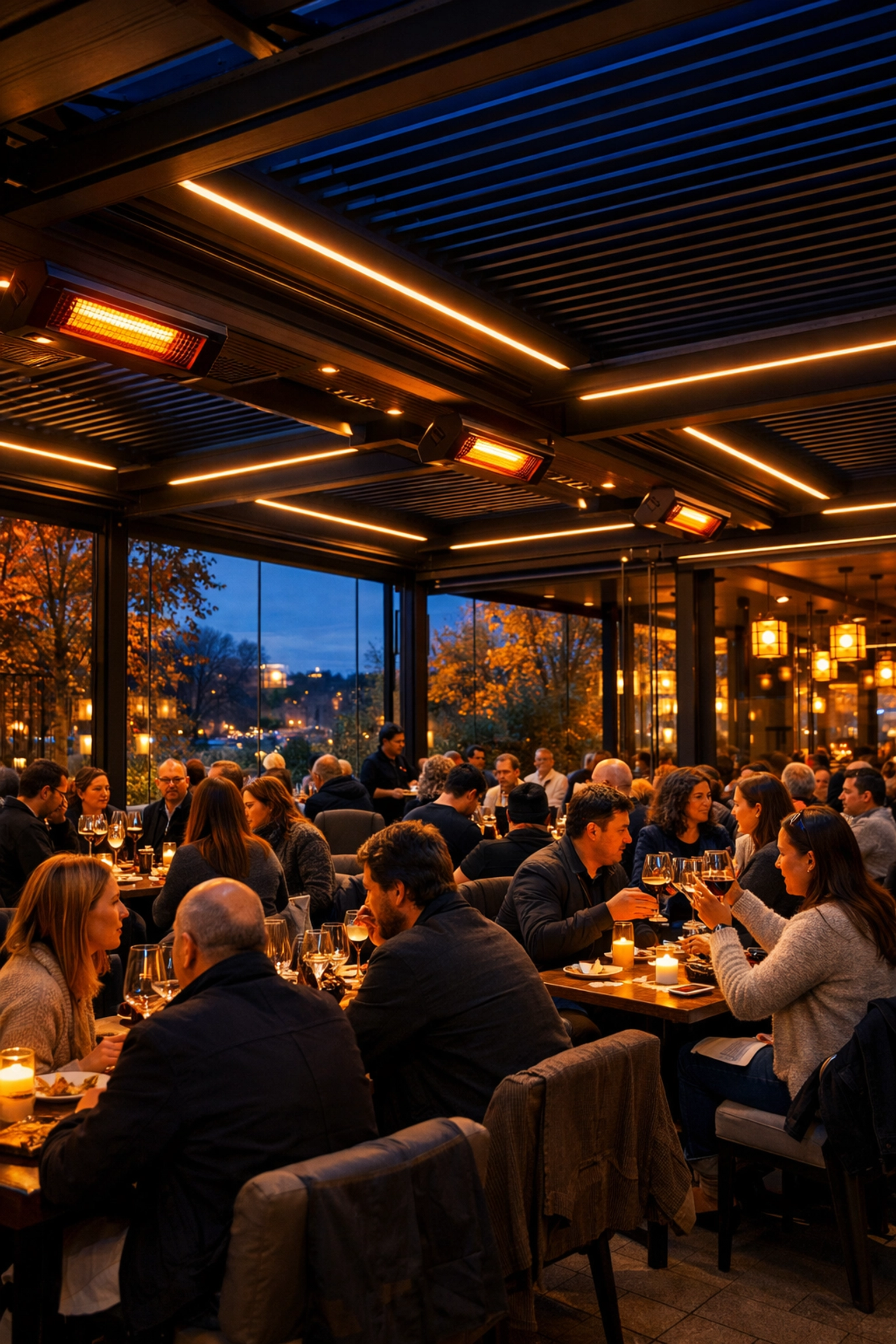
Weather uncertainty acts as a hidden tax on hospitality businesses. When a forecast calls for intermittent rain, managers face a difficult choice: staff the outdoor area and risk high labor costs with no customers, or understaff and lose potential revenue if the sun breaks through.
All-weather infrastructure: specifically automated louvered roofs and integrated side screens: eliminates this gambling. When an outdoor space is effectively enclosed and climate-controlled, it becomes part of the "internal" floor plan. This reliability allows for:
To achieve a total ROI, an outdoor space must do more than just provide shade. It must offer a "conditioned" environment that mimics the comfort of an interior room while maintaining the aesthetic appeal of being outdoors. Key structural components include:
Static umbrellas or fabric awnings are often insufficient for commercial applications. They are susceptible to wind damage and offer little insulation. Louvered roof systems allow operators to tilt blades to invite sunlight in during winter or close them completely to create a watertight seal during heavy downpours.
The "wind-chill factor" is the primary reason customers abandon outdoor seating. High-quality track-guided blinds or glass sliding systems are essential. These should be specified with a high wind-load rating to ensure they can remain deployed during coastal storms or high-altitude gusts. For more information on materials suited for high-exposure environments, professionals often consult coastal resilience specifications.
ROI is driven by comfort. If a customer is cold, they will not stay for a second drink or dessert.
All-weather outdoor areas unlock revenue streams that are typically unavailable to standard dining rooms. Because these spaces offer a unique "indoor-outdoor" vibe, they are highly sought after for private events.
Case studies in new commercial hubs, such as the Vuvale Plaza development, demonstrate that integrating advanced louvre systems into the initial design significantly increases the long-term valuation of the commercial lease.
When calculating ROI, the "Cost" side of the equation includes ongoing maintenance. Commercial spaces are high-traffic environments. Residential-grade furniture and structures will fail under the weight of daily commercial use.
Specify Commercial-Grade Materials:

For architects and business owners, the planning phase is where the ROI is secured. Misjudging the dimensions of a space or failing to account for existing structural obstacles can lead to expensive onsite modifications.
Modern planning techniques, such as 3D scanning and LiDAR, are now being used to create "Digital Twins" of a venue. This ensures that custom-manufactured all-weather structures fit perfectly into the existing architecture, reducing installation downtime: and getting the revenue-generating space open to the public faster. For professionals looking to integrate these solutions, reviewing the technical resources for architects is a recommended starting point.
Investing in all-weather seating is a mathematical decision as much as a design one. To maximize your return:
By removing the "outdoor" label and treating these areas as convertible climate-controlled zones, commercial venues can effectively expand their footprint and secure their revenue against the unpredictability of nature.


