
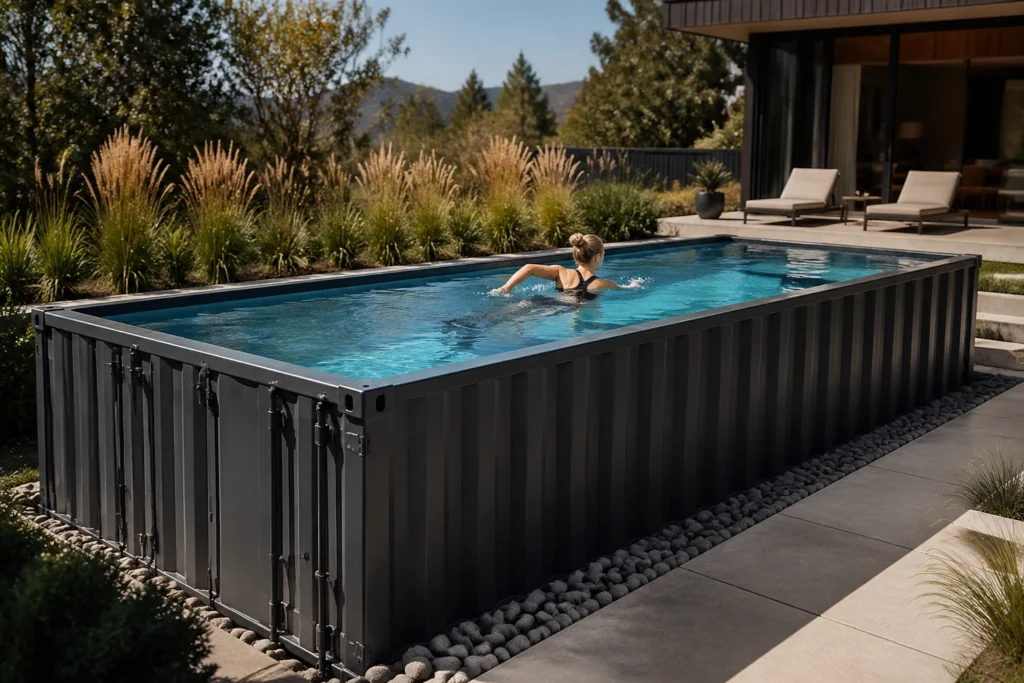
The rise of container pools has fundamentally shifted the landscape of residential landscape design. These units offer a modular, structurally sound, and aesthetically modern alternative to traditional in-ground concrete pools. However, the primary challenge of a compact footprint is the limitation on distance. For fitness enthusiasts and competitive athletes, a six-meter or twelve-meter pool typically lacks the length required for effective lap swimming.
Enter the countercurrent trainer. By integrating a high-performance propulsion system into the container pool structure, the constraints of physical length are virtually eliminated. This technology transforms a small aquatic space into an "infinite" swimming lane, providing professional-grade fitness opportunities in a fraction of the space.
A countercurrent trainer is not merely a pump; it is a sophisticated water propulsion system designed to create a consistent, directed flow. Unlike standard pool jets: which often produce turbulent, "bubbly" water that is difficult to swim through: high-end countercurrent systems focus on laminar flow.
Laminar flow refers to water moving in parallel layers with minimal disruption. In a swim fitness context, this creates a smooth, deep, and wide current that mimics the feel of swimming in open water. This is essential for maintaining proper body position and stroke technique.
The system typically involves a powerful turbine or a high-volume pump located at one end of the pool. It draws water in through intake grates and accelerates it back out through a specialized housing.

Container pools are prized for their versatility and ease of installation. Because they are self-contained units, they are often placed in urban backyards, rooftops, or sloping sections where space is at a premium. Integrating a countercurrent trainer is a logical upgrade for several reasons:
For those in the early stages of planning, it is critical to account for the mechanical layout, structural allowances, and service access required for the propulsion system. Integrating these components early helps ensure balanced water flow, clean installation, and reliable long-term performance.
Integrating a swim fitness system into a compact pool offers more than just a place to exercise; it provides a practical, high-usage fitness asset that can outperform the value of a larger leisure-only pool.
The most obvious benefit is the ability to swim continuously without stopping every few strokes to turn around. In a standard compact pool, repeated wall contact interrupts rhythm, heart rate, and stroke timing. A countercurrent system removes that limitation and makes a short pool usable for sustained endurance work.
This is where the bang-for-buck value becomes clear. A compact pool footprint can still support meaningful swim sessions, conditioning blocks, and technique training when the swimmer works against a stable current. Instead of paying for more length, the system increases the training value of the water already available.
Fitness needs change over time, and the current should change with them. A countercurrent trainer can typically be adjusted for:
Aquatic exercise is useful because it combines resistance with reduced joint impact. The buoyancy of the water lowers stress on the knees, hips, and back, while the adjustable current adds a controllable training load.

For athletes, the precision of a countercurrent trainer is a game-changer. When swimming in a traditional pool, it is difficult to monitor your own form. In a stationary environment created by a trainer, a swimmer stays in one place. This allows for the installation of mirrors at the bottom of the pool or cameras on the side to provide real-time feedback on stroke technique.
While swimming is the primary focus, these systems are increasingly used for other forms of "aquacise."
For homeowners looking to maximize their outdoor space, these systems can turn a simple pool into a multifunctional fitness hub without demanding the footprint of a full lap pool.
Installing a countercurrent system in a container pool requires careful consideration of the electrical and mechanical requirements.
These systems are powerful. They generally require a dedicated electrical circuit and, depending on the model, may require three-phase power to achieve maximum flow rates. It is essential to consult with an electrician during the design phase.
Because the pump is often housed within the pool’s equipment niche, insulation is key. High-quality systems are engineered to minimize vibration, ensuring that the peaceful atmosphere of your backyard isn't disrupted by a loud motor.
Despite their technical complexity, countercurrent trainers are remarkably low-maintenance. The primary requirement is keeping the intake grates clear of debris and ensuring the pool water chemistry is balanced to prevent scaling on the internal components.

One of the strongest arguments for a countercurrent setup is its ability to increase pool usage across the full year. In many climates, a standard pool is used heavily in summer and far less in cooler months. A fitness-focused pool changes that pattern because it supports structured exercise, not just casual recreation.
By pairing the trainer with appropriate water heating and seasonal planning, the pool can be kept at a usable exercise temperature for much longer periods. That gives the installation stronger long-term value: more sessions, more consistent fitness use, and better return from a compact footprint.

The integration of a countercurrent trainer into a container pool represents the pinnacle of efficient outdoor design. It bridges the gap between the logistical benefits of a compact footprint and the functional requirements of high-level fitness.
By treating countercurrent technology as a fitness multiplier rather than a luxury add-on, homeowners can turn a compact pool into a practical year-round training, conditioning, and rehabilitation asset.


