
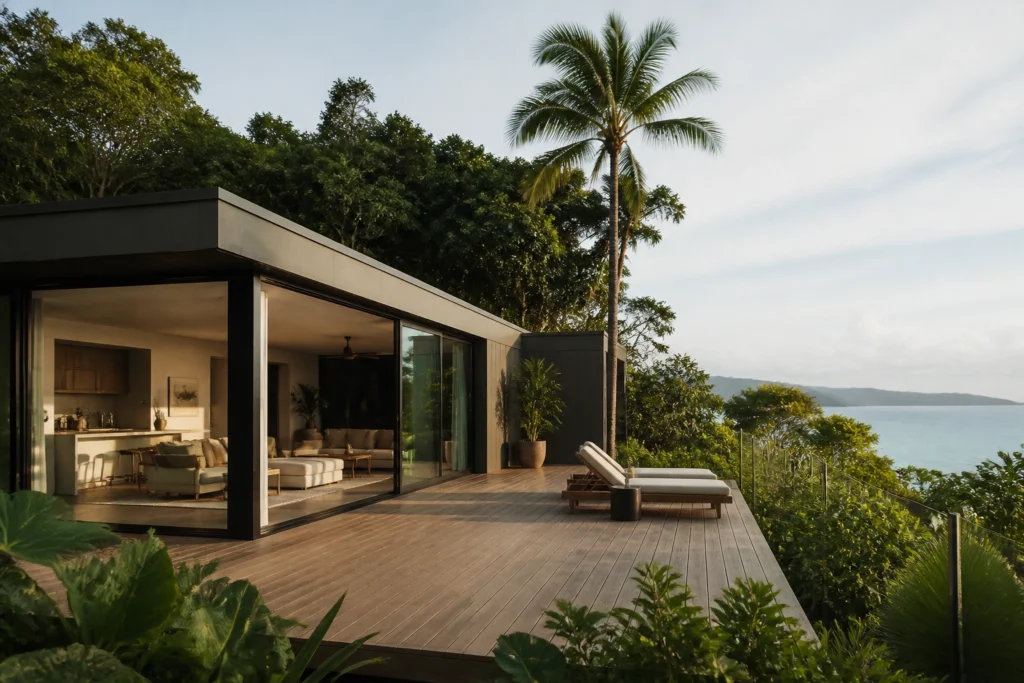
Living in the Pacific Islands offers an unparalleled lifestyle, defined by stunning vistas, vibrant cultures, and a deep connection to the ocean. However, for anyone involved in property development or home building, the "island paradise" comes with a unique set of logistical and environmental headaches. From the sheer cost of transporting materials to remote atolls to the relentless assault of salt air and tropical storms, traditional construction often struggles to keep up.
This is where expandable container homes and modular housing are stepping in to change the game. This isn't just a trend for "tiny home" enthusiasts; it is a calculated, high-ROI solution for resilient living in one of the most demanding climates on Earth.
Traditional "stick-built" or masonry homes have long been the standard, but they carry significant baggage in a Pacific context. In remote locations like Fiji, Samoa, or the Cook Islands, the supply chain is the first major hurdle. Every brick, bag of cement, and length of timber often has to be shipped in, leading to massive markups and project delays that can span years.
Beyond the logistics, the environment itself is the ultimate critic.
Modular housing addresses these issues by moving the construction process into a controlled factory environment. By the time the unit arrives at the island port, it has been engineered to withstand the specific rigors of a tropical maritime climate.

The core principle is durability. If a building system can’t survive ten years of salt-laden wind, it isn’t worth the investment. Expandable container homes are built on a foundation of high-grade, often marine-treated steel frames.
The best modular units utilize advanced coatings and galvanization processes. Unlike traditional builds where the protective layers are applied onsite: often under less-than-ideal conditions: modular units are coated in a controlled environment. This ensures that every nook and cranny of the steel frame is protected against the electrochemical reaction caused by salt and moisture.
One of the most significant advantages of a container-based modular home is its inherent structural rigidity. These units are designed to be stacked on massive cargo ships and endure the tossing of the open ocean. When bolted to a proper foundation on land, they offer exceptional resistance to high-velocity winds.

In the Pacific, time doesn’t just represent money: it represents risk. The longer a construction site is active, the more it is exposed to weather delays, labor shortages, and rising material costs.
Expandable container homes solve the "last mile" delivery problem. Because they fold down into a standard ISO shipping container footprint, they can be transported using existing global shipping infrastructure. You don’t need specialized flatbeds or oversized load permits for the sea voyage.
The "Unfolding" Process:
For a resort owner or a family in a remote village, this means going from an empty lot to a lockable, weatherproof shell in a single day. That is an incredible "bang for buck" when compared to a six-month traditional build.
When we talk about "bang for buck," we are looking at the Total Cost of Ownership (TCO). A modular home might seem like a significant upfront investment, but the ROI becomes clear when you look at the hidden costs of traditional island building.
Qualified tradespeople are often in short supply in remote areas. Bringing in a crew from the mainland involves flights, accommodation, and daily allowances. Modular homes require minimal onsite labor: essentially just a plumber, an electrician for the final hookup, and a small team to manage the expansion.
On a traditional building site, up to 30% of materials can end up as waste. In the islands, you also have to pay to remove that waste. Modular construction is a "zero-waste" process at the site level. Everything you pay for is part of the house.
Modern modular housing often utilizes high-density EPS (Expanded Polystyrene) or rock wool insulation. In the heat of the Pacific, this is vital. These homes stay cooler longer, drastically reducing the ROI on air conditioning and solar power systems.

One of the most attractive features of expandable modular housing is the ability to scale. Many island landowners have the land but not the immediate capital to build a four-bedroom mansion.
With modular living, you can:
This flexibility is a massive advantage for the tourism sector. Eco-resorts can test the market with three or four units and then quickly scale up to ten or twenty as demand grows, without ever having a "construction site" vibe that ruins the guest experience.

The shift toward modular housing in the Pacific isn't just about modern aesthetics; it’s about a pragmatic response to a challenging environment. By prioritizing resilience, speed, and logistical efficiency, owners are finding that they can achieve a much higher quality of life for a lower long-term cost.
Expandable modular housing offers a high-performance, cost-effective alternative to traditional construction in the Pacific Islands. By leveraging the durability of shipping container architecture and the efficiency of factory-controlled building, these homes provide a resilient solution that stands up to tropical climates while offering the flexibility to grow alongside the owner's needs. For those looking for the best "bang for buck" in island living, the future is undoubtedly modular.


