
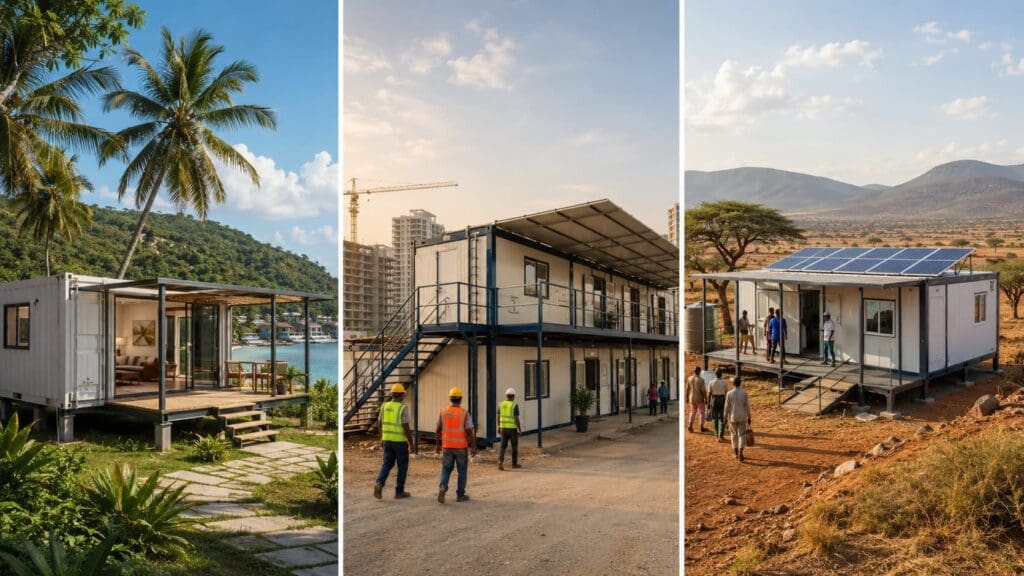
Expandable container houses are increasingly being considered for regions where conventional construction can be slow, expensive or difficult to deliver.
Unlike standard shipping containers, purpose-built expandable container buildings are manufactured as compact transportable units that open out on site to create significantly more usable floor space. Depending on the design, they can be configured as homes, offices, clinics, classrooms, accommodation blocks, retail spaces or temporary workstations.
Although the basic building system can be used almost anywhere, the priorities are different in each market. A building intended for a Pacific island community will face different challenges from one being used in a densely populated Indian city or at a remote African worksite.
The following three regional columns highlight where expandable container houses may provide the greatest value.
| Pacific Islands | India | Africa |
|---|---|---|
| Cyclone-conscious housing | Rapid urban accommodation | Remote workforce facilities |
| Disaster recovery buildings | Construction site offices | Mining and energy camps |
| Island workforce housing | Affordable staff housing | Clinics and community centres |
| Tourism accommodation | Temporary classrooms | Agricultural workstations |
| Remote clinics and classrooms | Commercial kiosks | Disaster response facilities |
Pacific island communities often face a combination of limited local construction resources, high material transport costs, severe weather exposure and a shortage of suitable accommodation.
Expandable container houses can provide a practical alternative when buildings need to be transported to an island, delivered to a remote site and assembled without a large construction workforce.
Cyclones, flooding and other natural events can leave communities without homes, clinics, classrooms or administrative facilities.
Expandable buildings can be prepared in advance and deployed as:
Their compact transport format can make it easier to move multiple units by sea compared with transporting a fully assembled conventional building.
However, the building must still be matched to the local wind zone, foundation requirements and site conditions. Container-style buildings should not automatically be described as cyclone-proof. Structural certification, anchoring systems and local engineering advice remain essential.
Construction, infrastructure, telecommunications, energy and tourism projects often require workers to be accommodated close to a project site.
Expandable units can be arranged as:
Once a project is completed, the units may be relocated, repurposed or retained as permanent community facilities.
Small resorts, surf camps, fishing lodges and nature-based tourism operators may use expandable buildings to add accommodation without committing immediately to a large conventional development.
Units can be configured with bedrooms, bathrooms, kitchenettes, decks and covered outdoor areas. Exterior cladding, screening and landscaping can help the buildings fit more naturally into a tropical environment.
Important Pacific design considerations include:
India presents a very different set of opportunities. Rapid urban growth, major infrastructure projects, internal workforce movement and pressure on affordable accommodation all create demand for buildings that can be installed quickly.
Expandable container buildings may be particularly useful where speed, repeatability and controlled manufacturing are more important than traditional construction methods.
Large construction, transport, industrial and renewable energy projects require temporary buildings long before permanent facilities are completed.
Expandable units can be used as:
A project can begin with a small group of units and add more as the workforce increases.
Factories, logistics centres, warehouses and large agricultural operations may need to provide accommodation for workers travelling from other districts.
Expandable housing can create organised accommodation compounds with separate units for:
Good planning is critical. High-density accommodation requires adequate sanitation, fire separation, ventilation, safe electrical systems and reliable access to water.
In crowded urban areas, expandable buildings may be used where a conventional building would take too long to approve or construct.
Potential uses include:
Rooftop or stacked applications may sometimes be proposed, but these should only proceed after structural engineering, access, fire safety and local planning requirements have been assessed.
Heat is one of the most important considerations for many Indian locations. A metal-framed building without appropriate insulation and ventilation can become uncomfortable very quickly.
A suitable design may require:
The lowest-priced unit is not always the lowest-cost building to operate. Energy use and occupant comfort should be considered from the beginning.
Africa is not a single market. Requirements vary considerably between major cities, mining regions, coastal areas, agricultural districts and remote communities.
One of the strongest potential uses for expandable container buildings is supporting projects in locations where conventional materials, skilled labour and accommodation are difficult to access.
Mining, energy, surveying and infrastructure projects often operate far from established towns.
Expandable buildings can create modular camps containing:
A major advantage is repeatability. A company operating several sites can use similar layouts, parts and maintenance systems across its facilities.
Commercial farms, processing sites and agricultural cooperatives may require secure facilities near production areas.
Units can be used as:
Solar power, water tanks and wastewater systems can be incorporated where grid connections are unavailable.
Expandable buildings may help provide services in communities where a complete permanent building programme cannot be delivered immediately.
A basic clinic could include:
A modular classroom project could begin with one or two learning spaces and expand as funding or enrolment grows.
The design must still consider accessibility, sanitation, security, natural ventilation and local cultural expectations.
Building specifications should reflect the actual destination rather than using one standard design for an entire continent.
Different locations may require protection from:
Local contractors and engineers should be involved early so the building, foundations and services are suitable for the site.
Expandable container houses should not be treated as identical products that can be placed anywhere without modification.
The strongest regional strategies are:
The focus should be on corrosion resistance, severe-weather preparation, rain management, ventilation and efficient sea transport.
The focus should be on fast installation, heat management, workforce accommodation, sanitation and repeatable buildings for major projects.
The focus should be on off-grid capability, workforce facilities, modular community services, durability and access to maintenance parts.
Expandable buildings can be planned as individual units or combined into larger modular facilities.
Common configurations include:
Covered walkways, external decks, stairs, canopies and service buildings can connect several units into one organised development.
Before selecting an expandable container building, the purchaser should confirm:
These questions should be answered before manufacturing begins, especially for remote or international projects.
A common misunderstanding is that a transportable building does not require engineering, consent or local approval.
Requirements vary by country, region and intended use. A temporary site office may be treated differently from a permanent home, school or medical facility.
Purchasers should obtain advice from local planning authorities, engineers, building professionals and service providers before placing an order.
Fire safety, sanitation, structural design, electrical systems, accessibility and occupancy requirements may all apply.
Expandable container houses can provide flexible building solutions across the Pacific, India and Africa, but each region requires a different approach.
For Pacific projects, the main priorities are resilience, corrosion protection and transport logistics. In India, rapid installation, cooling and workforce accommodation are likely to drive demand. Across Africa, the strongest opportunities may be found in remote work camps, agriculture, community services and off-grid developments.
The real value of expandable construction is not simply that the building opens out quickly. It is the ability to manufacture repeatable spaces, transport them efficiently and adapt them to a wide range of residential, commercial and community applications.
A successful project starts by designing for the destination rather than attempting to make the destination fit a standard building.


