Description
How High-End Features Are Reshaping Modular Outdoor Systems
For a long time, motorisation and smart technology were clear markers of high-end outdoor systems. If a project included automated louvres, rain sensors, or app-based controls, it usually meant one thing: a fully custom, architect-specified solution with a premium price tag and complex installation.
Kitsets, by contrast, were simple by design. Manual operation, fixed configurations, and limited upgrade paths were the norm.
That distinction is now disappearing.
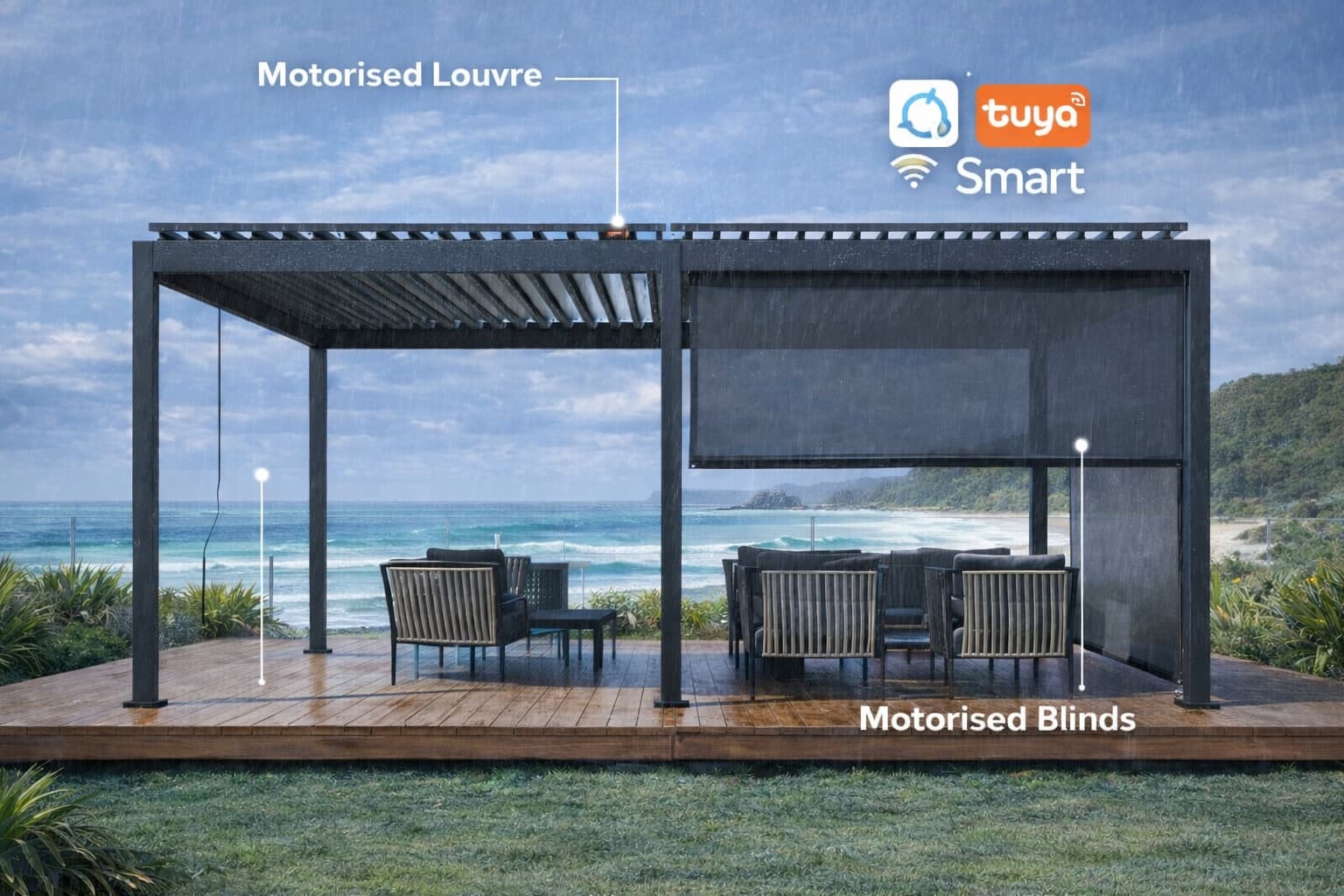
Motorised kitsets with integrated smart technology are emerging as one of the most important shifts in outdoor design — not because they replace high-end systems, but because they borrow their thinking.
Smart Technology Was Born at the Top
Automation didn’t start in the kitset world.
Motorised louvre roofs, retractable systems, and sensor-driven controls were originally developed for high-end residential and commercial projects where:
• Comfort needed to be instant and effortless
• Large spans required mechanical assistance
• Weather response was critical
• Integration with lighting, heating, and building systems mattered
These systems were engineered from the ground up. Motors were oversized, control systems were custom programmed, and installation was tightly coordinated with the building design.
In short, smart technology was never about convenience alone — it was about performance, longevity, and control.
Why Kitsets Stayed Manual for So Long
Kitsets historically avoided motorisation for good reasons:
• Motors increased cost and complexity
• Wiring and controls required skilled installers
• Earlier motors were less reliable outdoors
• Modular systems lacked the structural precision automation demands
As a result, motorisation was seen as incompatible with the very idea of a kitset.
But that assumption no longer holds.
What Changed: Technology Caught Up
Several key developments shifted the equation.
Motors improved dramatically
Modern outdoor motors are quieter, more compact, sealed against moisture, and designed for long duty cycles. This made them suitable for modular platforms.
Control systems became universal
Wireless remotes, smart hubs, and app-based platforms reduced the need for bespoke programming.
Sensors became affordable and reliable
Rain, wind, and sun sensors are now robust enough to be deployed at scale — not just on one-off projects.
Kitsets evolved structurally
Today’s better kitsets are engineered as platforms, not just products. Structural consistency, integrated drainage, and upgrade pathways are now expected.
Together, these changes allowed high-end concepts to migrate downward without losing their intent.
Motorised Kitsets: A New Category
Modern motorised kitsets don’t try to be cheap versions of bespoke systems. Instead, they occupy a new middle ground.
They offer:
• Motorised operation as a core design option
• Smart control without custom programming
• Sensor-based automation for weather protection
• Integrated lighting and accessory support
• Modular upgrades over time
This approach mirrors how high-end systems have always worked — the difference is delivery, not philosophy.
Companies such as Apollo NZ have adopted this platform mindset, designing kitsets that are:
• Structurally capable of automation
• Future-ready rather than fixed
• Adaptable across residential and light commercial use
The result is a product category that behaves like a premium system, even when supplied in modular form.
Why This Shift Matters
The rise of motorised kitsets reflects a deeper change in how outdoor spaces are used.
Outdoor areas are no longer secondary spaces
They function as dining rooms, workspaces, and entertainment zones. Static systems don’t support that flexibility.
Responsiveness is now expected
Spaces should close when it rains, open when the sun appears, and adjust without interrupting how people live.
Buyers think long-term
Starting with a motorised core and adding technology later is more realistic than committing to everything upfront.
In effect, kitsets are absorbing the mindset of high-end design, even if the execution is more streamlined.
Not the End of High-End Systems — But a Redefined Baseline
High-end, made-to-measure systems still exist for good reason. Complex sites, large spans, architectural integration, and commercial demands often require fully bespoke engineering.
What has changed is the baseline expectation.
Motorisation and smart technology are no longer viewed as luxury extras. They are increasingly seen as markers of good design, regardless of whether a system is custom-built or modular.
This is the same transition seen in lighting, climate control, and even vehicles — technology moves from exclusive to expected as it matures.
Motorised kitsets are not about lowering standards.
They are about raising them.
By bringing high-end thinking into modular systems, smart kitsets are redefining what “standard” means in outdoor design — and proving that intelligent spaces don’t have to be fully bespoke to be well designed.
The future of outdoor systems isn’t just smarter.
It’s more accessible, more flexible, and more intentional.