Description
The Quiet Evolution of Modular Systems
For many years, the word kitset carried a negative meaning.
In most cases, it suggested compromise.
Often, it implied cheaper materials or simplified design.
As a result, it was seen as a solution chosen out of necessity rather than preference.
Today, that perception is no longer accurate.
Modern kitset systems have evolved significantly.
As a result, they are now engineered, scalable, and reliable solutions used across construction, outdoor living, and infrastructure.
Importantly, they are not better because they are cheaper.
Instead, they are better because they are designed differently.
Why Kitsets Developed a Poor Reputation
In the past, most kitsets were designed with one priority in mind: reducing cost.
Because of this, many systems relied on:
-
Thin materials
-
Generic or fixed dimensions
-
Limited engineering input
-
Assembly-first thinking
On paper, these systems appeared acceptable.
However, real-world conditions quickly exposed their limitations.
Wind, water, movement, and long-term use revealed weaknesses that drawings and brochures could not predict.
What Changed in Modern Kitset Design
Over time, a fundamental shift occurred.
Rather than focusing on price alone, designers began changing where the thinking happens.
Today, modern kitsets are engineered before manufacturing begins.
As a result, critical decisions are made early rather than on site.
This approach means that:
-
Structural logic is built into the system
-
Load paths are calculated instead of assumed
-
Drainage and movement are considered from the start
-
Components are designed to work together repeatedly
Notably, this same approach is used in automotive manufacturing, modular housing, and large-scale infrastructure.
In short, the system now matters more than the individual parts.
Why Standardisation Improves Quality
Many people still believe that custom solutions are always better.
In reality, uncontrolled customisation often increases risk.
For this reason, modern kitsets rely on:
-
Tested component dimensions
-
Consistent manufacturing tolerances
-
Proven connection details
-
Predictable performance outcomes
As a result, standardisation reduces errors.
At the same time, it removes unnecessary variation while still allowing flexibility where it matters most, such as size, layout, and configuration.
How Logistics Improved Kitset Performance
Another important factor is logistics.
Over the last decade, packaging and transport methods have improved significantly.
Because of this, modern kitsets now benefit from:
-
Reduced damage during transport
-
Lower shipping risk
-
Improved cost control
Consequently, a system that arrives complete and undamaged often performs better than a site-built solution assembled from multiple suppliers.
Reliability, therefore, has become a key advantage.
The Role of Smart Technology
At the same time, technology has accelerated the evolution of kitsets.
As motorisation, sensors, and automation became more accessible, modular systems gained a clear advantage.
For example, modern systems now integrate:
-
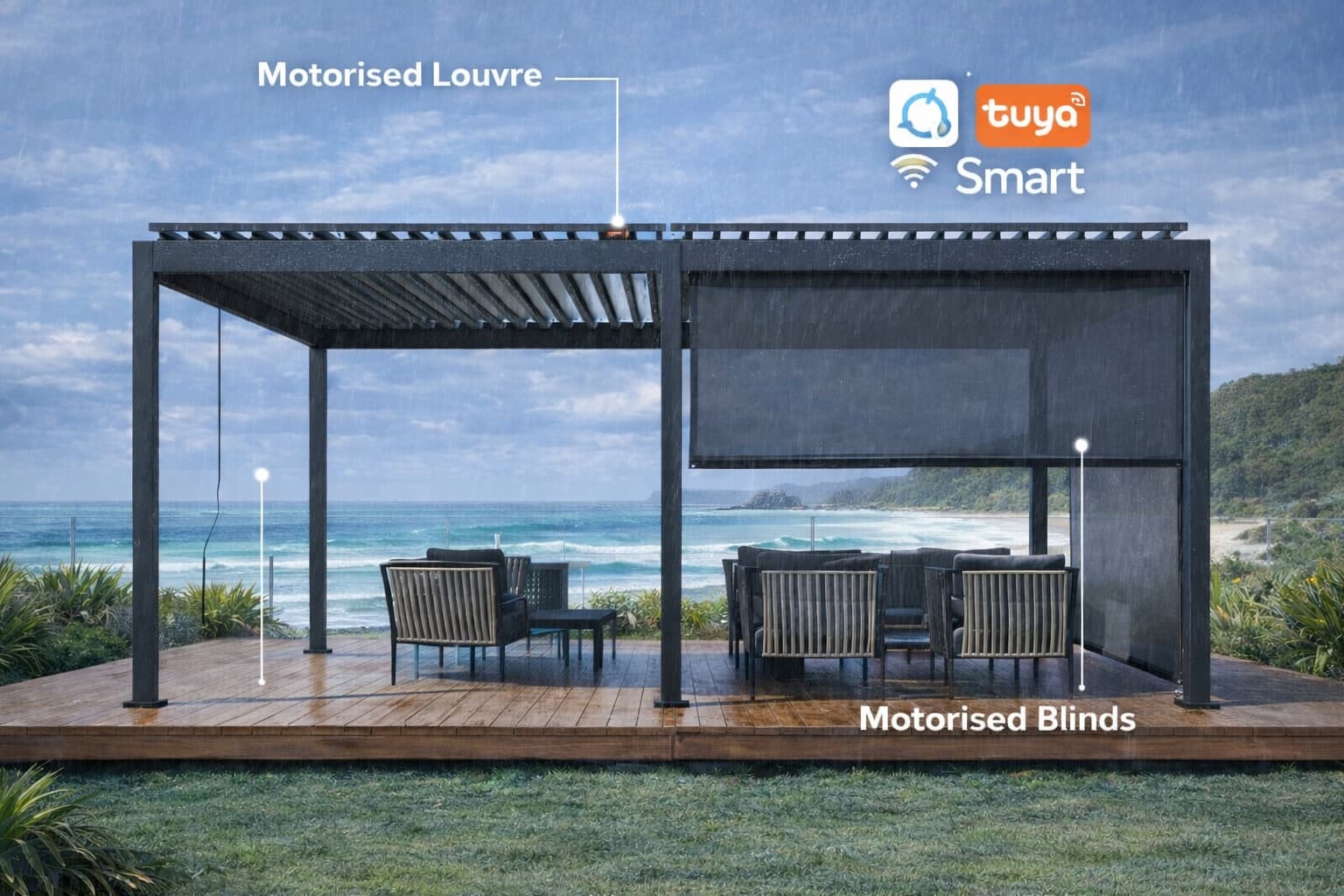
Motorised components
-
Integrated lighting
-
Weather sensors
-
App-based control platforms
Importantly, these features work best when designed into a system from the beginning.
By contrast, retrofitted technology is often less reliable and harder to maintain.
Designed for Real-World Conditions
Today, modern kitsets are no longer designed for ideal environments.
Instead, they are designed for real-world use.
Good systems now assume that:
-
Wind behaves unpredictably
-
Water will find entry points
-
Materials will expand and contract over time
-
Users will not always operate systems perfectly
Because these realities are considered early, modern kitsets last longer and require less maintenance.
This is not cost-cutting.
Rather, it is intelligent design.
How the Meaning of Value Has Changed
Previously, value was measured by the lowest upfront price.
However, expectations have shifted.
Today, value also includes:
-
Consistent long-term performance
-
Reduced installation and ownership risk
-
Faster deployment
-
Lower lifecycle maintenance
-
Greater confidence in outcomes
As a result, modern kitsets deliver value by reducing uncertainty rather than cutting corners.
They are no longer shortcuts.
Instead, they are strategic solutions.
The Future of Modular Systems
Looking ahead, modular construction will continue to grow.
This is because speed, scalability, and reliability now matter more than ever.
At the same time, engineering credibility has become non-negotiable.
For these reasons, well-designed modular systems will increasingly replace ad-hoc site-built solutions.
Not because they are cheaper.
But because they are smarter.