Description
Where intelligent automation is heading — and where Tuya stands right now
Louvre kitsets started as mechanical solutions.
Aluminium frames.
Rotating blades.
Manual control of sun and rain.
Then motors arrived.
Then remote controls.
Then phone apps.
Now a new layer is forming:
intelligence.
Not hype.
Not science fiction.
Real systems that read conditions, recognise usage patterns, and make decisions automatically.
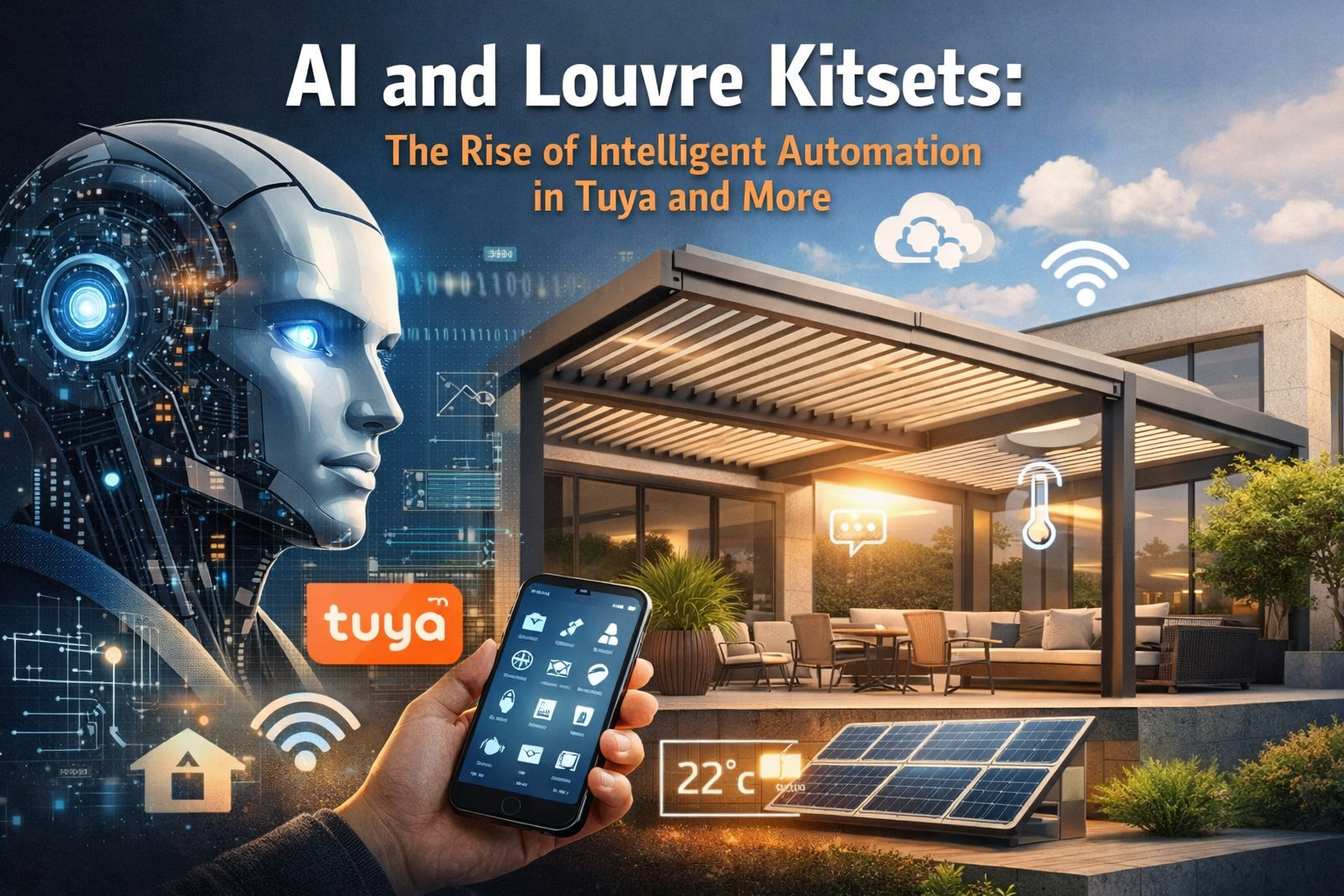
At the centre of many of these smart ecosystems is Tuya — the digital platform quietly powering a huge share of connected outdoor products worldwide.
From Moving Parts to Thinking Systems
Motorisation solved convenience.
Press a button → the blades move.
But intelligent control asks something far more important:
👉 Where should the blades be right now to maximise comfort, protection, and efficiency?
Answering that requires:
• environmental data
• historical behaviour
• sensor input
• decision logic
• cloud processing
This is applied AI in the real world.
What Tuya Actually Is (Important Clarification)
Tuya does not manufacture pergolas.
It is a global IoT infrastructure that allows hardware makers to build smart, connected products quickly.
When a louvre kitset uses Tuya, it usually means you get:
• smartphone control
• secure cloud access
• compatibility with other smart devices
• voice assistant support
• programmable scenes and routines
• remote service capability
In simple terms → Tuya is the digital nervous system behind the hardware.
Where Tuya Stands Today
The platform is already highly capable, particularly in four areas.
Device compatibility
Millions of smart products across lighting, blinds, HVAC, and security already operate inside the ecosystem.
Cloud stability
Communication between sensors, motors, and apps is mature and dependable.
Scene automation
Users can easily build rules such as:
• close when wind exceeds a limit
• open at sunrise
• shut during rain
• link with lights
• coordinate with blinds or glazing
Growing AI intelligence
Investment is accelerating toward:
• behaviour learning
• energy optimisation
• predictive suggestions
• more natural voice interaction
• smarter coordination between devices
We are shifting from direct control → toward assisted decision making.
What AI Means for Louvre Kitsets
Here’s the important part.
AI doesn’t change the aluminium.
It changes how the aluminium responds.
Systems are starting to:
• detect overheating patterns
• anticipate repeat glare issues
• learn hospitality schedules
• act ahead of forecast weather
• fine-tune airflow for comfort
• reduce HVAC demand
Instead of reacting after discomfort appears, the system acts beforehand.
Smart vs Intelligent
Smart = you create the rule.
Intelligent = the system refines the rule.
That is the direction of travel.
Why Kitsets Accelerate AI Development
Because kitsets are standardised.
Large numbers of similar motors.
Large numbers of comparable environments.
That creates enormous datasets, allowing platforms to improve automation models much faster than unique, one-off installations.
Scale fuels learning.
What Users Experience
When intelligence works properly, people barely notice the technology.
They notice results:
• fewer urgent weather reactions
• stable temperatures
• protected furniture
• smoother opening and closing
• reduced energy waste
Good automation feels effortless.
Are We Fully Predictive Yet?
No.
Most systems today still depend on triggers and user-defined routines.
But the building blocks are already in place:
connectivity ✔
cloud computing ✔
data streams ✔
software updates ✔
Meaning systems installed today can become smarter over time.
The Strategic Change Happening Now
Louvre kitsets are evolving from a product into a platform.
And platforms continuously improve.
Manufacturers aligned with Tuya can add future intelligence through software, without changing the physical structure.
The Question Buyers Should Ask
Not:
❌ Does it have a motor?
Instead:
✅ Can it grow more intelligent in the future?
Because expectations are rising quickly.
Soon, people won’t want to run their outdoor systems.
They will expect the systems to run themselves.