Description
Across New Zealand, the Pacific, and increasingly worldwide, container pools are quietly reshaping how communities think about aquatic spaces. What was once considered a novelty for residential backyards has evolved into a practical, scalable solution for sports centres, schools, community hubs, and hospitality precincts.
At the heart of this shift is one simple reality: traditional pools are expensive, slow to build, and often overbuilt for the actual needs of many communities.
Container pools change that equation.
The Community Shift Toward Modular Pools
Communities today face competing pressures:
-
Limited capital budgets
-
Faster project timelines
-
Multi-use facility demands
-
Space constraints in urban areas
-
Rising construction costs
Traditional in-ground pools can take 6–12 months (or more) to complete and often require significant civil works. For many schools, clubs, and councils, that timeline and cost structure simply doesn’t stack up.
Container pools—particularly systems like those supplied by Apollo NZ—offer a different pathway:
-
Factory-built
-
Transportable
-
Rapid deployment
-
Predictable costs
-
Scalable across multiple sites
This is why adoption is accelerating.
Why Container Pools Make Sense for Public Use
For community environments, the advantages go beyond novelty.
Speed of Delivery
A container pool can be:
-
Manufactured off-site
-
Delivered largely complete
-
Installed in a fraction of the time of a traditional pool
For councils and schools working within funding windows or seasonal deadlines, this speed is often decisive.
Cost Predictability
Public projects hate surprises.
Container pools provide:
-
Known manufacturing costs
-
Reduced site works
-
Lower labour exposure
-
Minimal weather delays during build
This makes budgeting significantly more reliable for boards, trusts, and local authorities.
Smaller Footprint, Smarter Use of Space
Many community sites don’t need Olympic-scale infrastructure.
Container pools are ideal where space is constrained:
-
Urban sports hubs
-
School courtyards
-
Rooftop recreation zones
-
Tourism precinct infill sites
-
Remote or island communities
They deliver high utility per square metre, which is increasingly important in modern planning.
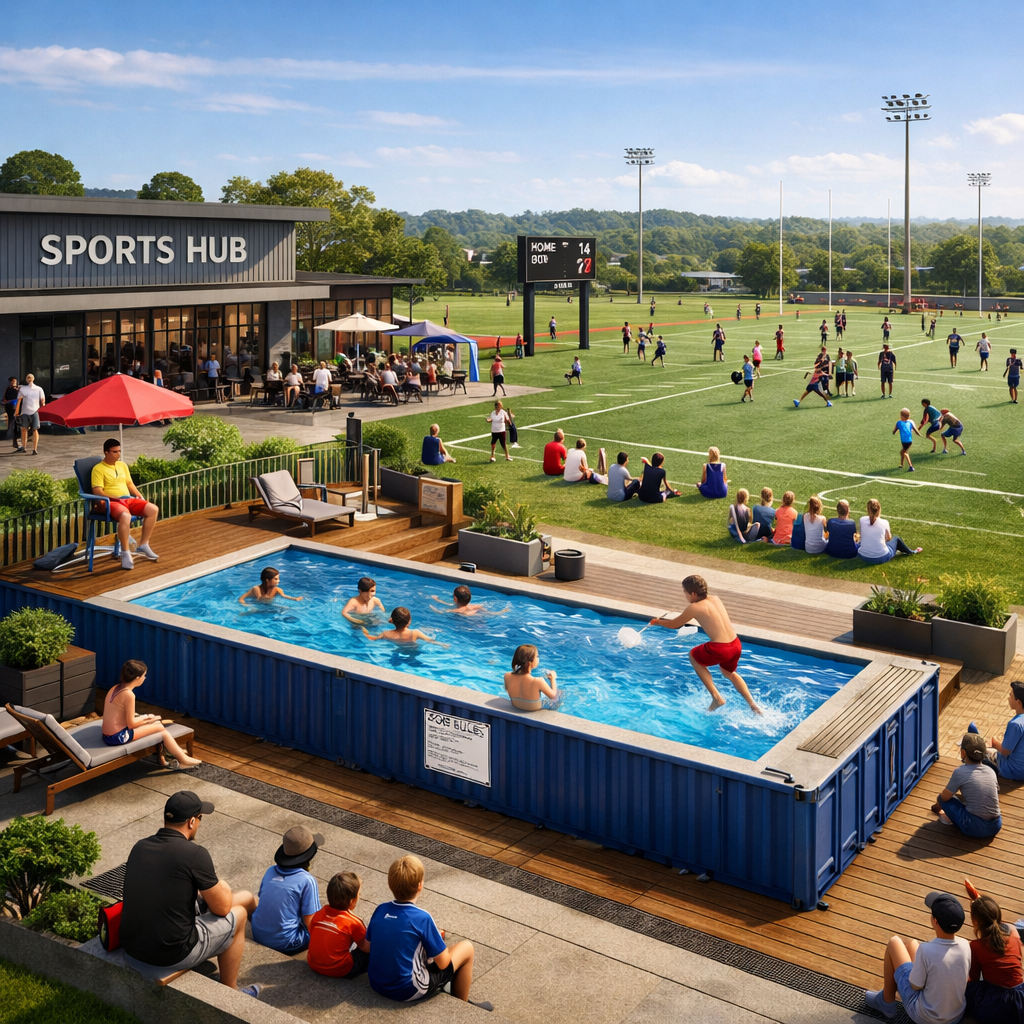
How Sports Centres Are Using Container Pools
Sports and recreation facilities are among the fastest adopters.
Recovery & Ice Bath Zones
High-performance environments are integrating container pools for:
-
Cold water immersion
-
Contrast therapy
-
Athlete recovery
-
Post-match regeneration
Instead of building full aquatic centres, clubs can deploy targeted recovery infrastructure quickly.
Learn-to-Swim Satellite Pools
Large aquatic centres are using container pools as:
-
Overflow teaching pools
-
Seasonal satellite locations
-
Community outreach installations
This expands programme reach without major capital builds.
Club & Community Recreation
For regional sports hubs, container pools support:
-
Family-friendly recreation areas
-
Summer activation zones
-
Event-day cooling pools
-
Multi-sport precinct upgrades
The key advantage: modular expansion over time.
Schools & Learn-to-Swim Programmes
This is one of the most impactful sectors.
Many schools across NZ and the Pacific struggle with:
-
Ageing pools
-
High maintenance costs
-
Compliance upgrades
-
Limited capital budgets
Container pools offer a compelling alternative.
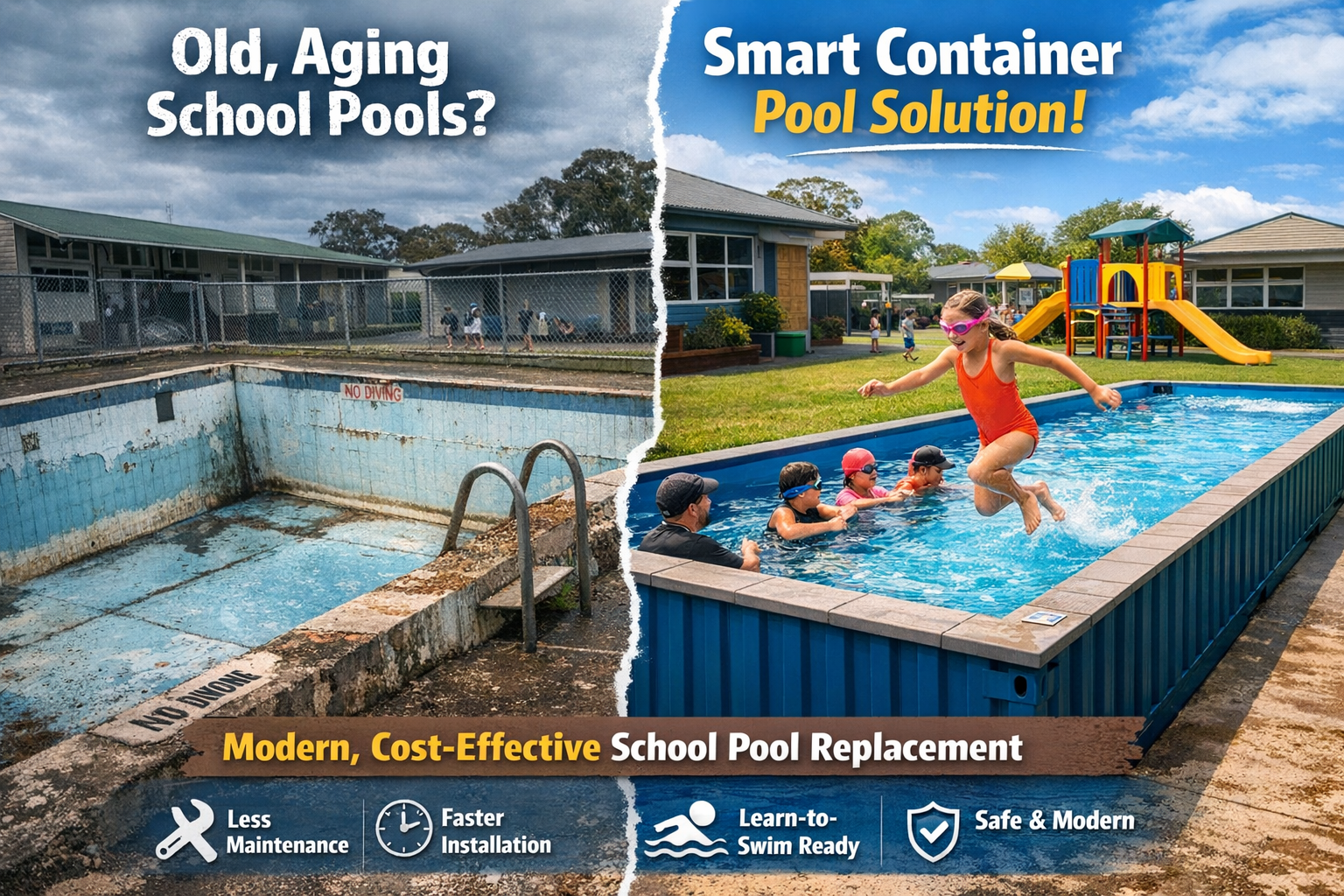
The School Pool Replacement Challenge
Here’s the reality many Boards of Trustees are now facing:
Across New Zealand, a significant number of school pools were built 30–50 years ago. While these pools have served generations well, many are now reaching the end of their practical and economic life.
Common issues include:
-
Structural deterioration
-
Leaks and water loss
-
Outdated filtration systems
-
Rising maintenance costs
-
Compliance and safety upgrades
-
Seasonal usability challenges
For many schools, the cost to fully refurbish an ageing in-ground pool can be surprisingly high—sometimes approaching the cost of a new build.
This is where container pools are entering the conversation.
Why Schools Are Considering Container Pools
Boards and principals are increasingly evaluating modular options because they offer:
-
Faster replacement timelines
-
Lower disruption during installation
-
Predictable capital costs
-
Reduced civil works
-
Modern filtration and safety systems
-
Potential for future relocation or repurposing
In some cases, schools are not looking for a like-for-like Olympic replacement. Instead, they want a fit-for-purpose learn-to-swim and water confidence facility that is financially sustainable.
Container pools align well with that brief.
Ideal School Use Cases
Container pools are being explored for:
-
Learn-to-swim programmes
-
Junior water confidence training
-
Summer curriculum activities
-
After-school swim programmes
-
Community shared-use agreements
Because many units arrive pre-engineered, installation timeframes can be significantly shorter than traditional pool rebuilds—an important factor for schools trying to minimise term-time disruption.
Particularly Relevant for:
-
Smaller primary schools
-
Rural and regional schools
-
Pacific Island schools
-
Schools facing full pool replacement decisions
-
Schools that previously decommissioned pools due to cost
For these environments, modular pools can restore aquatic capability without committing to a large-scale capital project.
Community & Council Applications
Local councils are increasingly looking at modular solutions.
Pop-Up Summer Pools
Some councils deploy seasonal aquatic facilities in:
-
Public parks
-
Urban plazas
-
Waterfront precincts
-
Event zones
Container pools are ideal for this because they can be:
-
Installed quickly
-
Relocated if needed
-
Decommissioned seasonally
Smaller-Town Aquatic Access
Not every town can justify a full aquatic centre.
Container pools allow councils to deliver:
-
Basic community swimming
-
Learn-to-swim access
-
Youth recreation
-
Cooling infrastructure in hot regions
This supports equity of access, which is becoming a major planning focus.
Hospitality & Tourism Precincts
Commercial adoption continues to grow rapidly.
Holiday parks, resorts, and boutique developments are using container pools to:
-
Upgrade facilities quickly
-
Add premium accommodation features
-
Improve guest retention
-
Activate underused land
Speed to revenue is a major driver here.
Design Flexibility & Deployment Speed
Modern systems like Boann container pools from Apollo NZ can include:
-
Multiple size options
-
Underwater lighting
-
Heating systems
-
Spa jets
-
Wave-maker options
-
Pool covers
-
Safety railings
-
Filtration upgrades
Communities are no longer choosing between speed vs quality—they can achieve both.
The Future of Modular Aquatics
Several trends are becoming clear:
-
Ageing school pool stock will drive replacement decisions
-
Distributed aquatic infrastructure will grow
-
Sports recovery zones will expand
-
Pop-up urban recreation will increase
-
Pacific and remote community uptake will accelerate
Container pools sit directly in the path of these shifts.
They are not replacing major aquatic centres—but they are filling the large gap between no pool and multi-million-dollar complex.
Container pools have moved well beyond backyard novelty. They are now a serious piece of community infrastructure.
For sports centres, they unlock targeted recovery and training capability.
For schools, they offer a practical pathway to replace ageing pool stock.
For councils, they provide scalable aquatic solutions.
For tourism operators, they accelerate amenity upgrades.
For many decision-makers, the question is no longer:
“Can we afford to build a new traditional pool?”
Increasingly, it’s:
“Is modular the smarter replacement strategy?”