Description
From Design Theory to Real-World Performance
In Part 1, we explored the scientific principles behind the Cerberus Louvre System — how physics, materials science, and environmental forces shape modern outdoor structures.
Part 2 goes deeper.
This is where theory meets engineering discipline: tolerances, fatigue, load behaviour, and why many outdoor louvre systems fail quietly over time — not suddenly, but predictably.
Cerberus was developed to prevent those failures.
Engineering Is About Predictability, Not Optimism
Most pergola systems are designed with an optimistic assumption:
“If it handles today’s conditions, it will probably handle tomorrow’s.”
Engineering doesn’t work that way.
Cerberus is designed around predictable behaviour under repeated stress, not best-case scenarios. This includes:
• Repeated wind loading, not single gusts
• Daily thermal cycling, not seasonal averages
• Long-term moisture exposure, not occasional rain
• Mechanical wear over years, not months
This is the difference between designed performance and assumed performance.
Structural Fatigue: The Silent Failure Mode
Very few pergola failures are dramatic.
Most occur through material fatigue — micro-movements that accumulate over time.
Cerberus addresses fatigue through:
• Rigid square-frame geometry that resists torsional twist
• Controlled connection points that prevent stress concentration
• Load paths that move forces vertically, not diagonally
• Reduced reliance on thin brackets or floating joints
By limiting unintended movement, Cerberus reduces cyclic stress — the primary cause of long-term structural degradation.
Precision Tolerances: Why Millimetres Matter
Outdoor louvre systems are mechanical structures.
That means tolerances matter.
Cerberus is engineered with:
• Consistent aluminium expansion rates across components
• Allowance for micro-movement at blade pivots
• Clearance tolerances that prevent binding under heat
• Motor alignment that remains stable through temperature change
Many systems fail not because components break — but because they move where they shouldn’t.
Cerberus is designed so movement happens only where intended.
Louvre Blade Mechanics: Beyond Open and Close
Louvre blades are not decorative panels — they are moving aerodynamic components.
Cerberus blades are engineered to:
• Distribute wind pressure along their length
• Reduce uplift at partially open angles
• Avoid pressure traps under rapid weather change
• Maintain alignment under repeated cycling
This reduces motor load, hinge wear, and blade distortion over time.
In engineering terms, the system is designed for mechanical longevity, not just function.
Water + Wind: The Most Difficult Combination
Rain alone is easy to manage.
Rain with wind pressure is not.
Cerberus integrates drainage as part of the structural logic:
• Directional louvres control water entry
• Internal gutters manage volume without overflow
• Concealed downpipes protect flow paths from wind interference
• Drainage exit points are positioned to prevent backflow
This is based on fluid dynamics — not assumptions — ensuring predictable behaviour even during wind-driven rain events.
Smart Systems Are Not Features — They’re Control Layers
In Cerberus, motorisation and automation are not “add-ons”.
They act as control layers that reduce structural stress.
Smart control enables:
• Rapid louvre response to changing conditions
• Reduced exposure during extreme weather
• Lower mechanical strain through optimised movement
• Consistent positioning rather than manual guesswork
This is why Cerberus is designed as smart-ready from the start, not retrofitted later.
Why Lab Thinking Matters in Outdoor Architecture
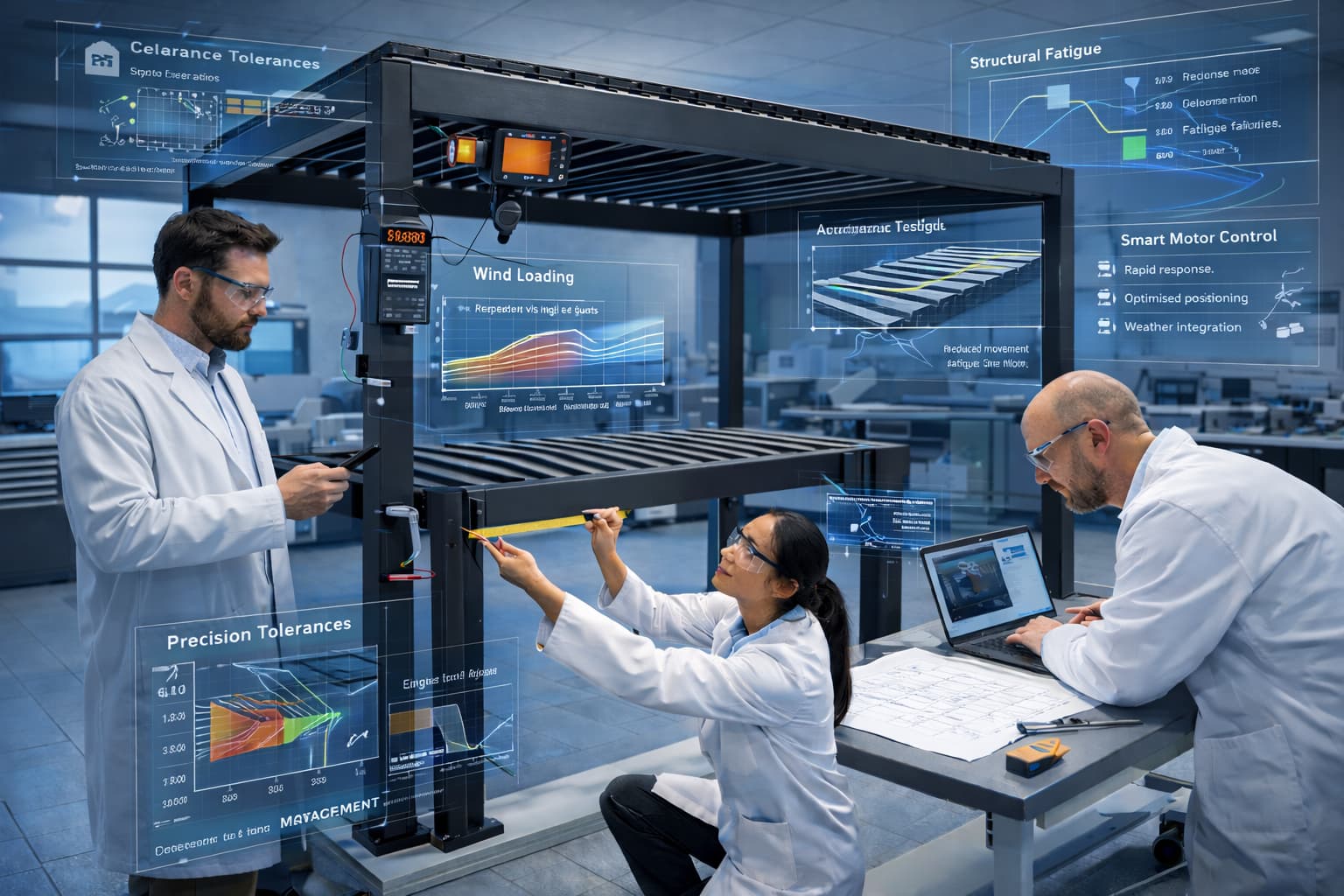
The lab image associated with this series is intentional.
Cerberus is not developed through trial-and-error installation — it is built using engineering logic applied before production.
That includes:
• Anticipating failure points
• Designing for long-term repetition
• Reducing dependency on perfect installation
• Ensuring predictable behaviour across environments
This mindset is what separates engineered systems from commodity kitsets.
Cerberus Standard vs Cerberus Plus — Same Science, Different Depth
Both Cerberus Standard and Cerberus Plus share the same scientific foundation:
• Structural load management
• Aerodynamic louvre behaviour
• Integrated drainage logic
• Thermal expansion control
Cerberus Plus extends this further with increased integration options and higher adaptability — but the engineering DNA remains the same.