
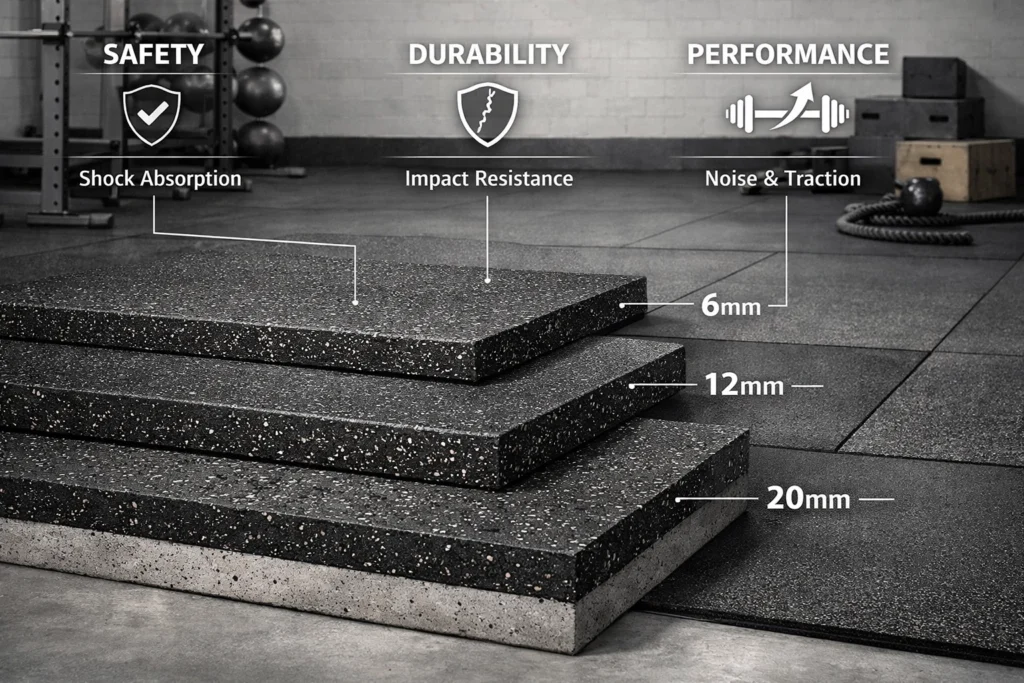
High-density rubber flooring is widely used because it solves practical problems in busy spaces. It helps protect the floor underneath, reduces noise, improves grip underfoot, and stands up well to repeated use.
This makes it a common choice in fitness spaces, circulation zones, training areas, play environments, and mixed-use commercial settings. The key is not just choosing rubber flooring, but choosing the right format, right thickness, and right layout for the job.
High-density rubber flooring is specified for three main reasons: protection, safety, and daily performance.
Rubber flooring helps absorb force from foot traffic, equipment, and dropped items. This matters for two reasons:
In practical terms, thicker flooring is generally used where impact is heavier. Thinner flooring is usually enough where the priority is surface protection and stable footing.
Rubber flooring also helps reduce sound and vibration. In multi-story buildings, this is especially important.
It can help limit:
This is why rubber flooring is often considered in upper-level gyms, apartment amenities, schools, and shared commercial buildings.
A good rubber surface improves grip and helps make movement more secure. This is useful in spaces where people are lifting, pivoting, walking quickly, or working in areas that may occasionally become damp.
When reviewing options, specify surfaces that provide:
Safety is not only about cushioning. It is also about maintaining control during everyday movement.

Figure 1: Thickness comparison chart showing how thinner and thicker rubber floors suit different levels of impact and protection.
Thickness should be matched to the type of use, not chosen at random. Start by identifying the main load on the floor: walking traffic, fixed equipment, free weights, or repeated drops.
Use this range where the main goal is to protect the finished floor and provide a durable surface for regular use.
Typical applications include:
This thickness range is often selected when equipment stability and basic floor protection matter more than heavy impact absorption.
Use this range where the floor must handle a mix of movement, equipment, and moderate impact.
Typical applications include:
This is often the middle ground. It provides more protection and comfort than thinner flooring without moving fully into heavy-duty drop-zone construction.
Use this range where dropped loads, high-impact movement, or fall protection are part of the design brief.
Typical applications include:
Thicker systems are usually chosen when the main priority is impact absorption and subfloor protection.
The best flooring format depends on how the space will be used, how often it may need to be changed, and how fast installation needs to happen.
Rubber tiles are modular and easy to plan into defined zones.
Use tiles when you need:
Tiles are often used in strength areas because they make it easier to build out specific zones and manage future maintenance.

Figure 2: Simple installation diagram showing how interlocking tiles fit together to create a continuous surface.
Rubber rolls are designed to cover larger areas with fewer joins.
Use rolls when you need:
Rolls are commonly used in broad training areas, circulation spaces, and large rooms where a uniform surface is the priority.
Turf is used where the floor must support movement patterns that differ from standard rubber use. It is often selected for sled work, agility training, and marked training lanes.
Use turf when you need:
Turf is not a replacement for rubber in heavy impact areas. It is usually part of a broader flooring plan.
Many spaces work better when flooring types are combined instead of using one surface everywhere.
A practical layout might include:
This approach helps define each activity clearly and match the floor to the task. It also improves space planning by separating impact zones from movement zones.
When planning a mixed surface layout, specify:
The goal is simple: use the right surface in the right place.

Figure 3: Impact absorption infographic showing how force is reduced before it reaches the subfloor.
If you are comparing flooring options, focus on the basics first.
Specify:
Avoid overcomplicating the process. The best results usually come from matching the flooring system to the actual use of the space.
High-density rubber flooring is valued because it does essential jobs well. It helps protect floors and equipment, reduce noise, and improve safety underfoot. The right choice depends on three basics: thickness, format, and application. Use thinner systems for general protection, thicker systems for heavier impact, and combine tiles, rolls, and turf where different functional zones are needed. A clear, practical specification will always perform better than an overly complex one.


