The outdoor living category is evolving—but not in the way many expected.
For years, the industry pushed toward more: more features, more automation, more complexity. Motorised roofs, integrated lighting, sensors, apps, and layered add-ons became the benchmark of a “premium” outdoor system.
But something has shifted.
Across New Zealand—and globally—there’s a growing move back toward simpler outdoor systems.
Not basic. Not cheap.
Just… smarter.
Modern outdoor systems reached a point where complexity started working against the user.
Highly engineered louvre systems, retractable roofs, and fully automated setups are impressive—but they also come with:
• Higher upfront cost
• More installation requirements
• Ongoing maintenance and servicing
• Greater risk of component failure over time
For many homeowners, that trade-off no longer makes sense.
Instead, people are asking a different question:
“What do I actually need this space to do?”
Outdoor spaces are no longer occasional-use areas—they’re becoming everyday living zones.
In New Zealand especially, outdoor areas are being used for:
• Daily dining
• Remote work setups
• Year-round entertaining
• Covered transition spaces between indoors and outdoors
Because of this, people are prioritising reliability over features.
A simple fixed roof, a clean frame-only system, or a well-designed kitset often delivers exactly what’s needed—without overcomplicating the experience.
And importantly:
These systems still achieve the core goal—extending usable living space outdoors
Kitset and simplified systems are designed to go up quickly.
Pre-engineered components reduce install time significantly and remove many of the unknowns that come with custom builds
For builders, that means:
• Faster project turnaround
• Lower labour costs
• Easier planning
For homeowners:
• Less disruption
• Quicker results
One of the biggest drivers behind simpler systems is cost clarity.
Custom outdoor structures often evolve during the build process—adding cost along the way.
Simpler systems:
• Have fixed sizing
• Known material costs
• Clear upgrade paths
This makes them far more accessible to a wider market.
This is a major factor—and often underestimated.
Modern aluminium systems dominate because they offer:
• Corrosion resistance
• Minimal upkeep
• Long-term durability
Compare that to motorised systems with moving parts, sensors, and electronics—and the appeal of simplicity becomes obvious.
Today’s simpler systems are not limited.
They’re modular.
That means you can still add:
• Outdoor blinds
• Lighting
• Glass enclosures
• Heating
But you’re doing it when needed, not all upfront.
This staged approach aligns better with how people actually invest in their homes.
Outdoor areas are getting tighter—especially in urban environments.
Simpler systems:
• Fit into compact spaces
• Work with existing structures
• Maximise usability without dominating the layout
Even small patios can be transformed into functional, covered outdoor rooms with the right structure
There’s also a strong design shift happening.
Modern outdoor systems are moving toward:
• Clean lines
• Slim profiles
• Neutral colours
• Reduced visual clutter
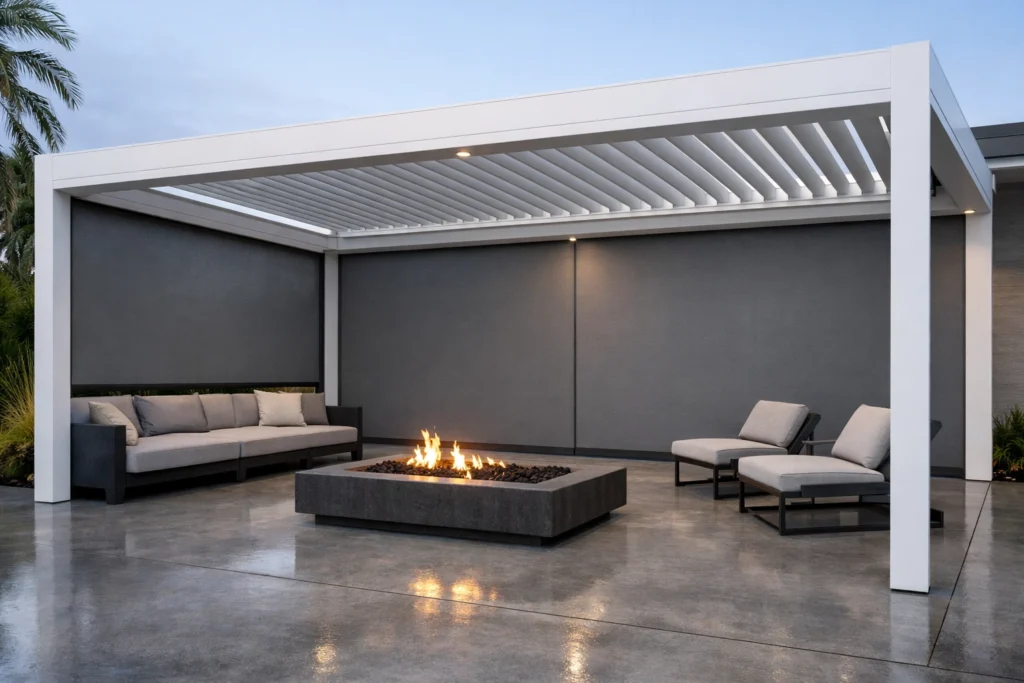
Minimalist pergola designs are now leading trends, focusing on simplicity and architectural integration rather than feature overload
This is where simple systems actually outperform complex ones.
They don’t compete with the house—they complement it.
There’s a broader trend at play here.
Consumers are becoming more intentional.
They’re no longer chasing the most advanced option—they’re choosing the most appropriate one.
In many cases:
A fixed roof
A frame-only system
A well-designed kitset
…is not a compromise.
It’s the optimal solution.
This shift is significant.
It signals a move toward:
• Modular outdoor ecosystems
• Mid-range, scalable solutions
• Faster-to-market products
• Broader accessibility
The future of outdoor living isn’t just high-end, fully automated systems.
It’s flexible systems that match real-world use.