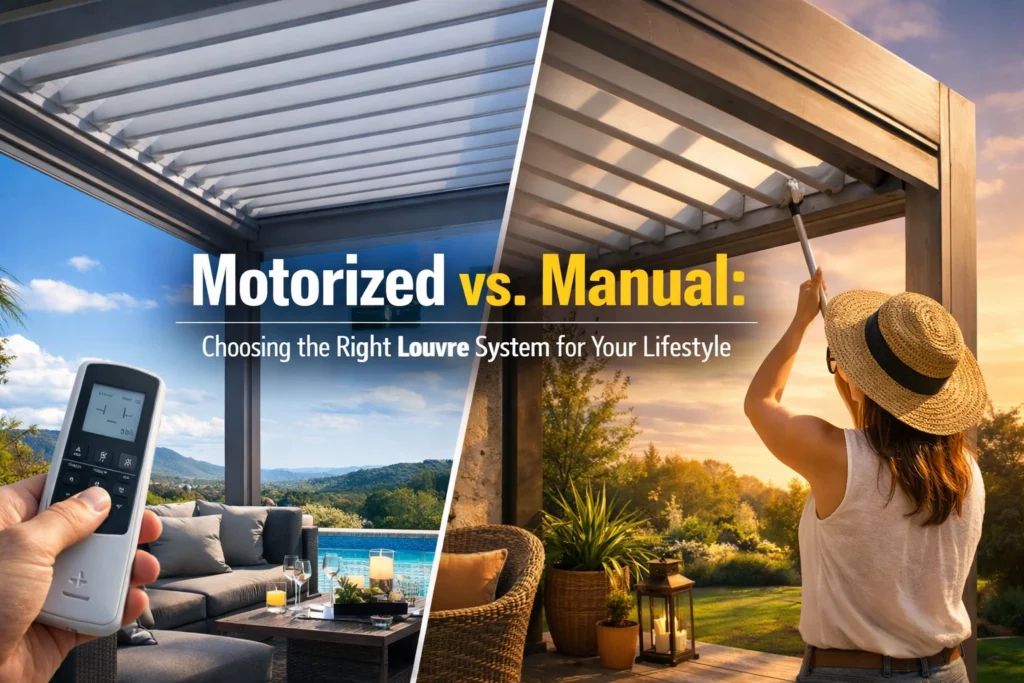
Motorized vs. Manual: Choosing the Right Louvre System for Your Lifestyle
March 30, 2026
Spread the love
Deciding to install a louvre system is a significant upgrade for any New Zealandhome. It effectively adds a new room to your property, providing a sheltered, versatile space that can be used year-round. However, once you’ve committed to the idea, the biggest technical fork in the road is choosing between a manual or a motorized system.
In the NZ market, where weather conditions can swing from a calm morning to a gale-force afternoon in a matter of minutes, this decision isn't just about luxury, it’s about functionality, engineering, and long-term durability. Both systems have their place, but they cater to very different lifestyles and budgets.
In this guide, we will break down the technical specifications of both systems, focusing on the core materials, automation technology, and how they perform in our unique high-wind environments.
The Foundation: 6063-T5 Aluminum
Before looking at how the louvres move, we need to look at what they are made of. Whether you choose a manual or a motorized system, the "gold standard" for the base material remains the same: 6063-T5 Architectural Grade Aluminum.
Why is this specific alloy the industry standard?
Corrosion Resistance: This alloy is exceptionally resistant to atmospheric corrosion, which is non-negotiable for coastal properties in New Zealand.
Structural Integrity: The "T5" refers to the tempering process. The aluminum is cooled from an elevated temperature and then artificially aged. This gives it the hardness required to support long spans without sagging and to withstand the lateral forces of high-wind zones.
Surface Finish: 6063-T5 takes powder coating beautifully. This ensures that the aesthetic of your system remains intact for decades without peeling or fading under our harsh UV sun.
Regardless of the drive system you choose, always verify that the extrusions meet this standard.
Manual Louvre Systems: The Case for Simplicity
Manual louvre systems are operated using a hand-crank or a lever mechanism. They are the "analogue" solution to outdoor living, favored by those who appreciate mechanical reliability and straightforward design.
The Benefits of Going Manual
Lower Entry Cost: Because there are no motors, wiring, or smart sensors involved, manual systems are significantly more affordable. This makes them an excellent choice for those wanting the structural benefits of a louvre system without the "tech" price tag.
Zero Electrical Requirements: A manual system requires no electrician and no connection to the mains power. If you are installing a louvre in a remote part of a large property or an off-grid cabin, manual is the only logical choice.
Mechanical Reliability: With fewer moving parts and no electronic components, there is very little that can go wrong. As long as the gearbox is kept clean and lubricated, a manual system will perform reliably for years.
Quiet Operation: While modern motors are quiet, they still produce a mechanical hum. A manual system is as silent as you are.
Technical Considerations for Manual Systems
Manual systems usually utilize a high-ratio internal gearbox. This means you don’t need to be an Olympic athlete to turn the louvres; a simple hand-crank allows for smooth rotation. However, for very large spans, the physical effort required to move dozens of blades can become tedious if you find yourself adjusting them multiple times a day.
Motorized Louvre Systems: The Peak of Convenience
Motorized systems are the modern standard for high-end residential and commercial builds. They replace the hand-crank with a concealed, high-torque motor integrated directly into the internal frame.
The Powerhouse: High-Torque Motors
In the NZ market, motorized systems must use high-torque motors. These aren't your standard blind motors; they are heavy-duty units designed to rotate hundreds of kilograms of aluminum blades against wind pressure.
These motors are typically housed within the louvre rafters, keeping them protected from the elements. They offer "soft-start" and "soft-stop" functionality, which reduces the wear and tear on the mechanical pivot points by slowing the movement at the end of the rotation cycle.
Integrated Rain and Wind Sensors
The most significant technical advantage of a motorized system is autonomy. High-end systems come equipped with:
Rain Sensors: These sensors detect the first sign of moisture and automatically trigger the motor to close the louvres, protecting your outdoor furniture and electronics even if you aren't home.
Wind Sensors: If wind speeds exceed a safe threshold (often adjustable in the settings), the system can automatically open the louvres to a vertical position. This reduces the "sail effect" and allows wind to pass through, protecting the structural integrity of the frame during a storm.
Smart Home Integration: The Tuya Ecosystem
For the modern homeowner, a motorized system is more than just a remote-controlled roof; it’s part of a connected home. Many modern motorized systems utilize the Tuya Smart integration.
Tuya is a global leader in IoT (Internet of Things) technology. By using a Tuya-compatible controller, you can:
Control via App: Open or close your louvres from anywhere in the world using your smartphone.
Voice Commands: Integrate the system with Amazon Alexa or Google Home. "Hey Google, close the patio roof."
Scheduling: Set timers so the louvres open at 8:00 AM to let light into the house and close at 5:00 PM to trap the day's heat.
This level of control is impossible with a manual system and adds a layer of "future-proofing" to your property value.
Structural Integrity and NZ Wind Zones
One common misconception is that manual systems are "weaker" than motorized ones. In reality, the structural integrity depends on the gauge of the aluminum and the engineering of the frame, not the drive system.
In New Zealand, we categorize areas into Low, Medium, High, and Very High Wind Zones.
Manual Systems: You must manually ensure the louvres are in the correct position during high winds to avoid damage.
Motorized Systems: These offer a safety net. If you forget to open the louvres during a gale, the wind sensor does it for you. This often makes motorized systems the preferred choice for exposed coastal sites where sudden gusts are common.
Long-Term ROI and Maintenance
When considering the return on investment (ROI), it’s important to look at both the resale value of your home and the cost of ownership.
Maintenance for Manual Systems:
Check the crank handle for wear.
Apply silicone-based lubricant to the gearbox and pivot points once or twice a year.
Clear the gutters of leaves to ensure the manual drainage system works efficiently.
Maintenance for Motorized Systems:
Keep the rain sensor clear of debris (bird droppings or leaves can trigger false closings).
Check the battery in your remote control.
Ensure the motor remains unobstructed.
From a resale perspective, motorized systems generally provide a higher ROI. Modern buyers are looking for "turn-key" luxury, and an automated outdoor space is a major selling point that often outweighs the initial higher cost of installation.
Which System Should You Choose?
The decision ultimately comes down to your priorities:
Choose a Manual System if:
You are working with a tighter budget but don't want to compromise on material quality.
The area is small and easy to adjust by hand.
You want a low-maintenance, "set and forget" structure with no electronic components.
Choose a Motorized System if:
Convenience is your top priority.
You have a large outdoor area where manual cranking would be cumbersome.
You want the peace of mind provided by automatic rain and wind sensors.
You are building a smart home and want everything integrated into a single app.
Regardless of your choice, investing in a high-quality louvre system built with 6063-T5 aluminum ensures that your outdoor living space will stand the test of time against the New Zealand elements.
Summary Checklist
Check the Alloy: Ensure it is 6063-T5 for durability.
Assess the Area: Large spans usually benefit more from motorization.
Consider the Weather: High-wind or high-rainfall areas are better served by motorized sensors.
Budget for Power: Remember that motorized systems require an outdoor-rated power supply.
Smart Home Ready: Look for Tuya-compatible systems for the best connectivity.
By focusing on these technical benchmarks, you can confidently select the system that best matches your lifestyle and property requirements.
Why choose the atomic youth redster j4 skis ?. Packed with jokes, pranks, comedy moments, fails, relatable humour, and viral short videos guaranteed to make you laugh. Immunology research compounds.