
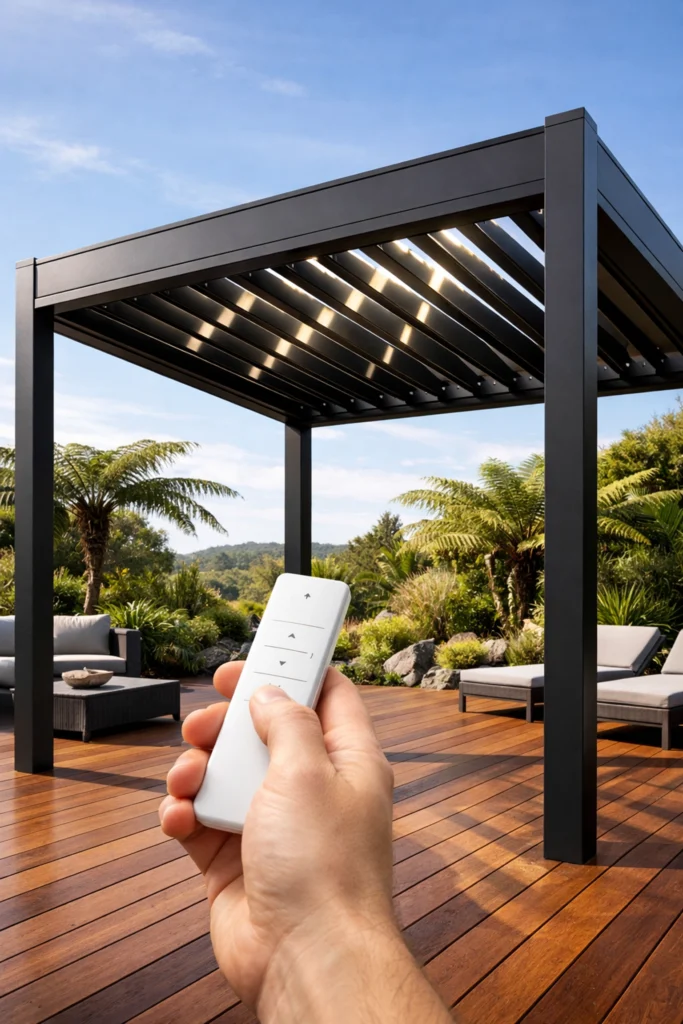
For years, the standard for outdoor pergolas and roof systems was the manual crank. It was a reliable, functional piece of engineering that allowed homeowners to adjust their environment: provided they were willing to put in the physical effort. However, as the demand for seamless indoor-outdoor flow increases, the technology behind these systems has undergone a significant transformation.
The rise of motorised kitset louvre systems is not just a trend; it reflects a broader shift in how homeowners approach outdoor living, automation, and DIY upgrades. As motor technology becomes more accessible, kitset louvre systems are moving beyond simple manual operation and into a category defined by convenience, smarter control, and better day-to-day usability.
For homeowners comparing manual vs motorised louvre systems, the difference is no longer just about price. It is about how easily the space can respond to sun, wind, and rain, and how well the system fits into a modern home. In practical terms, motorisation delivers a level of responsiveness and integration that manual systems cannot replicate.
Manual louvre systems operate using a gearbox and a removable crank handle. To open or close the blades, the user must physically attach the handle and rotate it until the desired angle is achieved.
While manual systems are often the entry-level choice due to their lower initial price point, they come with inherent limitations:
The transition to motorised kitset louvre systems has been driven by more affordable motors, simpler control systems, and growing homeowner interest in smart outdoor living. For DIY buyers, this matters because motorisation is no longer treated as a specialist extra. It is increasingly seen as a practical upgrade that changes how the space works every day.
The most immediate benefit of motorisation is simple: adjustment becomes instant. Instead of locating a crank handle and manually winding the blades open or closed, users can make fast changes with a remote control, wall switch, or app-connected interface.
This improves the experience in several ways:
That last point is important. A feature that is easy to use tends to get used properly. Motorisation reduces friction, which means the louvres are more likely to be adjusted for comfort, glare reduction, and airflow instead of being left in a fixed position.
One of the biggest reasons motorisation is gaining ground is its compatibility with broader smart home systems. While a manual system operates as a standalone mechanical feature, a motorised kitset can become part of a connected environment.
Depending on system design, integration may include:
For homeowners, this changes the louvre roof from a basic shade structure into a more responsive part of the home. The value is not just in the motor itself. It is in the ability to control the outdoor area in the same way other modern home functions are controlled.
Perhaps the most significant practical advantage is the integration of weather sensing, especially rain detection. Manual systems depend entirely on the user noticing a weather change and acting quickly enough to protect the area underneath. Motorised systems can reduce that gap.
Common benefits include:
This is where motorisation clearly moves beyond convenience and into practical protection. In climates where conditions can change quickly, automated response is a major advantage over manual operation.
A motorised kitset is typically designed to balance DIY-friendly assembly with reliable automated performance. Structurally, many systems follow the same core layout as manual versions. The main difference is the addition of a powered drive system and control components.
The Motor Drive System
Most systems use a linear actuator or similar motorised mechanism to rotate the louvre blades. This component is usually concealed within the frame to protect it from the weather and preserve a clean external appearance. Once activated, the motor applies consistent movement across the blade set, which helps deliver smoother and more repeatable adjustment than manual cranking.
Control Components
Motorised systems may include:
These parts work together to automate movement and reduce reliance on manual intervention.
Material Compatibility
Because louvre systems are exposed to outdoor conditions, the surrounding frame and blades are commonly manufactured from powder-coated aluminium with corrosion-resistant fixings. Lightweight, durable materials are important because they allow the motor to operate efficiently while supporting long-term performance in exposed environments.
A common misconception is that a motorised system is dramatically harder to install than a manual one. In many cases, that is not true. The structural assembly of a motorised kitset is often very similar to a manual version, with the main additional considerations being power supply, control setup, and sensor placement.
For DIY planning, focus on these points:
For many homeowners, the key takeaway is this: motorisation does not necessarily make the build process complex, but it does require better planning. That planning is often well worth it for the usability gained after installation.
While a motorised kitset usually costs more upfront than a manual system, the more useful question is what the extra spend delivers over time.
If a space can be adjusted instantly, it is more likely to be used properly. Homeowners tend to get more value from outdoor areas when shade, ventilation, and shelter can be changed without effort.
Motorisation adds practical benefits that go beyond appearance. Faster adjustment, easier access, and automated weather response can make the outdoor space more functional in day-to-day life.
Automated louvre positioning can help manage sunlight on doors, glazing, and adjoining rooms. That can support more stable indoor comfort and reduce unwanted heat gain during hotter parts of the day.
When comparing costs, avoid looking only at the purchase price. Consider frequency of use, ease of operation, and weather responsiveness, because those are the factors that often determine whether the system becomes a genuinely useful part of the home.
The rise of motorisation has also created opportunities for additional features that manual systems do not support as effectively:
These features matter because they shift the louvre system from a simple adjustable roof to a more responsive outdoor environment management tool.
The shift toward motorised kitset louvre systems reflects a broader change in homeowner expectations. People no longer want outdoor structures that simply exist. They want systems that respond quickly, operate easily, and integrate with the way modern homes function.
Manual systems still provide basic adjustability. But motorised systems raise the standard by improving convenience, accessibility, weather response, and control. For DIY buyers, that makes motorisation more than a luxury feature. It becomes a practical upgrade that can change how often the space is used and how effectively it performs.
Key Takeaways:


