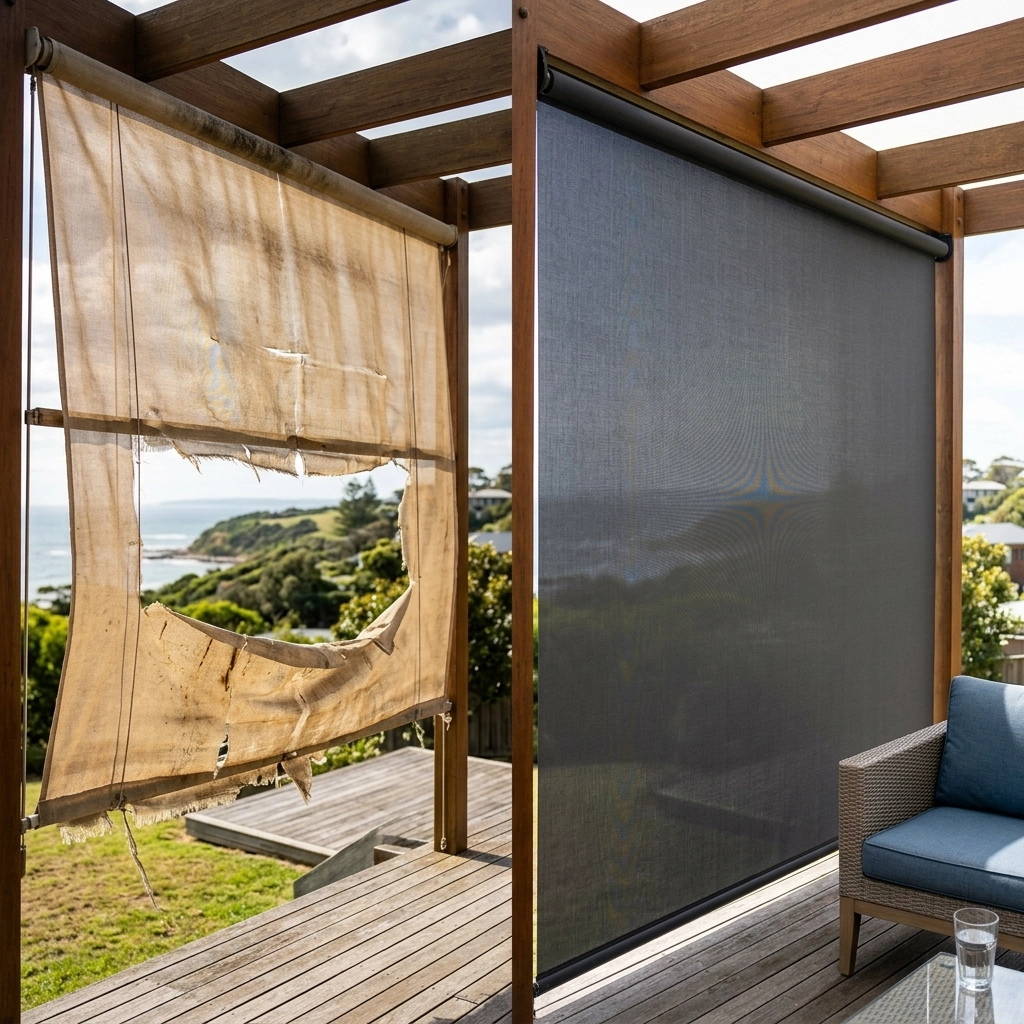
The Fabric Science: Why Most Outdoor Blinds Fail

April 7, 2026
Spread the love

For many property owners, outdoor blinds are a serious investment in comfort, usability, and property performance. Yet fabric failure remains one of the most common issues in external shading. Poorly specified materials can begin to show brittleness, fraying, discoloration, loss of tension, and mechanical problems far earlier than expected.

Understanding why this happens means looking beyond appearance alone. It requires attention to polymer chemistry, thermal dynamics, airflow management, and environmental exposure. This guide examines the core factors that determine whether an outdoor blind performs reliably over time or degrades prematurely under real-world conditions.

The UV Factor: Photo-Oxidation and Polymer Breakdown

The primary cause of failure in outdoor fabrics is UV radiation. While we perceive sunlight as warmth and light, at a molecular level, UV rays are high-energy waves capable of breaking chemical bonds.

Most modern outdoor blinds are made from synthetic polymers like polyester or acrylic, often coated with PVC. When these materials are exposed to consistent UV radiation, particularly in high-exposure regions like New Zealand and the Pacific Islands, a process called photo-oxidation occurs.

  1. Bond Cleavage: UV energy penetrates the fabric and breaks the molecular chains of the polymer.
  2. Free Radical Formation: This creates "free radicals" that further attack the surrounding material, leading to a chain reaction of degradation.
  3. Physical Loss: As the polymer chains break, the fabric loses its tensile strength. This is why a blind that initially appears sound can eventually tear, crack, or lose structural integrity under normal wind and weather exposure.

UV Stability is not a binary "yes or no" feature; it is measured by the quality of the stabilizers added during the manufacturing process. Low-grade fabrics often have a surface-level UV coating that wears off, whereas premium fabrics have stabilizers "solution-dyed" into the core of the fiber.

The Thermal Trap: Why Color Choice Affects Longevity

A common misconception is that dark-colored blinds are better for heat protection because they provide more shade. While they do block more visible light, they behave very differently regarding thermal emissivity.

Dark fabrics: especially blacks, charcoals, and deep navies: absorb a high percentage of solar energy. This energy is converted into heat, which is then re-radiated. If a dark blind is installed too close to a glass window or within a poorly ventilated enclosure, it can create a "thermal trap."

  • Expansion and Contraction: The constant heating (up to 70°C in direct sun) and cooling of the fabric causes the material to expand and contract. Over time, this repeated stress leads to "fabric memory" loss, causing the blind to sag, ripple, or develop "smiles" (curving at the bottom).
  • Warping: In lower-tier synthetic materials, intense heat can reach the glass transition point, where the material becomes slightly plastic and permanently deforms under its own weight.

Weave Types and the "Openness Factor"

The performance of an outdoor blind is dictated by its Openness Factor (OF). This refers to the weave density and is usually measured in percentages (e.g., 1%, 5%, or 10%). Selecting the wrong openness factor is a leading cause of owner dissatisfaction and mechanical failure.

The Problem with "Blackout" Fabrics

While 0% openness (blackout) fabrics provide total privacy and light blockage, they are often the worst choice for large outdoor spans.

  • Wind Loading: A blackout blind acts as a solid sail. Even a moderate breeze exerts hundreds of kilograms of pressure on the fabric, side tracks, and mounting brackets.
  • Air Stagnation: Without airflow, the area behind the blind becomes a convection oven. Heat is trapped against the building, negating the cooling benefits of the shade.

Finding the "Sweet Spot"

For most residential and commercial applications, a 5% openness factor is considered the industry standard. It provides a clear view outward and strong UV protection while allowing enough air to pass through the weave to equalize pressure and dissipate heat.

This balance matters because weave type affects more than privacy. It directly influences:

  • Airflow: More breathable weaves reduce trapped heat and pressure build-up.
  • Fabric Stress: Controlled air passage lowers the constant load on the blind during gusty conditions.
  • Comfort: Better ventilation makes outdoor areas more usable, especially in humid or high-sun locations.
  • Longevity: Reduced heat concentration and lower wind stress help preserve both fabric shape and hardware performance.

If you are looking for specific hardware to support these fabrics, you can explore the technical specifications of various systems in the product sitemap.

Salt Air and the Chemical Battle of Coastal Living

For properties located within five kilometers of the ocean, the environment is significantly more aggressive. Salt air is not just a corrosive agent for metals; it is a catalyst for fabric degradation.

Hygroscopic Stress
Salt is hygroscopic, meaning it attracts and holds moisture. When salt spray dries on a blind, it leaves behind microscopic crystals. These crystals:

  1. Abrade the Fibers: As the blind moves in the wind, the salt crystals act like sandpaper, grinding away at the protective coatings of the yarn.
  2. Retain Moisture: By holding moisture against the fabric, salt creates a micro-environment perfect for mold and mildew growth, even on synthetic materials that are technically "rot-resistant."

Hardware Oxidation
Coastal failure often starts at the edges. If the side channels and bottom bars are not made of high-grade architectural aluminum with a minimum powder coat thickness of 60-80 microns, the "tea staining" (initial rust) will bleed onto the fabric, causing permanent staining and structural weakening at the attachment points.

Natural vs. Synthetic: The Longevity Gap

It is tempting to opt for natural materials like bamboo or heavy canvas for a specific aesthetic. However, from a structural engineering standpoint, these materials face an uphill battle in outdoor environments.

  • Natural Fibers (Bamboo/Matchstick): These lack inherent UV resistance. With ongoing weather exposure, the cellulose structure typically becomes brittle, and the cordage used to weave them together begins to snap.
  • Standard Polyester: Often used in "budget" outdoor blinds, untreated polyester has poor UV resistance. Without a heavy-duty PVC or Acrylic coating, it will yellow and degrade rapidly.
  • Solution-Dyed Acrylic: This is the gold standard for longevity. Because the pigment is added while the fiber is in a liquid state, the color and UV protection go all the way through, rather than just being a "painted" layer on top.

For those planning a high-end outdoor space, understanding how these materials integrate into larger structures is vital. You can see how different material choices impact total project design by viewing completed project pages.

Directional Exposure: The "Orientation Penalty"

Not all blinds are created equal because not all elevations receive the same punishment.

  • North-Facing (Southern Hemisphere): Receives the most consistent, high-angle sun throughout the day. This requires maximum UV stability.
  • West-Facing: Receives the harsh, low-angle afternoon sun. This is where the Thermal Trap is most dangerous, as temperatures are already at their peak when the sun hits the fabric directly.
  • South-Facing: Often stays damp longer. These blinds are more prone to mold and moss growth because they rarely "bake" dry in the sun.
High-performance outdoor blinds diffusing intense west-facing sunset glare on a luxury villa terrace.

Summary of Key Takeaways for Durable Selection

To avoid premature fabric failure, consider the following technical checklist when specifying outdoor blinds:

  • Specify Solution-Dyed Materials: Ensure the UV stabilizers and pigments are part of the fiber core, not a surface treatment.
  • Optimize Openness Factor: Use a 5% weave for the best balance of wind-load reduction, airflow, and visibility. Avoid 0% (blackout) on large, exposed spans.
  • Prioritize Heat Dissipation: On west-facing elevations, choose lighter colors or high-performance metallic-backed fabrics to reflect heat rather than absorbing it.
  • Coastal Grade Hardware: If within 5km of the sea, insist on architectural-grade aluminum and stainless steel components to prevent corrosive "bleed" onto the fabric.
  • Maintenance Protocol: Even the best fabrics require an annual wash with fresh water to remove salt crystals and atmospheric pollutants that accelerate degradation.

By understanding the science of fabric performance, property owners can move away from "disposable" shading solutions and invest in systems designed to withstand the elements for the long term.

Return to insights

Charities We Support

cart
heavy equipment transport morris nj. Pontoon boat transport. rv transport missouri.