
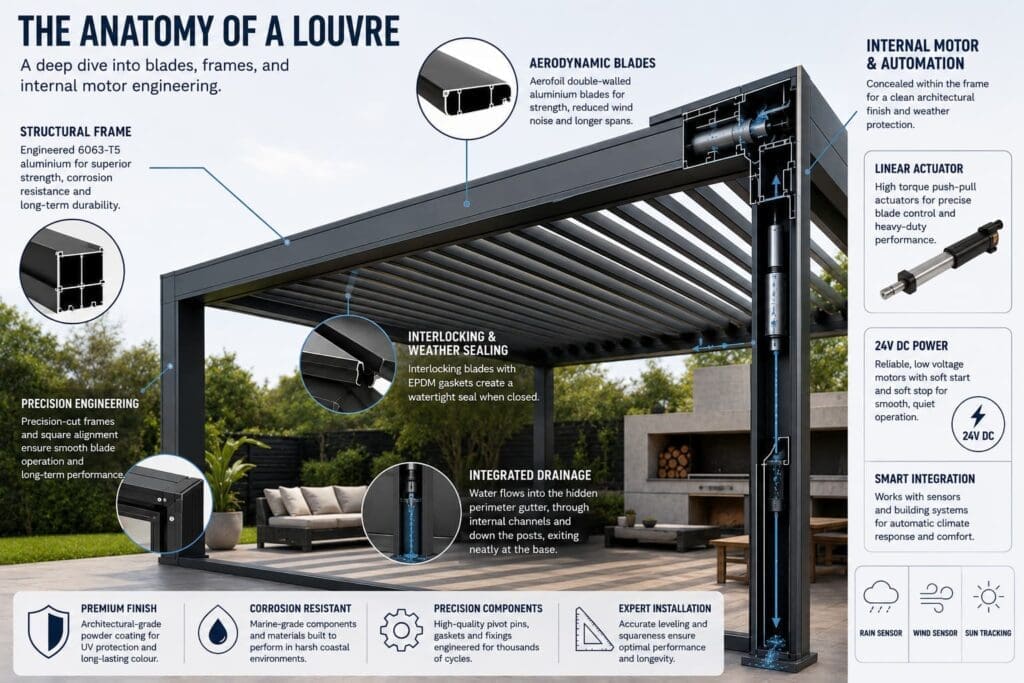
Modern architectural design has evolved far beyond static outdoor structures. Today’s demand for climate-responsive outdoor living has driven the rise of sophisticated aluminium louvre systems that combine engineering, automation, aerodynamics, and architectural styling into one integrated solution.
A modern louvre roof is no longer simply a collection of slats attached to a frame. High-performance systems are precision-engineered structures designed to manage sunlight, airflow, rainfall, wind loads, and long-term durability in demanding environments like New Zealand and coastal regions.
For architects, builders, developers, and homeowners, understanding the anatomy of a louvre system is essential when specifying a structure that needs to perform reliably for decades. From structural frames to aerodynamic blades and concealed motor systems, every component plays a critical role in the overall functionality and lifespan of the system.
The frame is the primary structural component of any louvre roof system. It is responsible for handling vertical loads such as rain accumulation, debris, and snow, while also resisting lateral wind forces.
Most premium louvre systems use extruded aluminium, particularly 6063-T5 grade aluminium, due to its excellent balance of strength, corrosion resistance, and lightweight performance.
The perimeter structure typically consists of:
These structural profiles are often oversized intentionally to conceal drainage systems, motors, wiring, and moving components while maintaining rigidity.
One of the biggest differences between entry-level and high-end louvre systems is the engineering of the frame itself.
Premium systems commonly feature:
This helps prevent:
In larger systems, intermediate supports known as mullions are used to stabilize long blade spans and distribute structural loads evenly.
The blades are the active component of the system and determine how effectively the pergola controls sunlight, ventilation, and rain protection.
Blade engineering directly impacts:
There are two primary blade profiles used in modern louvre systems.
Aerofoil blades are curved and double-walled, creating a strong yet lightweight structure.
Benefits include:
These are commonly used in high-end architectural systems where performance and strength are priorities.
Flat blades create a sharper, more minimalist appearance and are popular in modern architectural styling.
However, compared to aerofoil designs, they typically:
One of the most important engineering requirements of a louvre system is the ability to create a dry zone when closed.
Professional systems achieve this through several integrated features.
Each blade is engineered with overlapping flanges or lips that interlock with adjacent blades when shut.
High-grade EPDM seals are integrated into blade edges to create:
The blades rotate using precision-engineered pivot pins made from:
These components are designed to withstand thousands of operational cycles without excessive wear.
A common misconception is that louvre roofs simply drain water over the outside edges.
Modern high-performance systems instead feature concealed internal drainage networks.
When closed, the blades are positioned at a subtle angle that directs water into hidden perimeter gutters inside the beams.
From there:
This creates a cleaner architectural appearance without exposed gutters or pipes.
Premium systems may also include:
The “first-drop rule” is another important engineering concept. Blade edges are shaped specifically to prevent water from wicking backward into the covered area when the roof is first opened after rain.
The motor system is effectively the nervous system of the louvre roof.
Modern designs conceal motors inside the frame to maintain a clean architectural finish while protecting internal electronics from weather exposure.
Linear actuators use a push-pull mechanism and are ideal for:
These are commonly used in premium motorised systems.
Tubular motors are more compact and often used in:
Modern louvre systems increasingly integrate with smart home and building management platforms.
Most advanced systems now operate on 24V DC motors, which provide:
Automatically close the louvres when rain is detected.
When wind speeds exceed certain thresholds, blades may automatically adjust to reduce uplift pressure on the structure.
Advanced systems can automatically reposition blade angles throughout the day to balance:
These technologies help transform outdoor spaces into highly responsive architectural environments.
Even the best-engineered structure will fail prematurely without proper finishing systems.
Architectural-grade powder coating is the industry standard for aluminium louvre systems because it provides:
Qualicoat-certified finishes are often preferred for premium projects.
In coastal environments, internal components must also resist salt exposure.
This includes:
Proper engineering prevents galvanic corrosion between aluminium and stainless steel components.
Installation quality is just as important as manufacturing quality.
Because louvre systems are precision mechanical structures, small alignment issues can significantly affect long-term performance.
The structure must be level to ensure proper water drainage through internal gutter systems.
Even minor deviations can cause:
Aluminium expands and contracts significantly with temperature changes. Proper engineering must allow for movement without damaging blades or seals.
A high-performance louvre system is a sophisticated combination of structural engineering, water management, automation, and architectural design.
When evaluating a louvre system, key technical considerations should include:
By understanding the engineering behind the frame, blades, motors, and drainage systems, architects and homeowners can make better-informed decisions and ensure their outdoor structures remain functional, durable, and visually impressive for many years to come.


