
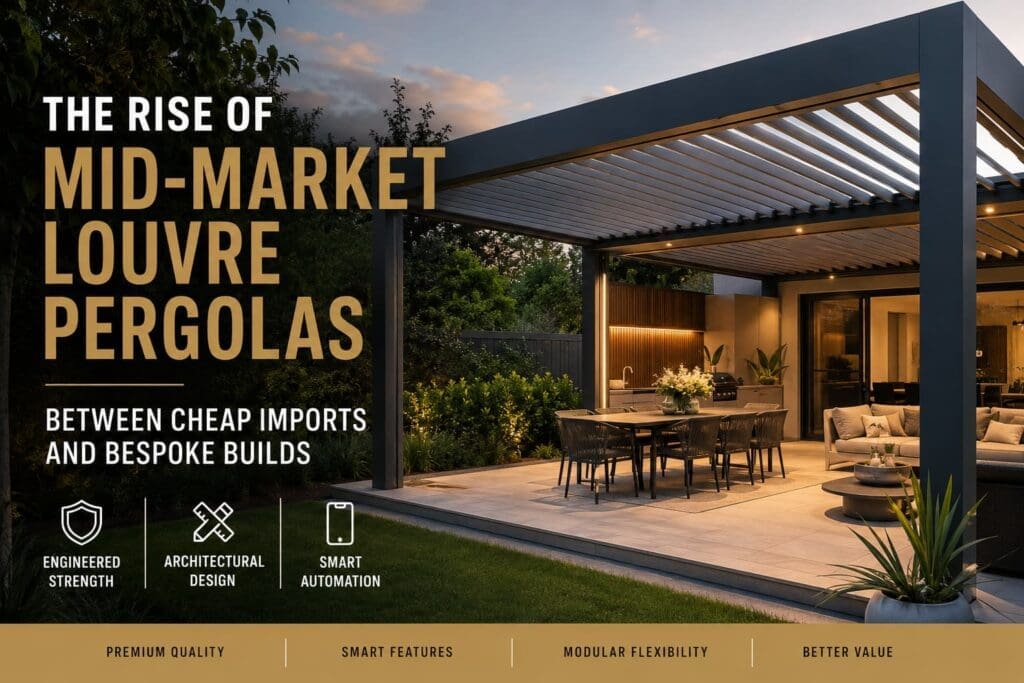
For years, the outdoor structure market was heavily divided into two extremes.
On one side sat low-cost pergola kitsets — lightweight imports focused almost entirely on price. On the other sat fully bespoke architectural builds, often carrying premium engineering, custom fabrication, and price tags that placed them beyond the reach of many homeowners.
Now, a third category is rapidly taking over the market: the mid-market engineered louvre pergola.
This segment is changing how homeowners approach outdoor living. It combines the clean architectural appearance and advanced functionality of high-end systems with the efficiency and accessibility of modular kitset construction. Across New Zealand, Australia, and many international markets, this “middle ground” is becoming the dominant direction for modern outdoor spaces.
Historically, buyers were often forced into a difficult compromise.
Budget systems typically focused on affordability above all else. While attractive on paper, many suffered from issues such as:
In harsh environments like coastal New Zealand or tropical Pacific regions, these weaknesses became even more obvious over time.
Many systems looked good initially but struggled with long-term durability, especially when exposed to high UV, salt air, strong winds, and heavy rainfall.
At the opposite end of the market sat custom-designed pergola systems.
These often featured:
The downside was cost.
Bespoke outdoor structures could quickly escalate into projects costing tens of thousands of dollars beyond the reach of many residential buyers. Installation timelines were longer, and customization often required complex design and consent processes.
The rise of engineered mid-market systems has effectively filled the gap between these two categories.
These systems aim to deliver:
Rather than choosing between “cheap” or “fully custom,” homeowners now have access to systems that provide a premium experience without requiring a fully bespoke build.
This trend mirrors broader changes in outdoor living globally, where outdoor spaces are increasingly viewed as permanent extensions of the home rather than seasonal add-ons.
One of the biggest drivers behind this shift is changing homeowner expectations.
Outdoor areas are no longer viewed as simple patios or occasional entertainment spaces. They are becoming:
Modern homeowners expect outdoor spaces to perform year-round.
That means structures now need to provide:
This has pushed demand toward systems that offer more than basic shelter.
The mid-market category has also benefited from major improvements in manufacturing and engineering.
Modern louvre pergola systems now commonly include:
These features were once largely reserved for premium architectural systems.
Now, manufacturing efficiencies and global demand have made them increasingly accessible to a wider audience.
Another major shift is the evolution of the kitset itself.
Older pergola kitsets were typically viewed as temporary or lightweight products.
Today’s engineered systems are increasingly positioned as “architectural kitsets” — products designed to bridge the gap between mass-market affordability and architectural-grade appearance.
This includes:
The result is a structure that looks significantly closer to a custom architectural installation while still benefiting from modular production efficiency.
One reason mid-market systems are outperforming both cheap imports and fully bespoke builds is adaptability.
Modern buyers increasingly prefer systems that can evolve over time.
For example:
This modular approach allows homeowners to spread investment over time while still maintaining a cohesive design language.
Material selection has become one of the defining characteristics of the modern pergola industry.
While timber pergolas remain popular for certain aesthetics, aluminium systems are increasingly dominating the mid-market category due to their balance of:
Unlike timber, aluminium does not warp, crack, or require ongoing staining and sealing.
This makes it especially attractive in coastal and high-exposure environments like New Zealand and the Pacific.
Another major driver behind the mid-market boom is smart integration.
What was once considered a luxury upgrade is quickly becoming standard.
Features now commonly expected include:
As smart home ecosystems expand, outdoor structures are increasingly becoming part of the connected home environment.
The outdoor living market is still evolving rapidly.
However, one thing is becoming increasingly clear:
The future likely belongs neither to the cheapest pergolas nor exclusively to ultra-premium bespoke structures.
Instead, the strongest growth appears to be happening in the engineered middle ground — systems that balance performance, design, flexibility, and accessibility.
For homeowners, this creates far more choice than ever before.
For the industry, it represents a fundamental shift in how outdoor architecture is designed, manufactured, and experienced.
Outdoor living is no longer seasonal.
It is becoming permanent infrastructure for the modern home.


