
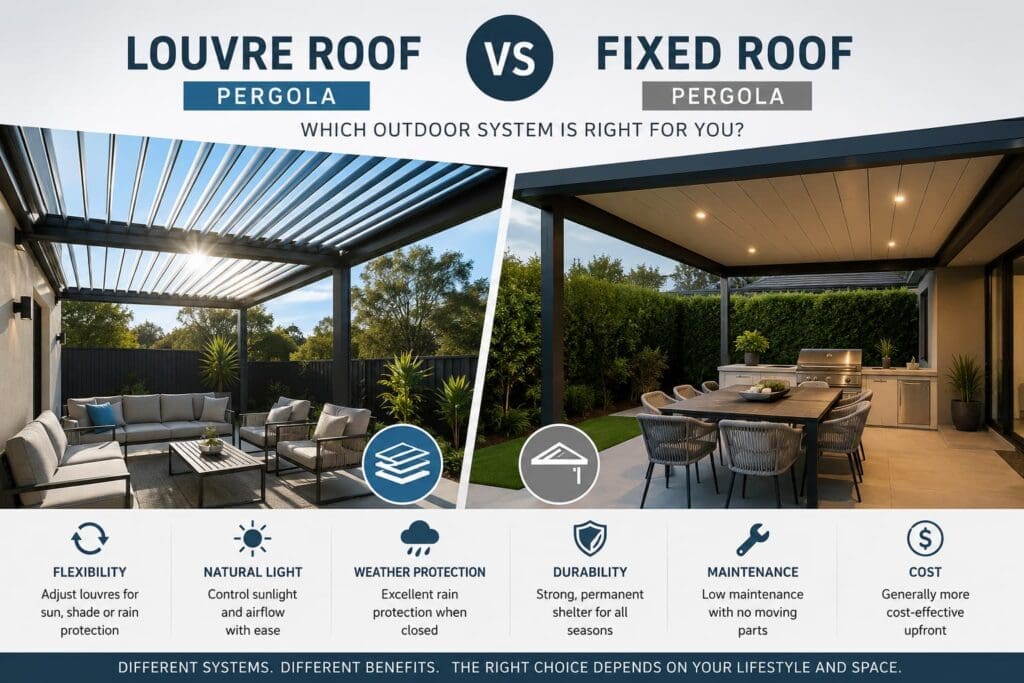
Outdoor roofing systems have evolved far beyond basic patio covers. Today, one of the biggest decisions homeowners, builders, and commercial developers face is whether to choose a louvre roof pergola or a fixed roof pergola.
Both options can completely transform an outdoor area, but they are designed for very different styles of outdoor living.
A louvre roof pergola uses adjustable aluminium louvres that can rotate open or closed depending on weather conditions and how much sunlight or airflow you want.
Motorised systems can often be controlled by:
When closed, the roof forms a weather-resistant cover. When open, it allows ventilation, sunlight, and airflow.
Modern systems like the Apollo NZ Cerberus and Orion ranges also include:
A fixed roof pergola uses a permanent roofing material that does not move or open.
Common fixed roof materials include:
These systems are designed to provide permanent shelter and year-round weather protection without moving components.
Fixed roof pergolas are commonly used for:
The biggest advantage of a louvre system is flexibility.
You can:
This creates a much more dynamic outdoor environment.
In New Zealand conditions, where weather can change rapidly, adjustable roofing gives users significantly more control over comfort levels.
A fixed roof provides consistent protection all year round.
There are no moving parts or roof adjustments required.
This can be beneficial for:
Louvre roofs allow users to fully control natural light levels.
Open louvres can:
Some hybrid systems can also incorporate polycarbonate sections for added daylight.
Fixed roofs provide more consistent shading.
Polycarbonate fixed roofs can still allow filtered light through, while insulated panel roofs create deeper shade and stronger thermal protection.
Both systems can provide excellent weather protection when engineered correctly.
High-quality louvre systems can provide:
However, because the roof moves, sealing performance can vary depending on engineering quality.
Fixed roofs generally provide:
This makes them particularly suitable for fully enclosed outdoor spaces.
Because louvre systems contain moving components, they can require:
Modern systems are highly reliable, but they are mechanically more advanced.
Fixed roof systems are generally simpler.
With fewer moving components, maintenance is usually lower over time.
Louvre systems are often seen as the more modern and architectural option.
They suit:
The adjustable roof creates a premium outdoor experience.
Fixed roof pergolas can create a cleaner and more solid structural appearance.
They work particularly well for:
Louvre roofs are typically more expensive because they include:
Large-span commercial systems can become significantly more complex.
Fixed roof systems are often more cost-effective per square metre.
This makes them popular for:
Both systems can work extremely well in New Zealand when properly engineered.
One of the fastest-growing trends is the use of hybrid pergolas that combine both systems.
Examples include:
This allows homeowners and designers to create more customised outdoor environments.
There is no single “best” option between a louvre roof pergola and a fixed roof pergola.
The right choice depends on:
For many homeowners, louvre roofs provide the ultimate outdoor living experience through flexibility and smart control.
For others, fixed roof systems offer unbeatable simplicity, shelter, and year-round protection.
The outdoor living market is increasingly moving toward systems that combine comfort, weather performance, smart technology, and architectural design — and both louvre and fixed roof pergolas now play a major role in that evolution.


