Housing in the Pacific Islands must contend with environmental conditions that are very different from those found in many conventional residential developments.
Salt-heavy coastal air, high humidity, intense sunlight, tropical rainfall and strong winds can quickly expose weaknesses in unsuitable building materials. In remote areas, even relatively minor maintenance work can become expensive and difficult because replacement materials, equipment and skilled labour may need to be transported between islands.
This is why choosing the right housing system from the beginning matters.
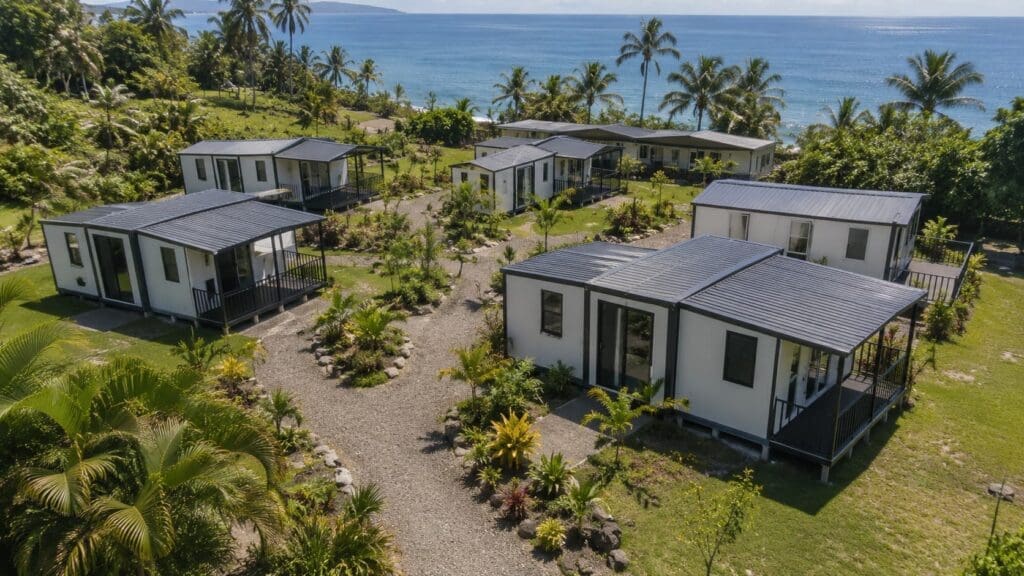
Arborlon Expandable Container Houses offer a practical alternative for coastal housing, tourism projects, worker accommodation, community developments and disaster-response applications throughout Fiji, Samoa, the Cook Islands and other Pacific regions.
Rather than treating coastal protection as an optional upgrade, Arborlon homes incorporate corrosion resistance, weather sealing and transport efficiency into the core building system.
Coastal living has many advantages, but the surrounding environment can be extremely aggressive toward buildings.
Salt carried through the air can settle on exposed steel, fixings, joins and fittings. Combined with moisture and heat, this can accelerate corrosion and reduce the service life of inadequately protected components.
Pacific Island buildings may also face:
A structure that performs well in a dry inland environment may not provide the same long-term performance when positioned close to the ocean.
Arborlon expandable houses are intended for coastal, tropical and remote environments where durability and reduced maintenance requirements are important.
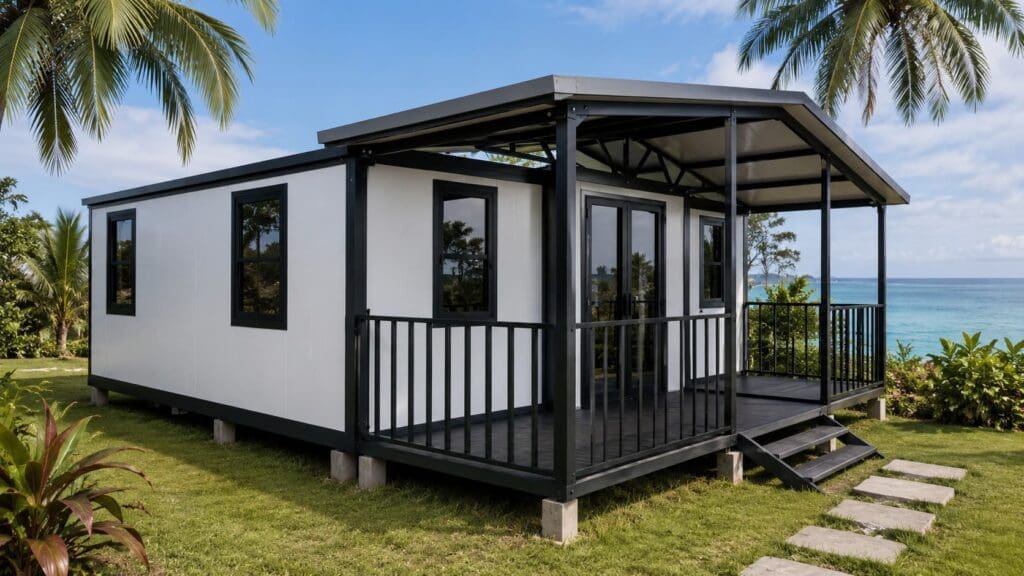
An expandable container house is a prefabricated building that is transported in a compact configuration and expanded once it reaches the site.
This approach combines the transportation advantages of containerised construction with a significantly larger completed internal area.
Once delivered, the side sections are opened and secured to create the finished building footprint. Internal rooms, windows, doors, wall linings and selected services can be incorporated before delivery, depending on the project configuration.
The result is a system that can reduce the amount of building work required in difficult or remote locations.
Expandable houses can be used as:
Their modular format also allows developments to begin with a smaller number of buildings and expand as demand, funding or visitor capacity increases.
One of the most important considerations for any coastal building is corrosion protection.
Arborlon homes use corrosion-resistant structural steel as the main supporting framework. The steel structure is supported by aluminium alloy components and marine-grade stainless steel in critical areas.
The primary steel framework provides the strength required to support the expandable building.
Unlike untreated steel systems, the Arborlon structure incorporates protective materials and surface treatments intended to slow rust, oxidation and structural deterioration in salt-heavy environments.
Aluminium alloys are used for selected windows, trims and fittings.
Aluminium is lightweight and naturally resistant to many forms of corrosion, making it suitable for buildings exposed to humidity and coastal air.
Critical fasteners and fixtures use 316L stainless steel.
This grade of stainless steel is commonly selected for marine and offshore environments because of its resistance to salt exposure and oxidation. Using suitable fasteners is particularly important because even a well-protected structural frame can be compromised when inferior screws, bolts or connectors begin to corrode.
Effective corrosion protection should not rely on a single surface coating.
Arborlon homes use a multi-stage protective process intended to create several barriers between the structural steel and the surrounding environment.
Galvanisation provides a foundational protective layer over the steel.
The zinc coating helps protect the underlying material from direct exposure to moisture and oxygen. It also provides additional protection when small surface scratches occur.
An epoxy zinc-rich primer adds another corrosion-resistant barrier.
This layer improves coating adhesion while providing additional protection against moisture and salt exposure.
The external system is completed with a polyurethane topcoat.
This finish is intended to provide resistance against ultraviolet exposure, water and general surface deterioration. It also helps reduce peeling, fading and degradation caused by prolonged exposure to tropical weather.
The combination of galvanisation, zinc-rich primer and polyurethane finishing provides substantially stronger protection than a basic painted steel surface. This is especially valuable in remote areas where frequent repainting and structural maintenance may be difficult.
Moisture entering through poorly sealed joins is one of the most common causes of building damage.
Water can travel behind exterior cladding, enter wall cavities and collect around structural components. Over time, this may lead to corrosion, mould, damaged insulation and deterioration of internal finishes.
Arborlon expandable houses use reinforced welded joints and weather-tight seals around key joins and edges.
The construction system is intended to provide:
This sealing is particularly important for buildings in tropical areas, where intense rain may be driven horizontally against walls, doors and roof connections during storms.
A correctly installed drainage and sealing system helps the building remain dry and usable while reducing the risk of hidden moisture damage.
Material specifications are important, but testing provides additional confidence that a building system has been considered for demanding environmental conditions.
Arborlon housing components undergo testing that includes ASTM B117 salt spray exposure. This process places coated materials in a controlled salt-fog environment to assess corrosion resistance.
Moisture and wind-load testing is also used to assess the system’s ability to perform in humid and storm-prone conditions.
For especially exposed locations, enhanced protection packages may be available with additional coatings, upgraded sealing products and further protection around vulnerable components.
Project requirements should still be assessed according to the specific site, building use, terrain, foundations and local approval requirements.
Transporting conventional building materials to an island can be complicated.
A project may require multiple deliveries of timber, roofing, insulation, cladding, windows, doors, fixings and interior materials. Delays involving only one component can prevent the next stage of construction from beginning.
Expandable container houses simplify this process by combining much of the building into a prefabricated package.
During transportation, the expandable sections remain folded within the main structure. Once the building reaches the prepared site, it is positioned, opened and secured.
This can offer several logistical benefits:
The reduced site workload can be particularly useful for outer islands where access to cranes, specialist trades and large construction teams may be limited.
Prefabricated buildings are sometimes assumed to be temporary or disposable.
However, installation speed and building quality are separate considerations.
A building can be manufactured in a controlled environment, transported efficiently and installed quickly while still using durable structural materials and protective coatings.
For island projects, reducing construction time can provide significant practical advantages.
Traditional building programmes may be disrupted by:
Completing more of the building before transportation reduces exposure to these risks.
It also means accommodation can become operational sooner, whether it is being used for a family home, resort, community programme or emergency response.
Tourism developments often need to increase accommodation capacity without committing immediately to a large conventional construction programme.
Expandable container houses can be configured as individual villas, guest rooms, staff quarters or supporting facilities.
Their modular format allows resort operators to add units in stages. This makes it possible to match development costs with visitor demand.
Potential resort applications include:
Solar power, rainwater collection and selected off-grid systems can also be considered for locations where public services are limited or unavailable.
Pacific communities can face urgent accommodation requirements following cyclones, flooding and other natural disasters.
Conventional reconstruction takes time. Materials must be sourced, shipped and installed while affected communities may already be dealing with damaged infrastructure and limited access.
Expandable housing can provide a faster path to establishing:
Because the units can be transported compactly and expanded after arrival, multiple buildings can be planned as part of a coordinated relief or reconstruction programme.
The same units may also be designed for continued use after the immediate response period rather than being discarded once the emergency has passed.
Not every Pacific Island site has reliable access to electricity, mains water or wastewater infrastructure.
Arborlon homes can be planned with optional systems that support more independent operation.
These may include:
Rainwater collection can be particularly useful in regions where rainfall is plentiful but reticulated water services are limited.
Solar power can also reduce dependence on diesel generation and help control long-term operating costs for remote homes, resorts and community buildings.
The final configuration will depend on the number of occupants, intended building use, climate, available services and desired level of independence.
Expandable container houses do not have to follow a single standard floor plan.
Internal arrangements can be selected according to the intended application.
Residential layouts may include:
Commercial and community layouts may be configured for:
Planning the layout before manufacture can reduce the amount of alteration required after the building reaches the site.
The initial purchase price is only one part of the true cost of a building.
For coastal properties, ongoing repainting, rust repairs, replacement fixings, leaking joins and moisture damage can become major expenses.
These costs can be even higher on an island because labour and replacement materials may need to be brought in from elsewhere.
Arborlon’s corrosion-resistant framework, marine-grade components, protective coating system and weather sealing are intended to reduce the rate of deterioration and lower ongoing maintenance requirements.
No coastal building is completely maintenance-free. Regular cleaning, inspection and care are still important, particularly around drainage outlets, roof surfaces, exterior seals and exposed hardware.
However, beginning with materials selected for the environment can reduce avoidable repairs and help protect the value of the building.
Arborlon expandable container houses may be suitable for a wide range of Pacific Island projects.
For homeowners building near the coast or in a remote location, expandable housing can provide a practical alternative to a lengthy conventional build.
Expandable villas and staff buildings allow accommodation capacity to be added progressively.
Repeatable modular units can support larger residential, rental or tourism developments.
The system may be considered for housing programmes, community facilities, remote offices and infrastructure projects.
Rapid deployment and flexible layouts can support disaster-response, healthcare, education and community-development programmes.
Expandable buildings can provide accommodation, offices and support facilities for workers operating far from established towns.
The Pacific Islands require buildings that reflect the reality of the environment.
A standard structure with basic coatings and unsuitable fasteners may look satisfactory when it is first installed, but salt exposure, humidity, ultraviolet radiation and tropical storms can reveal weaknesses surprisingly quickly.
Arborlon Expandable Container Houses bring together:
For homeowners, developers, tourism operators and organisations working throughout the Pacific, this creates a housing option designed around durability, logistics and long-term practicality.