
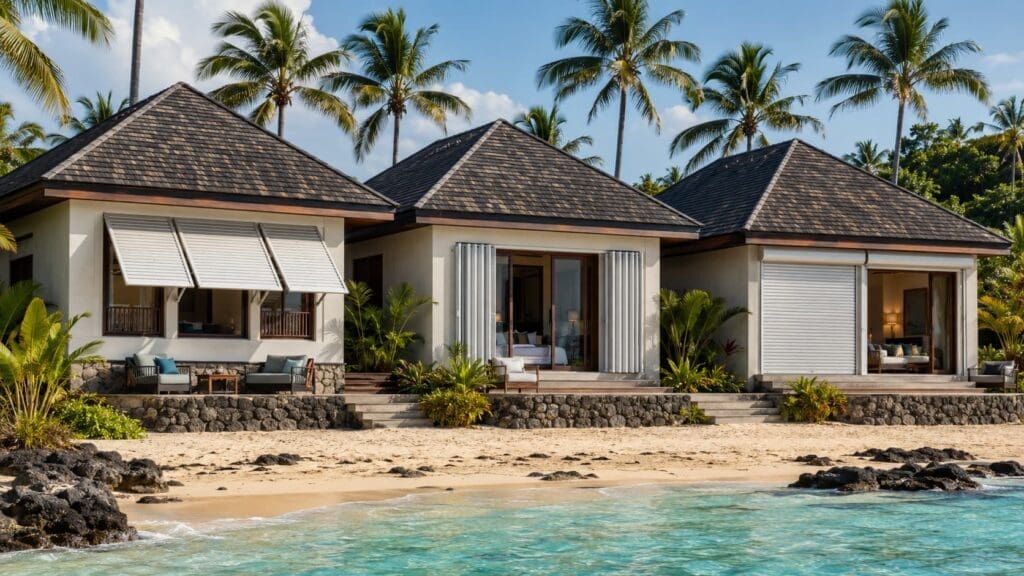
For buildings in Fiji, Samoa and other cyclone-prone coastal regions, protecting windows and glazed doors should be considered part of the building-envelope strategy—not an accessory added shortly before a storm.
When an unprotected opening fails, wind and rain can enter the building, potentially increasing internal pressure and causing wider damage. Properly specified storm shutters are intended to protect openings against wind pressure and wind-borne debris, but the shutters must be securely connected to the building structure.
Three of the most practical permanent systems are:
Each can suit cyclone-prone projects, but they differ considerably in appearance, deployment, maintenance, cost and suitability for large developments.
| System | Best suited to | Main advantage | Main consideration |
|---|---|---|---|
| Bahama shutters | Villas, homes, boutique resorts and smaller windows | Combines storm protection, shade and architectural character | Must be a tested storm-rated system, not a decorative shutter |
| Accordion shutters | Resorts, apartments, staff accommodation and commercial buildings | Practical coverage with fast manual deployment | Folded shutters remain visible beside the opening |
| Roll-down shutters | Premium villas, reception buildings, restaurants and large glazed openings | Fast, convenient and visually discreet when retracted | Higher cost and greater mechanical complexity |
No shutter style is automatically cyclone-rated. The complete system—including blades, tracks, hinges, locks, fasteners and structural attachment—must be selected for the opening size and required design pressures.
Bahama shutters are permanently mounted above the window and hinged along their upper edge. During normal use, they project outward like a small awning. Before a storm, the shutter is lowered and secured over the opening.
Their tropical appearance can complement resort villas, coastal homes, restaurants and traditional island-style architecture. They can also provide useful everyday shading, reducing direct sun while still allowing some outward visibility and ventilation.
This makes Bahama shutters one of the few storm-protection systems that can contribute to the building’s appearance throughout the year rather than remaining unused until cyclone season.
Bahama shutters are particularly suitable for:
Bahama shutters are usually better suited to conventional windows than very wide sliding doors or large glazed walls.
They also create a distinct architectural look. That can be an advantage for tropical villas but may not suit a highly contemporary façade.
Most importantly, decorative Bahama shutters should not be confused with engineered storm shutters. A cyclone-protection system must have suitable structural framing, locking points and tested or documented performance for the intended application.
Choose Bahama shutters when appearance, shade and storm preparation are equally important.
They are especially effective where the project has numerous smaller windows and the shutters can become a deliberate part of the architecture.
Accordion shutters are permanently installed on tracks beside an opening. When not required, the interlocking blades fold into compact stacks at the sides. To deploy them, the shutter is pulled across the opening and locked.
Accordion systems can cover windows, sliding doors, balconies and some larger openings. Certain systems can also turn corners or enclose an entire outdoor area.
Manufacturer systems commonly use extruded aluminium blades with stainless-steel components, and some are designed to enclose full balconies with a single shutter assembly.
For developments with many guest rooms or repeated building designs, accordion shutters provide a practical balance between affordability and operational speed.
Staff do not need to locate and install separate storm panels. The shutters remain attached to each opening and can generally be closed manually within a relatively short period.
This can be particularly useful for:
The folded stacks remain visible beside the window or door. On smaller openings, this may slightly reduce the clear view or available opening width.
Tracks and locking components also require regular cleaning. Sand, salt deposits, insects and landscaping debris can interfere with smooth operation if the shutters are neglected.
Choose accordion shutters when the project requires reliable permanent protection across many openings without the higher cost and mechanical complexity of motorised roll-down systems.
For larger resorts, accordion shutters are often a sensible standard specification for guest accommodation, utility buildings and secondary façades.
Roll-down shutters use interlocking horizontal slats that travel within side guides and coil into a housing above the opening.
They may be operated by:
When open, most of the shutter is concealed within the headbox, leaving only the side guides visible. The housing can also be recessed into a wall, soffit or architectural bulkhead when incorporated during the design stage.
Roll-down shutters provide the fastest and most convenient storm preparation of the three systems.
Multiple shutters can potentially be operated from switches, grouped controls or a central building-management arrangement. They can also provide everyday privacy, shading, light control and additional security when the property is unoccupied.
These characteristics make roll-down shutters particularly suitable for:
Motorisation should not be treated as the only operating method in a cyclone-prone location.
The specification should address what happens if electrical power is lost before or during storm preparation. Depending on the system, this may involve manual override controls, crank operation, backup power or designated emergency procedures.
For remote resorts and outer-island projects, the availability of replacement motors, controllers and specialist technicians should also be considered before selecting a highly automated system.
Roll-down shutters contain more moving parts than Bahama or accordion systems. Motors, shafts, bearings, guides, controls and slats should therefore be included in the property’s planned maintenance programme.
Saltwater exposure and strong coastal winds create demanding conditions for shutters and doors, making proactive maintenance important for avoiding operational failures.
Choose roll-down shutters where rapid deployment, large-opening coverage, appearance and security justify the additional investment.
They are often the strongest option for front-of-house resort areas and premium accommodation, particularly when incorporated into the building before construction begins.
A resort does not necessarily need to use the same shutter system on every building.
A mixed specification can provide better value.
Use roll-down shutters for large glazed doors and highly visible façades. Bahama shutters may be used on smaller bedroom or bathroom windows where a tropical architectural style is preferred.
Accordion shutters generally provide a practical balance between appearance, cost and deployment speed.
Roll-down shutters are often suitable for wide doors, serving openings, glass walls and prominent public areas.
Accordion shutters can provide straightforward permanent protection without unnecessary automation.
Bahama shutters can provide storm protection, shade and a more integrated architectural appearance.
New construction provides the best opportunity to conceal roll-down housings, reinforce fixing points and coordinate shutters with windows, doors, cladding, soffits and waterproofing.
The shutter supplier, architect and structural engineer should coordinate opening sizes and loads before the façade is finalised.
Accordion shutters are often practical for retrofit projects because they can be surface-mounted around existing openings.
Bahama shutters can also be retrofitted but will noticeably alter the façade.
Roll-down systems can be installed on existing buildings, although visible headboxes, limited headroom and the strength of the existing wall structure must be assessed.
Request technical documentation for the complete shutter assembly—not only the aluminium blade.
A system suitable for a small window may not be suitable for a four-metre-wide sliding door.
Storm shutters must transfer loads into adequate structural framing, masonry or concrete. Fixing only into lightweight cladding is not enough.
Specify materials, coatings and fasteners suitable for salt-laden coastal environments. Establish cleaning and inspection requirements from the beginning.
Calculate the total number of shutters, available staff, access requirements and realistic cyclone-preparation time.
FEMA classifies deployed shutters as an active mitigation measure because they must be closed or installed before the storm arrives. Upper-level openings may also require additional access equipment and labour.
Motorised systems should have an appropriate emergency-operation plan.
Shutter locations must be coordinated with emergency escape routes, accessible entrances and the building’s fire-safety requirements.
Fiji’s National Building Code is prescribed for buildings covered by the relevant legislation, and major development applications are subject to local approval requirements.
Samoa has also adopted a National Building Code, and applicable building work requires approval through the responsible authorities. Current government project documentation states that a building permit is required from the Ministry of Works, Transport and Infrastructure to confirm compliance with the Samoa Building Code.
Requirements can vary according to building location, use, height, importance and exposure. Final shutter selection and fixing design should therefore be reviewed by the project architect, structural engineer, shutter supplier and relevant local authority.
There is no single best shutter for every coastal development.
Choose Bahama shutters for smaller windows where tropical character, ventilation and solar shading are important.
Choose accordion shutters for economical, dependable protection across repeated villas, apartments and commercial openings.
Choose roll-down shutters for premium buildings, large glazed areas and projects where fast deployment and a clean appearance are priorities.
For many Fiji and Samoa resorts, the best solution will be a coordinated combination: roll-down shutters for major glazed openings, accordion shutters for repeated accommodation buildings and Bahama shutters as an architectural feature on selected windows.
The most important decision is not simply which shutter looks best. It is whether the complete system has been correctly selected, engineered, installed and maintained for the building and its coastal environment.


