
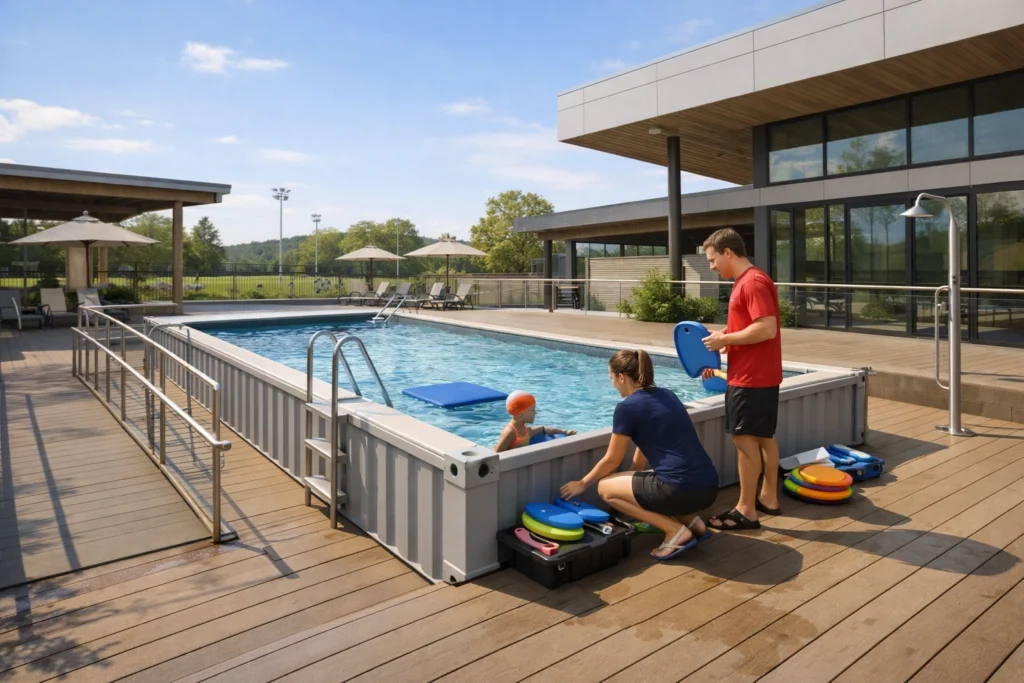
Public aquatic infrastructure is increasingly being evaluated through two lenses at once: community impact and delivery efficiency. In that context, container pools have emerged as a serious planning and infrastructure tool for schools, civic hubs, sports precincts, and regional communities that need access to water-based recreation and training without the long timelines and site burdens of traditional construction.
The core value of modular aquatics is not novelty. It is the ability to deliver functional, durable, and scalable public water facilities in locations where conventional in-ground pool projects can be delayed or constrained by capital budgets, limited land availability, site disruption, or phased development requirements.
For planners, councils, educators, and project teams, the shift matters because aquatic access is not only a leisure question. It is tied to learn-to-swim capacity, public health, sports recovery, youth programming, and regional equity. Container-based systems bring technical advantages that align directly with those public needs.
Traditional public pool construction is often slowed by a predictable set of constraints. These projects demand extensive excavation, specialist trades over long durations, dedicated plant room space, and significant on-site coordination. For many community-scale developments, those requirements become the main barrier, not the demand for the facility itself.
Container pools change the delivery model by shifting much of the complexity off-site.
Project teams evaluating public aquatic infrastructure typically need to reduce pressure in three areas:
This matters most in public settings where infrastructure must compete for land and capital against other priorities such as parking, classrooms, green space, or community buildings.

In public planning terms, a container pool should be assessed as a multi-outcome asset. The same body of water can support swim education, low-impact therapy, sports recovery, supervised recreation, and seasonal programming depending on how the facility is specified and scheduled.
✔ Schools and education settings can use modular pools to expand learn-to-swim access without waiting for major campus redevelopment.
✔ Community hubs can add aquatic capability to mixed-use sites that already include courts, gyms, libraries, or event spaces.
✔ Regional towns can improve access to supervised aquatic activity where permanent large-scale facilities are not financially viable.
✔ Sports precincts can integrate compact recovery pools close to training spaces, reducing travel between venues.
For urban planners, this flexibility changes the decision from "Can this site support a full pool complex?" to "What level of aquatic service does this community need, and how quickly can it be delivered?"
Public infrastructure must perform consistently under repetitive use, variable supervision patterns, and exposure to weather. That makes the technical case for modular pools especially important.
A properly engineered container pool relies on reinforced steel framing, protective coatings, and internal waterproofing systems to manage hydrostatic loads, corrosion risk, and long-term wear.
Key durability considerations include:
For community operators, durability is not just a technical metric. It directly affects maintenance cycles, downtime, and long-term service continuity.
The strongest operational advantage of modular aquatics is speed to service. Public projects often have narrow windows linked to school calendars, grant funding, seasonal demand, or staged precinct openings.
Because modular units are manufactured and assembled off-site, teams can:
Traditional pool facilities typically require separate plant rooms, extended service runs, and larger dedicated building footprints. Modular systems compress these requirements into a tighter infrastructure package.
This compactness helps in dense or constrained public environments where every square metre matters.
Technical planning advantages include:
For architects and planners, this means aquatic infrastructure can be inserted into sites that would otherwise be ruled out on spatial grounds alone.

One of the most useful characteristics of container-based aquatics is that they support phased infrastructure thinking. Not every community needs a full-scale aquatic centre on day one. Many need an initial, highly targeted facility that can expand later if usage proves demand.
This is especially relevant in renewal precincts, temporary activation sites, growth corridors, and regional locations where population patterns or funding pathways may still be evolving.
In any school or community setting, technical performance must be matched by clear operational safety design. That includes circulation safety, water quality control, access management, slip resistance, and maintenance accessibility.
Project teams should specify:
For public operators, the real benchmark is simple: can the facility be kept safe, reliable, and easy to run over time?
Container pools are increasingly relevant because they align technical efficiency with community infrastructure need.
Container-based aquatic infrastructure is no longer a fringe concept. It is a practical planning response to the challenge of delivering accessible water facilities where communities need them most.


