
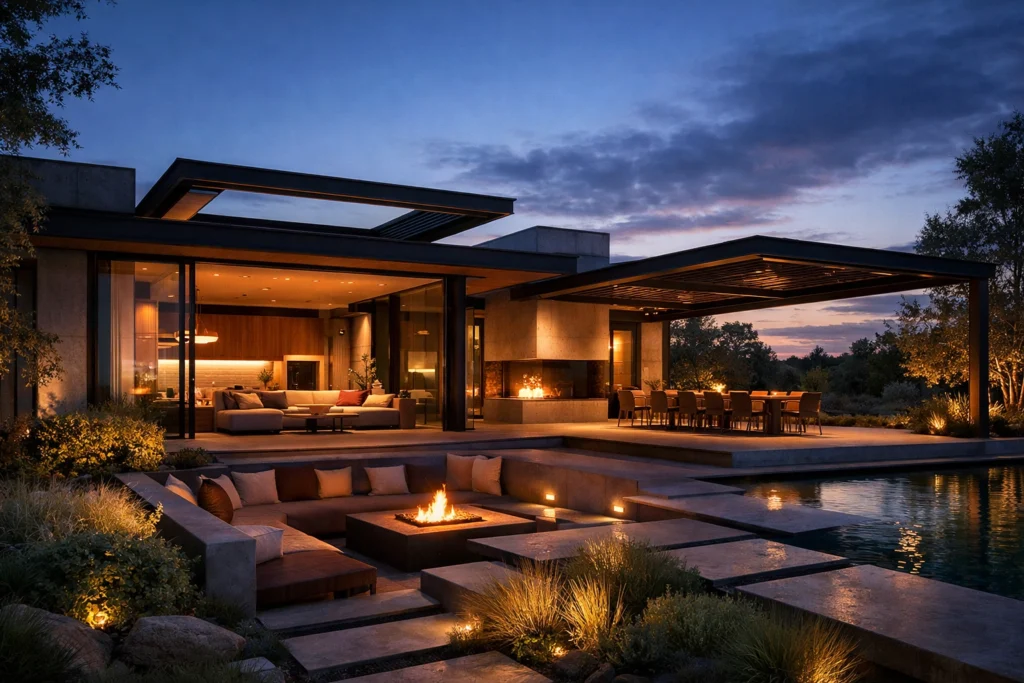
The traditional boundary between "home" and "work" has dissolved. In the wake of shifting global work patterns and increasing urban density, a new architectural priority has emerged: the Third Space.
Historically, the concept of the "third space" referred to social surroundings separate from the two usual environments of home (first space) and work (second space): think of the Parisian café or the English pub. However, in modern residential design, the third space has migrated inward. It is now defined as a hybrid area within the property that is neither purely a domestic chore zone nor a professional office, but a dedicated environment for social and personal rejuvenation.
The challenge for architects and developers today is that these spaces are often the most underutilized. Expansive decks sit empty during the winter, and urban balconies are frequently rendered useless by wind and exposure. The solution lies in Kinetic Architecture: the integration of retractable technology that allows a structure to respond dynamically to its environment.
Kinetic architecture moves beyond the static nature of traditional building. It views a home not as a fixed shell, but as a responsive organism. When we apply this to the third space, we shift the focus from "square meterage" to "utility hours."
The primary driver in making a backyard or balcony a viable third space is the ability to control environmental variables. A space that is beautiful but uncomfortable will never fulfill its role as a sanctuary. By introducing movement: retractable roofs, automated screens, and pivoting glass: designers can reclaim "dead" areas of a floor plan and transform them into high-value zones for wellness and social connection.

Consider the typical urban apartment balcony. In many high-density developments, these areas are designed to meet a compliance quota rather than a lifestyle need. They are often too windy, too noisy, or too exposed to the gaze of neighbors to be used comfortably.
By installing automated vertical screens, that dead square meterage is transformed into a private sanctuary. These systems provide several critical functions:
When a balcony is shielded, it ceases to be a ledge for a drying rack and becomes a "Third Space": a place for morning meditation, a sunset drink, or a quiet reading nook that feels distinct from the rest of the apartment.
The same logic applies to large-scale residential projects where expansive decks often sit empty for six months of the year. A static pergola provides shade, but it cannot provide a sanctuary during a rainstorm or on a frigid evening.
By introducing a retractable overhead system, the space becomes a multi-functional zone capable of adapting in real-time.
The architectural benefits of kinetic systems are clear, but the psychological impact is perhaps more profound. A true third space serves as a "liminal" area: a place where the mind can transition from the stresses of the day.
For architects and high-end developers, the integration of these systems must be seamless. The goal is to ensure the technology does not overwhelm the aesthetic.
High-end third spaces prioritize structural clarity. This involves:
Designers should review structural layouts, facade coordination, drainage planning, and movement tolerances early so the technology reads as part of the architecture rather than an applied layer.
The most successful third spaces are those that require the least effort to manage. Modern kinetic architecture is increasingly tied to environmental sensors.

When specifying kinetic elements for a third space, durability is the cornerstone of the design. Because these spaces are intended for rejuvenation, the last thing a homeowner wants is a high-maintenance "gadget."
Specify systems that utilize marine-grade components and high-cycle tested motors. Highlight the importance of site-specific integration by local experts who understand the specific microclimate of the project. Describe the long-term value of these systems not just as an "add-on," but as a fundamental upgrade to the building's livable footprint.
The ultimate goal of reclaiming the third space is to create a zone that is "always ready." Whether the design uses an overhead opening element or more complex glazed transitions, the architecture should serve the lifestyle, not the other way around.
When the environment is controlled, the social potential of the home expands. We see a rise in the "outdoor hearth": the integration of fire pits and outdoor kitchens within these kinetic sanctuaries. This creates a year-round destination for hosting, further cementing the third space as the heart of the modern home.

Designing the third space is no longer a luxury: it is a necessity for balanced modern living. By leveraging kinetic architecture, we can stop viewing our balconies and decks as seasonal bonuses and start treating them as essential, high-functioning components of our daily lives.
Key Takeaways for Designers:
By focusing on the Third Space, we are not just adding a feature to a house; we are providing a blueprint for a more resilient and restorative lifestyle.


