
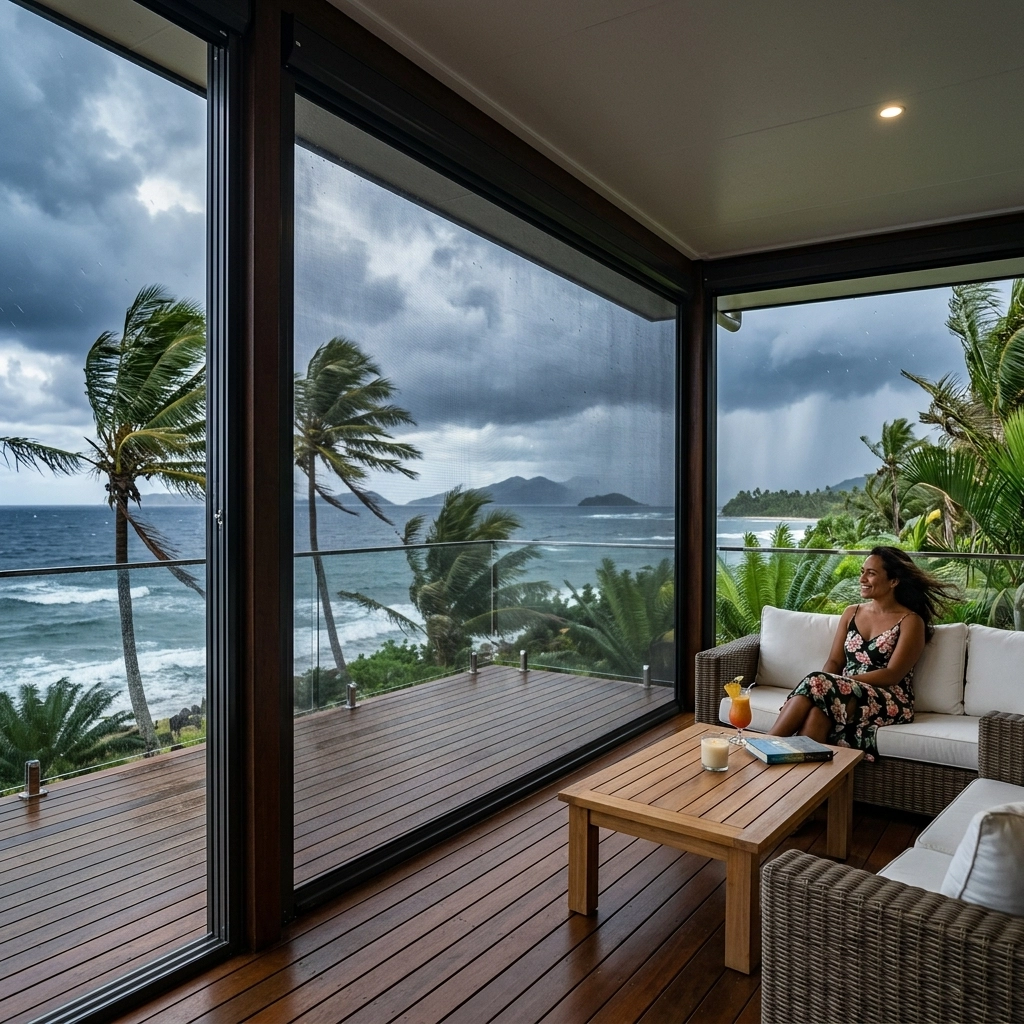
For resort owners, architects, and homeowners in Fiji and across the Pacific Islands, the outdoor living space is a primary asset. However, the tropical environment presents a unique set of challenges that standard shading solutions often fail to meet. From the intense UV radiation of the equatorial sun to the seasonal threat of tropical cyclones and persistent salt-laden air, the requirements for outdoor protection are exceptionally high.
In these environments, traditional "cafe blinds" or rope-and-pulley systems are often more of a liability than a benefit. When the winds pick up, these systems flap, rattle, and eventually tear, often causing damage to the very structures they were meant to protect. This has led to the rise of track-guided outdoor blinds, a heavy-duty engineering solution designed specifically for high-wind zones.
Understanding the technical specifications and structural advantages of these systems is critical for ensuring long-term durability and safety in the Pacific.
Fiji's climate is characterized by its volatility. While the aesthetic goal is often to create a seamless transition between indoor and outdoor spaces, the functional requirement is to create a barrier that can withstand extreme pressure.
Key environmental stressors in Fiji include:
To meet these challenges, shading systems must transition from "decor" to "structural components." This is where track-guided technology becomes essential.
The fundamental difference between a standard outdoor blind and a track-guided system lies in how the fabric is secured. In a standard system, the fabric hangs freely or is secured at the bottom corners. In a track-guided system, the fabric is "locked" into vertical side channels along its entire length.
This is often referred to as zip-track technology. A specially designed "zipper" or spline is welded to the edges of the fabric. This spline slides into a groove within an aluminum side track. Because the fabric is held taut from top to bottom, it cannot flap or pull out of the channel, even under significant wind pressure.
When specifying blinds for the Pacific, the most critical metric is wind resistance. High-performance systems are engineered to meet or exceed Typhoon 12 ratings on the Beaufort scale. This equates to wind speeds of 118–150+ km/h.
For a blind to survive these forces, every component must be reinforced:
In a tropical maritime environment, material choice is non-negotiable. Standard steel or low-grade alloys will fail prematurely due to corrosion.
Specify 6063-T5 Aluminum: This is the gold standard for Pacific installations. It offers an excellent strength-to-weight ratio and natural resistance to corrosion. When finished with a high-quality powder coating, it provides a barrier against the salt air.
Utilize 304 Stainless Steel Components: All internal springs, screws, and fixings should be 304-grade stainless steel. This grade is specifically designed for "marine" environments, containing molybdenum to resist pitting and crevice corrosion in chloride-rich environments.
By prioritizing these materials, property owners can avoid the costly cycle of replacing corroded hardware every two to three years. For more information on integrated shading and structural solutions for the islands, you may want to explore the Titan outdoor blinds guide.

The choice of "skin" for the blind system depends entirely on the intended use of the space. In Fiji, there are generally two preferred options:
This is the most popular choice for tropical resorts. High-density polyethylene (HDPE) or vinyl-coated polyester meshes allow for airflow while blocking up to 95-99% of UV rays.
For areas that require absolute protection from rain and wind while maintaining 100% clarity, industrial-grade PVC is the solution.

In many Pacific Island locations, power consistency can be an issue, and simplicity often leads to better long-term reliability.
Manual Spring-Tensioned Systems: These are often preferred for their "fail-safe" nature. They use an internal glass-reinforced plastic or steel spring to balance the weight of the blind. This allows the user to raise or lower the blind with a single finger. Because there are no electrical components, there is less risk of failure due to power surges or humidity affecting motor circuitry.
Motorized Systems: For large-scale resorts with dozens of blinds, motorization is often a requirement for operational efficiency. If choosing motorized, ensure the motors are rated for outdoor use and include a manual override feature. This is vital in Fiji; if a cyclone is approaching and the power goes out, you must be able to retract or secure the blinds manually.
For commercial operators, the installation of track-guided blinds is an investment in operational continuity. When a tropical storm hits, a resort with standard blinds must scramble to move furniture, roll up flapping fabrics, and eventually close down outdoor dining or bar areas.
With heavy-duty track-guided systems, the "weather-in" process takes seconds. Guests can remain in the outdoor area, protected from the rain and wind, while still enjoying the tropical view. This prevents loss of revenue and protects expensive outdoor assets like high-end fire pits or custom outdoor kitchens.
Furthermore, integrating these systems with other structural elements, such as Bahama shutters for window protection, creates a comprehensive "envelope" for the property, significantly reducing the risk of water ingress during the wet season.

Even the best-engineered system requires maintenance to survive the Fiji climate.
When planning an outdoor shading project in Fiji or the Pacific Islands, keep these technical priorities in focus:
By investing in high-specification, track-guided technology, Pacific property owners can create outdoor spaces that remain functional, beautiful, and safe, regardless of what the tropical weather brings.


