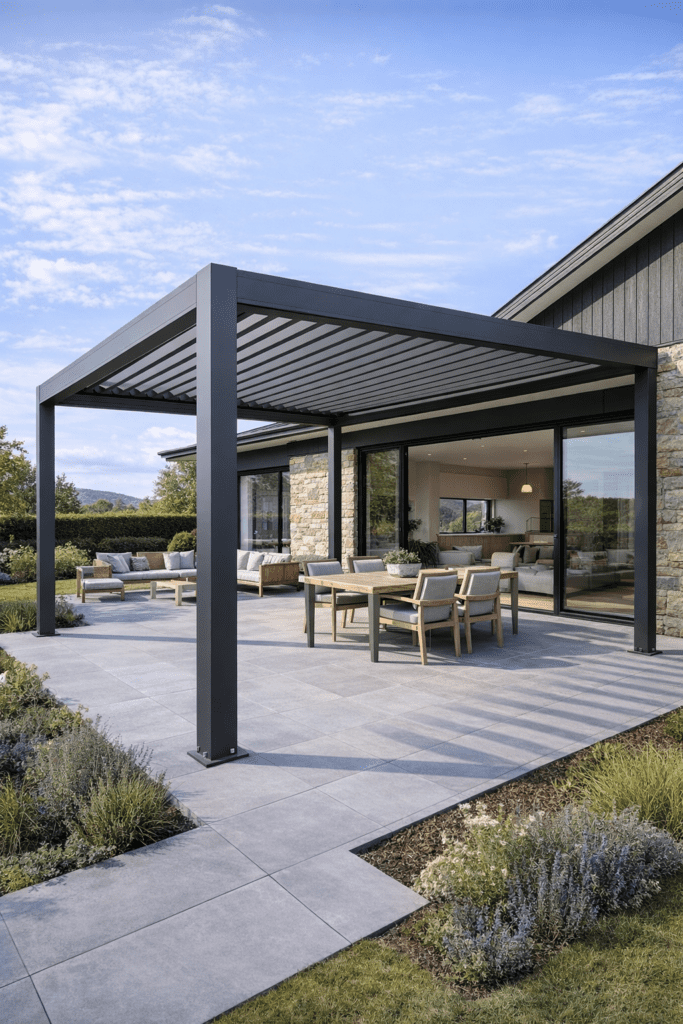
Flat-pack pergola systems have evolved rapidly across New Zealand and the Pacific. At the same time, traditional custom builds remain common for more complex architectural projects.
Choosing the right approach early can have a major impact on installation time, project cost, freight efficiency, and long-term flexibility.
This guide provides a practical comparison to help homeowners, builders, and developers make an informed decision.
Outdoor living areas are no longer occasional add-ons. Across NZ and the Pacific, they are now core functional spaces.
Several market pressures are influencing pergola selection:
These factors are driving strong adoption of engineered flat-pack pergola systems, while custom builds continue to serve high-complexity projects.
A flat-pack pergola (also known as a kitset pergola) is a pre-engineered outdoor structure built around standardised modules and repeatable components.
Typical characteristics include:
This model shifts more work into controlled manufacturing environments, which helps reduce on-site labour requirements.
A custom pergola is typically designed and fabricated specifically for one project.
The process usually involves:
Custom builds offer maximum design flexibility. However, they usually come with greater cost variability and longer delivery timelines.
Flat-pack pergolas are designed for faster assembly and are often installed by builders within a compressed timeframe.
Custom builds typically require longer on-site construction due to bespoke fabrication and integration work.
Flat-pack systems generally provide clearer cost bands because the structural platform is standardised.
Custom builds often involve:
For developers and commercial projects, cost certainty is becoming increasingly important.
Custom pergolas still lead when full architectural freedom is required.
Flat-pack systems prioritise:
The right choice often depends on whether the project is highly bespoke or performance-driven.
Freight efficiency is especially important for Pacific projects.
Flat-pack pergolas:
Custom welded structures are typically less efficient to transport.
Flat-pack systems reduce on-site labour requirements through pre-engineered components.
Custom builds generally require:
With labour costs rising across NZ, this factor is becoming increasingly influential.
Flat-pack pergolas are often the stronger option when:
This is why kitset systems are gaining strong traction across residential, education, hospitality, and developer segments.
Custom pergolas remain appropriate when:
The future market is not either/or — it is about selecting the right tool for the project.
Many projects now sit between lightweight DIY pergolas and fully bespoke construction.
Engineered architectural kitset systems are expanding into this middle space by offering:
This category is seeing some of the fastest growth in the outdoor structures sector.
Before committing to either path, buyers should assess:
Answering these questions early helps prevent costly project changes later.