
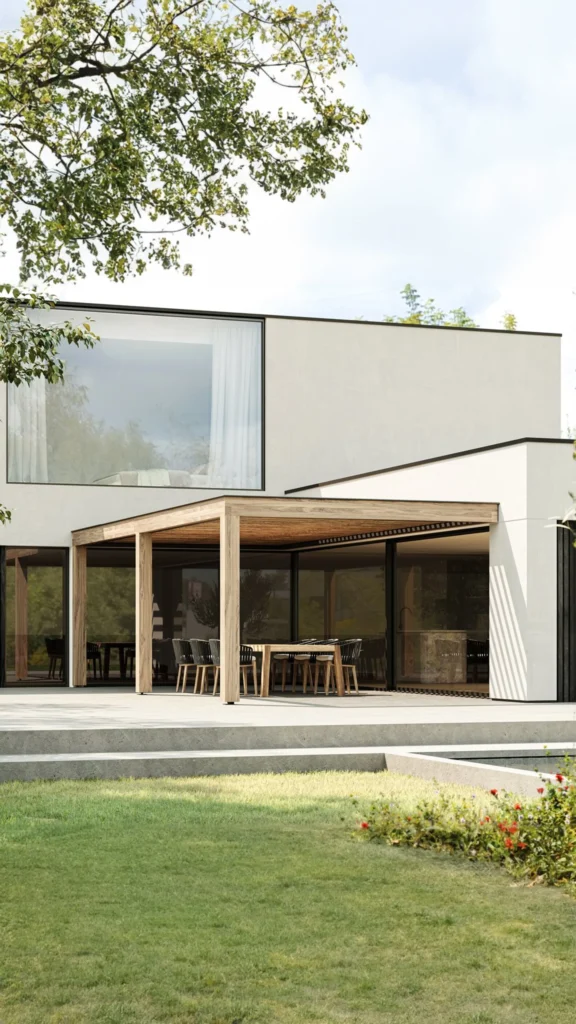
Modern architecture is undergoing a profound shift from static structures to responsive environments. At the heart of this evolution is the concept of the "living building skin": a facade that breathes, adapts, and manages the relationship between the interior and the external elements. Among the most sophisticated expressions of this movement is the motorized timber louvre system.
This is not simply a shading layer. It is a structural assembly that must resolve span, wind load, water management, movement control, and long-term dimensional stability in one coordinated package. The performance of the system depends as much on the engineering of the posts, beams, blade geometry, and drainage paths as it does on the visual appeal of the timber itself.
By combining the warmth of natural wood with precise mechanical design, these systems offer a solution that addresses both environmental control and architectural flexibility. This exploration focuses on the structural logic, functional detailing, and retrofit potential of the modern timber louvre.
In the past, the use of timber in external shading systems was often met with hesitation. Untreated wood is susceptible to the elements: warping, rotting, and silvering unevenly when exposed to high UV and moisture. However, the advent of thermal modification has fundamentally changed the viability of timber in high-end architectural applications.
Thermal ash has emerged as the gold standard for high-performance louvres. This process involves heating the timber to temperatures exceeding 200°C in an oxygen-free environment. This is not a chemical treatment; it is a structural transformation of the wood’s cellular makeup.
When specified in a louvre system, these properties ensure that architectural precision is maintained over decades. The blades remain perfectly straight, ensuring the motorization mechanisms are never strained by warped or twisted material.

While the timber defines the visual character, the system succeeds or fails on its load path and mechanical coordination. A motorized louvre roof or screen is not a loose collection of slats. It is a framed assembly in which blade weight, wind pressure, torsion, and water loads must be transferred cleanly through pivots, side channels, beams, and posts into the supporting substrate.
For larger openings, structural proportion matters. As spans increase, slender framing quickly becomes the weak point. Deflection in beams can misalign blade pivots, overload drive components, and compromise weather sealing. That is why robust louvre systems typically rely on large-format posts and beams rather than visually lightweight sections pretending to do structural work.
Specify the frame around the actual engineering demands:
In practical terms, larger louvre roofs and wide architectural openings generally require a deliberate hierarchy:
If that hierarchy is ignored, operational smoothness is usually the first thing to fail.
The mechanics of the blades are central to weather performance. In open mode, the blades act as adjustable shading elements. In closed mode, they must behave more like a controlled roofing surface. That transition only works when the blade profile is engineered to do more than rotate.
High-performing systems use interlocking blade geometry. As the blades close, adjacent profiles overlap or nest into each other, reducing capillary entry points and limiting direct water penetration. This interlock also helps manage tolerances across long runs, where even minor inconsistencies in alignment can create leakage paths.
Key functional requirements include:
This is where engineering detail matters more than appearance. A visually clean blade profile that lacks proper overlap may perform well as a sunshade but poorly as a rain-management system.
Rain protection is never achieved by the blades alone. Water must be collected, directed, and discharged in a predictable sequence. Well-designed louvre systems use integrated drainage channels built into the surrounding frame so water moves away from the occupied zone rather than falling through it.
The typical drainage path works like this:
This hidden drainage strategy is what separates a true all-weather assembly from a simple operable shade structure. It also affects detailing at every edge condition. Interface points with walls, fascias, soffits, and paving must all accommodate water exit and maintenance access.
The shift toward biophilic design: the practice of connecting building occupants more closely to nature: is a primary driver for the preference of timber over synthetic alternatives. While aluminum louvres offer durability and a sleek, industrial aesthetic, they often lack the tactile and psychological benefits of natural wood.
Timber louvres soften the hard lines of modern glass and concrete. They introduce a textural rhythm that changes as the light shifts, creating a dynamic interplay of shadow and warmth. In residential settings, this materiality transforms a functional shade device into a focal design feature that enhances well-being.
For architects and developers, the choice between timber and aluminum often comes down to the intended "language" of the project. While both materials serve a functional purpose, their performance profiles differ:
The modern timber louvre is rarely a standalone element. In high-end residential and commercial projects, these systems are integrated into broader building management systems (BMS).
Through the use of weather sensors: specifically wind and rain detectors: the louvre system can act autonomously. If sensors detect a certain threshold of rain, the louvres can automatically close to protect outdoor furniture or balcony spaces. Conversely, during high-wind events, the blades can tilt to a neutral position to reduce wind load on the structure, demonstrating a marriage of architectural precision and functional safety.
This automation is particularly relevant for large-scale facades. When hundreds of timber blades move in perfect unison, the building appears to "blink" or "shimmer," creating a kinetic art installation that serves a critical environmental purpose.
The application of motorized timber systems extends beyond the traditional roof structure. Architects are increasingly utilizing these systems in vertical orientations to create "breathable" walls.
One of the most useful characteristics of a well-engineered louvre system is its modularity. Because the assembly is made up of repeatable structural bays, coordinated blade sets, and integrated perimeter framing, it can be adapted to existing buildings without requiring a full rebuild of the surrounding architecture.
This makes louvres especially relevant in retrofit scenarios where the goal is to upgrade usability rather than start from scratch. Existing patios, courtyards, terraces, roof decks, and facade edges can often be reworked by attaching modular louvre zones to new support frames or to verified structural substrate.
For retrofit planning, focus on four requirements:
The modular approach also supports future alteration. Additional bays, side screens, or infill elements can be integrated later if the original structural grid and drainage logic have been planned properly.
In an era where sustainability is a non-negotiable aspect of high-end design, the sourcing of materials is paramount. Utilizing thermal ash supports a circular economy. Because the modification process is purely physical (heat and steam), the timber remains completely recyclable at the end of its life cycle, unlike chemically treated woods which may be classified as hazardous waste.
Furthermore, the longevity provided by European engineering ensures that the system does not need frequent replacement. High-torque motors, robust aluminum internal frames, and stabilized timber blades represent a long-term investment in the property’s value and performance.

The evolution of the timber louvre from a simple wooden slat to a motorized, thermally-modified kinetic system represents a major advance in responsive architectural enclosure.
By prioritizing structural clarity, functional detailing, and the innate beauty of natural materials, designers can create spaces that do more than look refined. They can perform with precision under real environmental loads, adapt to existing architecture, and deliver durable control over light, air, and rain.


