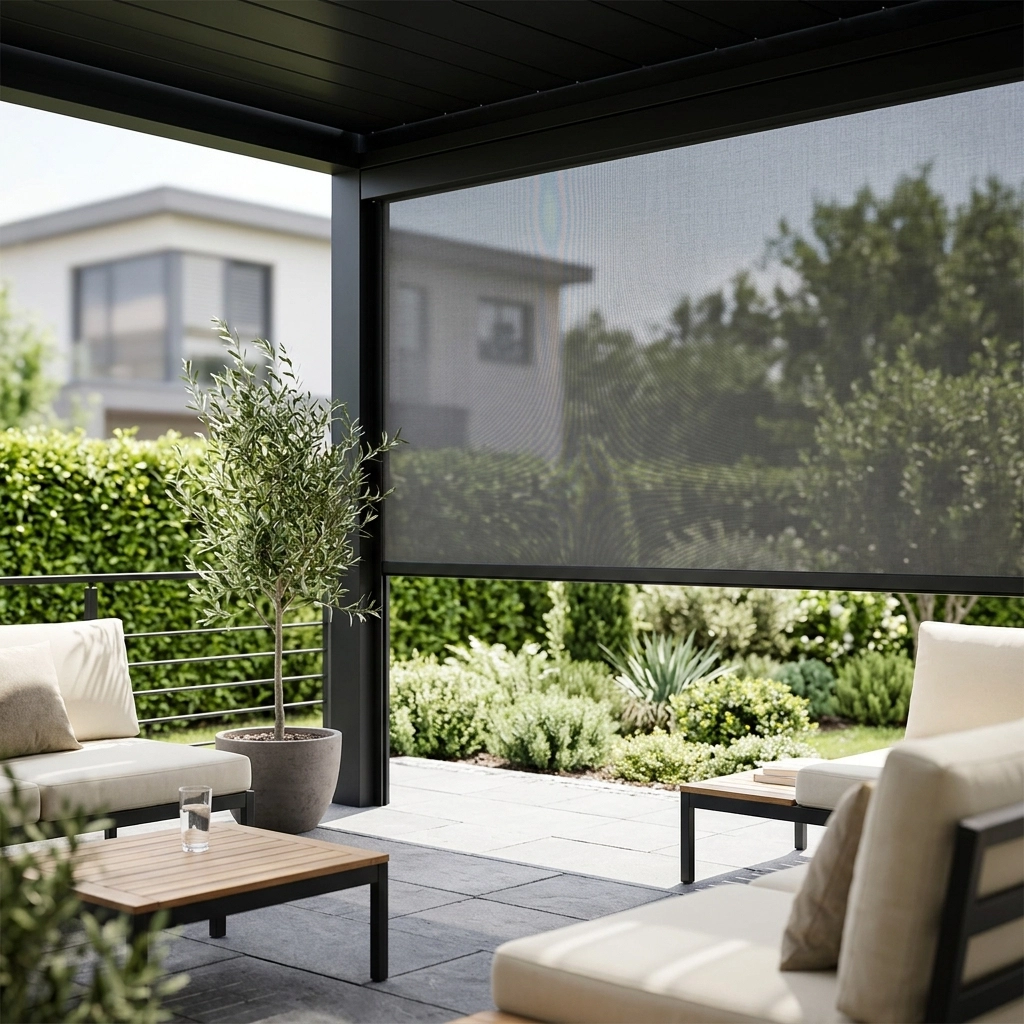
Outdoor Privacy Blinds: How to Block the Neighbours Without Blocking the Breeze
April 29, 2026
Spread the love
Creating a private sanctuary in your backyard often feels like a game of trade-offs. You want to shield your patio from the prying eyes of the neighbours, but you don't want to turn your outdoor living area into a stifling, windowless box. The challenge lies in finding a solution that offers visual density while maintaining the natural ventilation that makes being outside enjoyable.
Modern outdoor privacy blinds have evolved to solve this specific engineering problem. By utilizing advanced textile technology and precise installation methods, it is now possible to create a "one-way" privacy effect that allows air to circulate freely while keeping your private life hidden. This guide explores the technical aspects of selecting and installing outdoor shading solutions that master the balance between seclusion and airflow.
Understanding the "Openness Factor"
The most critical technical specification you will encounter when researching outdoor blinds is the openness factor. This is expressed as a percentage and refers to the weave density of the fabric. It essentially dictates how much "hole" there is versus "fabric" in the mesh.
1% to 3% Openness: These are tightly woven fabrics. They provide the highest level of privacy and block the most wind. While they are excellent for stopping rain spray and providing near-total visual blockage, they can significantly restrict the breeze.
5% Openness: Widely considered the "industry sweet spot" for residential use. This level of weave provides excellent daytime privacy: making it difficult for anyone outside to see in: while allowing a consistent flow of air to pass through the mesh.
10% to 14% Openness: These are much looser weaves. They are designed for areas where wind management and visibility are the priority over total privacy. You will still have a "screened-in" feel, but shapes and movements will be more visible from the outside.
Selecting the right percentage is a strategic decision. If your outdoor area is positioned very close to a high-traffic boundary, a 5% weave is usually the minimum required for comfort. If your goal is simply to soften the view of a distant house while maximizing a cool summer breeze, a 10% weave may be more appropriate.
The Science of Mesh and Airflow
It might seem counterintuitive that a physical barrier can block vision while letting air through. This works because of the aerodynamics of micro-perforated fabrics. High-quality outdoor shading solutions use synthetic yarns: often a combination of polyester and PVC: that are woven into a grid.
When wind hits the mesh, the individual strands break up the air pressure. A portion of the air passes through the microscopic gaps, while the rest is deflected. This creates a filtered breeze rather than a harsh gust. This filtering effect is actually beneficial; it prevents the "wind tunnel" effect often found on open decks while ensuring the space doesn't become stagnant and hot.
Thermal Comfort and Heat Dissipation
Another technical advantage of mesh outdoor blinds is their ability to manage heat. Solid barriers, like timber fences or plastic sheeting, can trap heat through a process called thermal mass or the greenhouse effect. Mesh fabrics, however, allow hot air to rise and escape through the weave. This continuous air exchange is what keeps a screened-in porch several degrees cooler than a fully enclosed room.
Strategic Hardware Selection
The effectiveness of your privacy blinds isn't just about the fabric; it’s about how that fabric is held in place. To maintain airflow without the blinds flapping uncontrollably in the wind, specific hardware systems are required.
Side-Channel Systems: These are the gold standard for modern outdoor installations. The fabric is locked into vertical side tracks. This eliminates gaps at the edges (improving privacy) and ensures the blind remains tensioned. Because the blind is secure, you can leave it partially open at the bottom to "scoop" more breeze into the area if needed.
Weighted Bottom Bars: A heavy-duty bottom rail ensures the fabric hangs flat. This prevents the "billowing" effect that can occur when wind catches a loose screen.
Cable Guide Systems: If side tracks aren't aesthetically suitable for your architecture, stainless steel cables can be used to guide the blind. This offers a more minimalist look while still providing enough stability to handle moderate breezes.
Caption: A generic technical diagram showing filtered airflow moving through privacy mesh to reduce pressure while maintaining ventilation.
Color Theory: Privacy and Visibility
A common mistake in choosing outdoor blinds is assuming that darker colors block more view. In reality, the physics of light works differently.
Darker Fabrics (Charcoal, Black, Bronze): These offer the best "view-through" from the inside looking out. Because dark colors absorb light rather than reflecting it, your eyes can focus past the mesh on the landscape beyond. However, for those outside looking in, the dark surface creates a visual void that is very difficult to see through during the day.
Lighter Fabrics (White, Cream, Grey): These reflect more light. While they are superior for heat reflection (keeping the space cooler), they can be harder to see through from the inside because of the glare on the fabric. They provide excellent daytime privacy but can sometimes feel more "enclosed" than a dark mesh.
To achieve the goal of blocking neighbours without feeling "boxed in," a dark 5% openness mesh is generally the most effective professional recommendation.
Manual vs. Motorized Operation
How you operate your blinds impacts how often you’ll use them to manage your environment.
Manual Crank: Reliable and cost-effective. It allows for precise positioning. If you feel the breeze dropping, you can quickly raise the blind a few inches to increase air intake.
Motorization: This allows for "smart" airflow management. Many high-end systems can be integrated with wind sensors. If the breeze turns into a gale, the sensors will automatically retract the blinds to protect the mechanism. Conversely, you can set timers to lower the blinds just as the sun hits a certain angle, ensuring your privacy is maintained without you having to lift a finger.
Technical Installation Tips for Maximum Airflow
To ensure you don't accidentally block the breeze entirely, consider these professional installation strategies:
The "Gap" Technique: If total insect protection isn't required, leaving a small 50mm to 100mm gap at the top or bottom of the installation can significantly increase the venturi effect, pulling cool air through the space.
Staggered Heights: If you have multiple blinds, you don't always have to have them all at the same level. Lowering the blinds on the side facing the neighbours while keeping the "garden-facing" blinds halfway up creates a cross-breeze that flushes out hot air.
Corner Integration: Avoid sealing corners airtight unless necessary. Allowing a small amount of "bleed" at the corners of a pergola or deck can prevent the air from becoming pressurized and stagnant inside the enclosure.
Maintenance for Longevity
Because outdoor privacy blinds are designed to let air through, they also act as a filter for dust and pollen. Over time, the microscopic holes in the mesh can become clogged, which reduces airflow and can eventually degrade the fabric.
Regular Rinsing: Use a low-pressure hose to rinse the mesh every few months. This keeps the "pores" of the fabric open.
Avoid Chemicals: Harsh cleaning agents can strip the UV coating from the PVC-coated yarns. Use only mild soapy water and a soft brush.
Dry Before Rolling: Always ensure the blinds are dry before retracting them for long periods. While the mesh is designed for outdoor use, trapping moisture inside a rolled-up blind can encourage mold growth in the small gaps of the weave.
Summary of Key Takeaways
Successfully blocking the neighbours while keeping the breeze requires a technical approach to material and hardware selection. Keep these points in mind for your project:
Prioritize a 5% openness factor for the ideal balance of privacy and ventilation.
Opt for darker mesh colors to maintain your view of the outdoors while preventing others from seeing in.
Utilize side-channel hardware to keep the fabric tensioned and stable in windy conditions.
Consider the orientation of your space; choose lighter colors for North-facing areas that require high heat reflection, and darker colors for East/West orientations where glare and view-through are the priority.
Maintain the fabric by regular rinsing to ensure the weave stays clear for optimal air exchange.
By focusing on the technical specifications of the fabric and the precision of the installation hardware, you can transform an exposed deck or patio into a private, breezy retreat that functions perfectly throughout the seasons.