
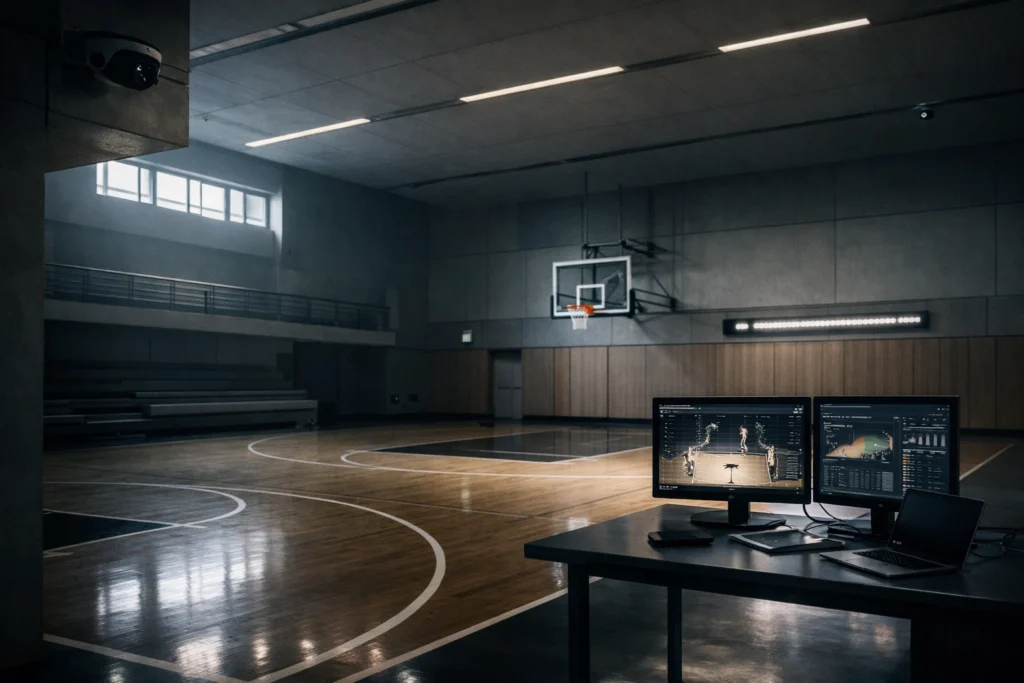
The sideline of a school rugby match or a local club basketball game used to look remarkably similar: a dedicated parent or an assistant coach standing on a rickety ladder, squinting through a viewfinder, trying to keep a fast-moving ball in the center of a shaky frame. This manual approach to sports recording was fraught with human error, poor angles, and a significant lag in delivery.
By the time the footage was uploaded and edited, the "teachable moment" had often passed.
Today, the landscape of sports education and performance analysis is undergoing a fundamental shift. Schools, regional clubs, and sports directors are increasingly moving away from manual recording in favor of AI-driven motion tracking systems. This pivot is not merely about convenience; it is a strategic move toward data-backed pedagogy and professional-level accessibility for athletes at every level.
For decades, the "game tape" was a grainy, low-resolution necessity. The challenges were twofold: logistics and quality. Relying on volunteers or students to film meant that critical plays were often missed when the camera operator was distracted. Furthermore, a single fixed-point camera rarely captures the tactical depth of a game: the spacing of the defense, the off-ball movement of the wingers, or the subtle shifts in team formation.
The transition to automated systems removes the "human bottleneck." Modern sports facilities are now being designed with integrated optical sensors and AI processors that act as an "always-on" observer. This evolution ensures that every second of play is captured with surgical precision, allowing coaching staff to focus on the athletes rather than the equipment.
To understand why this shift is happening, one must understand the technical architecture behind AI sports analysis. Unlike traditional cameras that require a person to pan and tilt, AI systems utilize computer vision and deep learning algorithms to understand the game in real-time.
In an educational setting, sports are a laboratory for physical and mental development. Sports directors are finding that AI-driven analysis is a powerful pedagogical tool.
Personalized Feedback Loops
Research indicates that AI-assisted teaching can increase student motivation by up to 30%. When a student can see their own movement patterns side-by-side with professional benchmarks, the abstract concepts of "form" and "technique" become tangible. AI systems allow for the immediate breakdown of a jump shot or a sprinting gait, providing a visual feedback loop that is far more effective than verbal instruction alone.
Tactical Intelligence
AI doesn't just record video; it generates data. It can track player density, passing lanes, and territorial dominance. For school teams, this means teaching "game sense" through empirical evidence. Coaches can show players a heat map of their movements, highlighting where they were most effective and where they were caught out of position.
Injury Prevention and Load Management
One of the most significant advantages for schools is the ability to monitor athlete welfare. By analyzing movement patterns, AI can identify signs of fatigue or irregular gaits that might indicate a budding injury. Reducing injury risk by identifying overload is a key priority for institutions responsible for student wellbeing.
For architects and facility renovators, the integration of AI sports tracking is now a standard requirement in the design phase. A "smart" sports facility requires more than just a court; it requires a digital infrastructure that supports high-level analysis.
While AI systems are becoming more sensitive to low light, high-end analysis still thrives on consistent lux levels across the entire playing surface. Renovators must ensure that lighting design eliminates "dead zones" where the AI might lose track of a player's silhouette.
Historically, high-end sports analysis was the exclusive domain of professional franchises with multi-million dollar budgets. The pivot toward AI-driven systems has effectively democratized professional-grade data.
Local clubs and secondary schools now have access to the same metrics used in the NFL or the Premier League. This leveling of the playing field has profound implications for talent identification. A scout in a major city can now review a high-resolution, AI-tracked stream of a player in a rural district, ensuring that talent is recognized regardless of geography.
Beyond the technical and educational benefits, the operational shift is undeniable. For sports directors, the "headache" of managing game-day media is largely solved by automation.
The transition from manual filming to AI-driven sports analysis represents a milestone in the evolution of athletic facilities. By removing the limitations of human-operated cameras, schools and clubs are gaining access to a level of detail and data that was previously unimaginable.
The move toward these systems is driven by:
For those involved in the design and management of sports spaces, the message is clear: the sideline is no longer just a place for spectators; it is a sophisticated data-gathering hub. Investing in the infrastructure to support AI motion tracking is no longer an "extra"( it is the baseline for any modern athletic environment.)


