
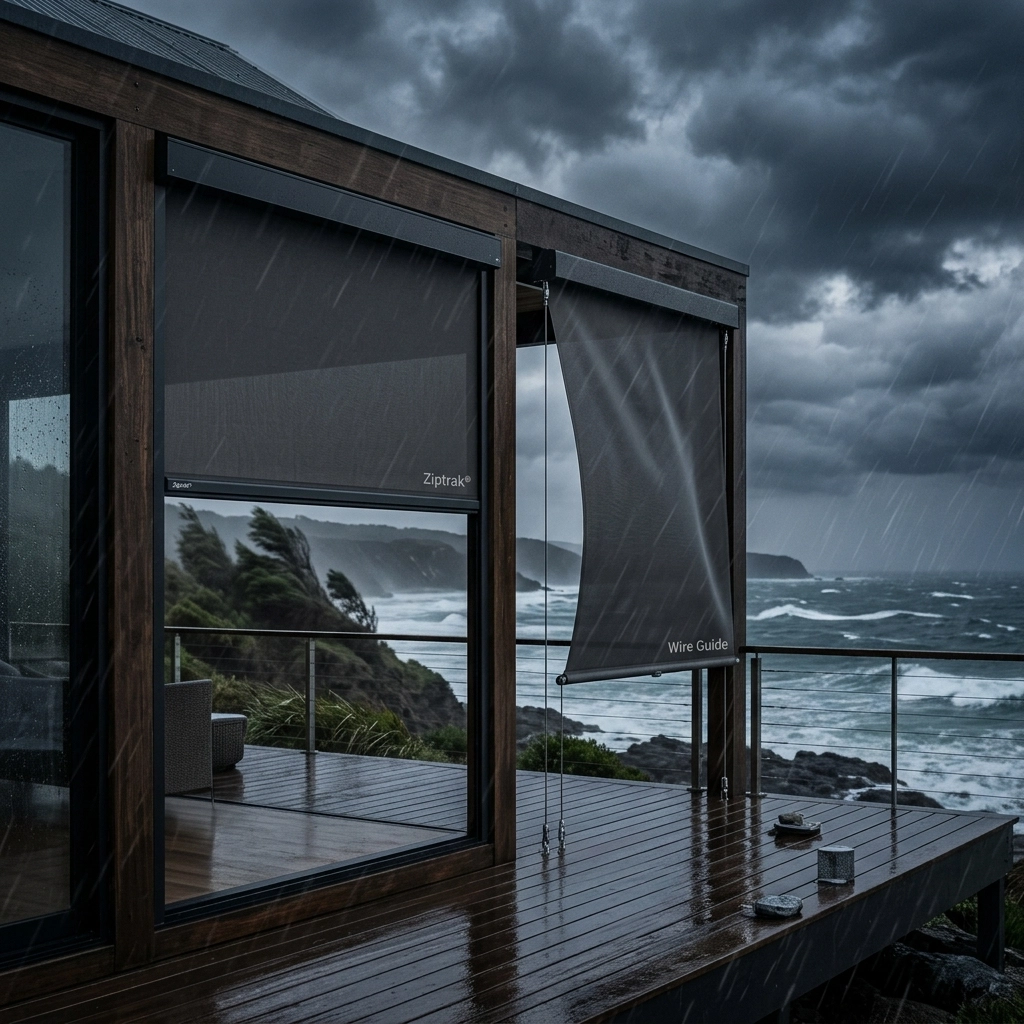
For homeowners and commercial designers looking to maximize usable square footage, outdoor shading solutions are no longer a luxury: they are a necessity. However, in regions prone to sudden weather shifts and high-velocity winds, the choice of hardware becomes a question of structural survival rather than just aesthetics.
The two heavyweights in the outdoor blinds industry are track-guided systems (often referred to as Ziptrak-style) and wire-guided systems. While both offer sun protection and privacy, their performance during a storm differs significantly due to their fundamental mechanical designs. This guide breaks down the technical engineering of both systems to determine which one truly stands up to the elements.
Track-guided systems are engineered for total enclosure. The defining characteristic of these custom outdoor blinds is the side channel. Unlike traditional blinds that hang freely, track-guided systems utilize a side-spline or "zipper" mechanism that is welded to the edge of the fabric. This spline is fed into a vertical aluminum track, effectively locking the fabric in place along its entire height.
Because the fabric is physically secured within the side tracks, there is zero gap between the blind and the structural posts. This creates a pressurized seal. During a storm, this design prevents the wind from getting "behind" the fabric. In fluid dynamics, this is critical because it minimizes the lift and drag forces that usually cause blinds to fail.
Most high-end track-guided systems are spring-balanced. This allows the blind to be left at any height, but when fully lowered and locked, the tension is distributed evenly across the side tracks rather than pulling solely on the bottom bar.

Wire-guided outdoor blinds offer a more minimalist, industrial aesthetic. Instead of bulky side channels, they utilize 3.16 marine-grade stainless steel cables that run vertically from the top hood to a fixed point at the bottom (usually the floor or a deck railing).
The bottom bar of the blind features eyelets or "stoppers" that slide up and down the tensioned wires. This prevents the blind from swinging wildly in a light breeze, maintaining the vertical trajectory of the fabric during operation.
Unlike track-guided systems, the stability of a wire-guide blind relies entirely on the tension of the wires and the weight of the bottom bar. There is no lateral (side-to-side) connection between the fabric and the environment. This results in "gaps" on either side of the fabric, which are necessary for the blind to move but act as entry points for wind and rain.
When comparing survival rates, the numbers speak for themselves. Most standard wire-guided systems are rated for winds only up to 30 km/h. Beyond this point, the fabric begins to act like a sail. Because the sides are not secured, wind can wrap around the edges, causing the "parachuting" effect.
In contrast, premium track-guided systems are often rated to withstand winds upwards of 160 km/h when fully deployed and locked. Some static load tests have even shown these systems surviving pressures equivalent to 260 km/h. This makes them the primary choice for coastal properties or high-altitude decks where wind gusts are unpredictable.
A "blow-out" occurs when the wind pressure exceeds the structural integrity of the blind, forcing the fabric out of its guides or snapping the hardware.
In an extreme storm, a track-guided blind is more likely to stay intact until the point of fabric failure. The risk here is the spline pulling out of the track. However, modern designs use "keder" or heavy-duty zip-locks that make this nearly impossible under normal storm conditions. If a blow-out does occur, it is often a "designed failure" to protect the building's structure from being pulled down by the sheer force of the wind on the blind.
Wire-guided systems are highly susceptible to blow-outs. Because the fabric is only held at the top and bottom, high winds cause the center of the fabric to bow significantly. This creates immense stress on the mounting brackets. If the wind catches the blind from the side, it can force the eyelets to jam or the wires to snap. In a storm, a wire-guided blind that is left down is almost guaranteed to suffer hardware damage.

A storm isn't just about wind; it’s about horizontal rain and flying debris.
If you are located in a high-wind zone, the installation method is just as important as the product choice.
To ensure your outdoor shading solutions survive a decade of storms, regular maintenance is required.
If your priority is survival and functional use during inclement weather, the track-guided system is the clear winner. Its ability to lock the fabric into a structural channel transforms the blind from a simple shade into a protective wall. It handles the physics of wind pressure by distributing the load across the entire vertical length of the track.
Wire-guided blinds remain an excellent choice for calm environments where a minimalist look is preferred, or where privacy is needed without the requirement for a total weather seal. However, they are "fair-weather" products. In a storm, a wire-guided blind must be retracted to avoid damage, whereas a track-guided system can remain deployed, protecting your furniture and your home.


