
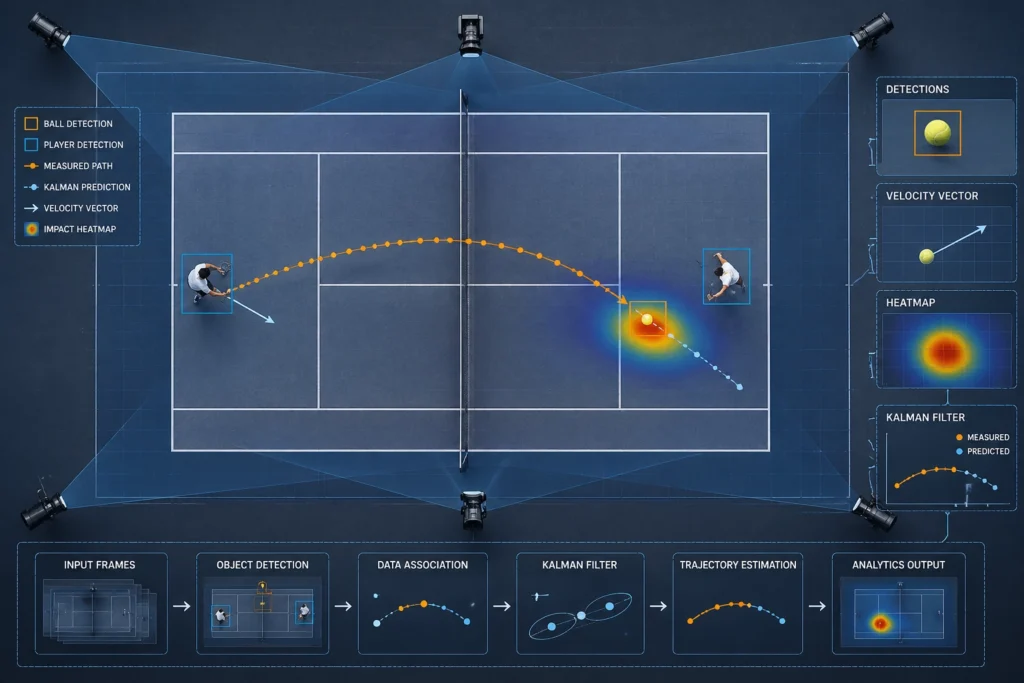
In the modern era of sports analytics, the ability to track a ball with millimetre precision at high velocities has transformed everything from professional scouting to automated broadcasting. Whether it’s a tennis ball traveling at 200 km/h or a basketball arc during a 3x3 match, the underlying technology relies on a complex marriage of Computer Vision (CV) and Artificial Intelligence (AI).
To the naked eye, a camera simply records motion. However, to an AI tracking system, every frame is a massive data set that must be parsed, filtered, and predicted in real-time. This guide explores the technical engineering and specific tracking algorithms that allow AI to "see" and follow sports movement with superhuman accuracy.
Before an AI can follow a ball, it must first be able to find it. Technical systems differentiate these into two distinct phases: Detection and Tracking.
In high-speed sports, detection alone isn't enough because motion blur can make a ball look like a smudge. Tracking algorithms must use physics and probability to fill in the gaps.
At the heart of modern ball detection are Convolutional Neural Networks (CNNs). Specifically, the industry has gravitated toward YOLO (You Only Look Once) architectures.

One of the greatest challenges in sports AI is that the ball is often the smallest object in the frame. In a 4K wide-angle shot of a basketball court, a ball might only occupy 0.01% of the total pixel area. Standard AI models often "miss" these tiny objects. To combat this, engineers use two primary techniques:
Instead of feeding a massive 4K image into the AI: which would require immense processing power: the system slices the frame into overlapping tiles. Each tile is processed independently at its native resolution, effectively "zooming in" so the AI can detect the ball with higher confidence.
For extremely fast sports like badminton or tennis, traditional "bounding box" detection (drawing a square around the ball) often fails due to motion blur. Systems like TrackNet use a heatmap approach. Instead of a box, the AI generates a probability map where the brightest point indicates the most likely position of the ball. By analyzing three consecutive frames simultaneously, the heatmap can account for the "streak" left by a high-speed ball.
Once the AI has detected the ball in several frames, it must "lock on." This is where tracking-by-detection algorithms come into play.
DeepSORT combines motion information with visual appearance. It uses a Kalman Filter to predict where the ball should be in the next frame based on its current velocity. If a detection appears near that predicted spot, the AI associates it with the existing "track."
In sports, objects are frequently occluded (hidden). A basketball might disappear behind a player's back or a hoop. ByteTrack is a motion-centric algorithm that excels here. It doesn't just look for "high-confidence" detections; it also looks at "low-confidence" detections: those blurry or partially hidden pixels: and uses the trajectory history to recover the ball's path.

Perhaps the most essential mathematical tool in the AI’s arsenal is the Kalman Filter. This is a recursive mathematical algorithm that operates in two steps:
This is why high-end sports cameras can track a ball even if it goes out of frame or is hidden behind a player for a split second. The "track" continues to exist in the AI's "imagination" until the ball reappears and confirms the path.
Software is only as good as the data it receives. To achieve professional-grade tracking, the hardware must meet specific technical thresholds.
For those looking to implement this in a recreational or professional setting, the core requirement is hardware that provides the necessary resolution and frame rates to support these high-level algorithms.
In outdoor sports, the AI faces challenges that indoor systems don't. Sunlight, shadows, and rain can all create "noise" in the data.
AI ball tracking is not a single technology but a stack of interlocking engineering solutions. By combining high-speed computer vision for detection with physics-based mathematical models for tracking, these systems can provide unprecedented insights into game performance.
Understanding these underlying mechanisms is the first step for any facility manager or coach looking to integrate automated sports technology into their environment. As tracking algorithms continue to evolve, the line between human observation and digital precision will only continue to blur.


