
You're probably looking at a patio, deck, or patch of lawn that gets used far less than it should. In summer it's too hot by midday. In shoulder seasons a light wind makes dinner outside feel like a bad idea. Then a quick shower rolls through and everyone heads back indoors carrying plates, cushions, and frustration.
That's the gap a well-designed outdoor room fills. In the New Zealand context, it isn't just a covered area. It's a controlled space that handles sun, wind, privacy, rain, and seasonal comfort well enough to ensure you use it. That could mean family dining beside the kitchen, a spa zone with screening, a compact courtyard retreat, or a commercial hospitality area that needs to stay functional when the weather turns.
Kiwis already place a clear value on outdoor life. The New Zealand sport and outdoor recreation sector generates an estimated $4.9 billion per annum, equal to 2.3% of national GDP, according to Sport New Zealand's economic value report. That broader culture matters when planning an outdoor room in NZ. You're not chasing a trend. You're investing in a space that fits how people here want to live.
If you're still shaping ideas, a visual planning tool like ai backyard patio design can help test layouts before you talk to a supplier, builder, or council. That's useful when you need to compare a dining-focused layout against a lounge, cooking, or wellness setup without committing too early.
An underused patio usually isn't a furniture problem. It's a shelter problem, or a planning problem. People often start by buying a table set, an umbrella, or a heater, then realise the space still doesn't work because the afternoon sun is too harsh, the prevailing wind cuts through from one side, or the rain comes in at an angle.
A proper outdoor room fixes those issues by treating the area like part of the house. It has a clear function, a roof strategy, side protection where needed, materials that suit the site, and enough comfort built in that you don't abandon it for half the year. That's the difference between a backyard feature and a living space.
Across Auckland, Wellington, Tauranga, Christchurch, and smaller coastal towns, the same pattern shows up. Homeowners have decent outdoor area but poor usability. The deck may be large enough, the connection to the kitchen may be good, and the view may be worth protecting, but the space only works on still, mild days.
That's why the best outdoor room projects start with this question: what makes this area unusable right now?
Sometimes it's one thing. More often it's a mix:
Practical rule: If you can't name the specific weather problem, you'll probably buy the wrong structure.
The outdoor room NZ projects that work well are rarely the most elaborate. They're the ones where roof form, side screening, access, furniture placement, and lighting all support one main use. A dining space needs clearance, service access, and protection over the table. A lounge zone needs softer edges, lighting, and often more wind control. A spa or sauna area needs privacy, drainage awareness, and a more deliberate approach to enclosure.
That's also why these projects make sense beyond aesthetics. In a country where outdoor activity is tied so closely to lifestyle and the wider economy, adding a more usable external living zone aligns with how people already want to use their property.
A successful project starts before you compare pergolas, blinds, or louvre roofs. Most expensive mistakes happen because the brief is vague. People say they want “more shelter” when what they need is evening shade, privacy from an upstairs neighbour, and a dry path between the ranchslider and the BBQ.
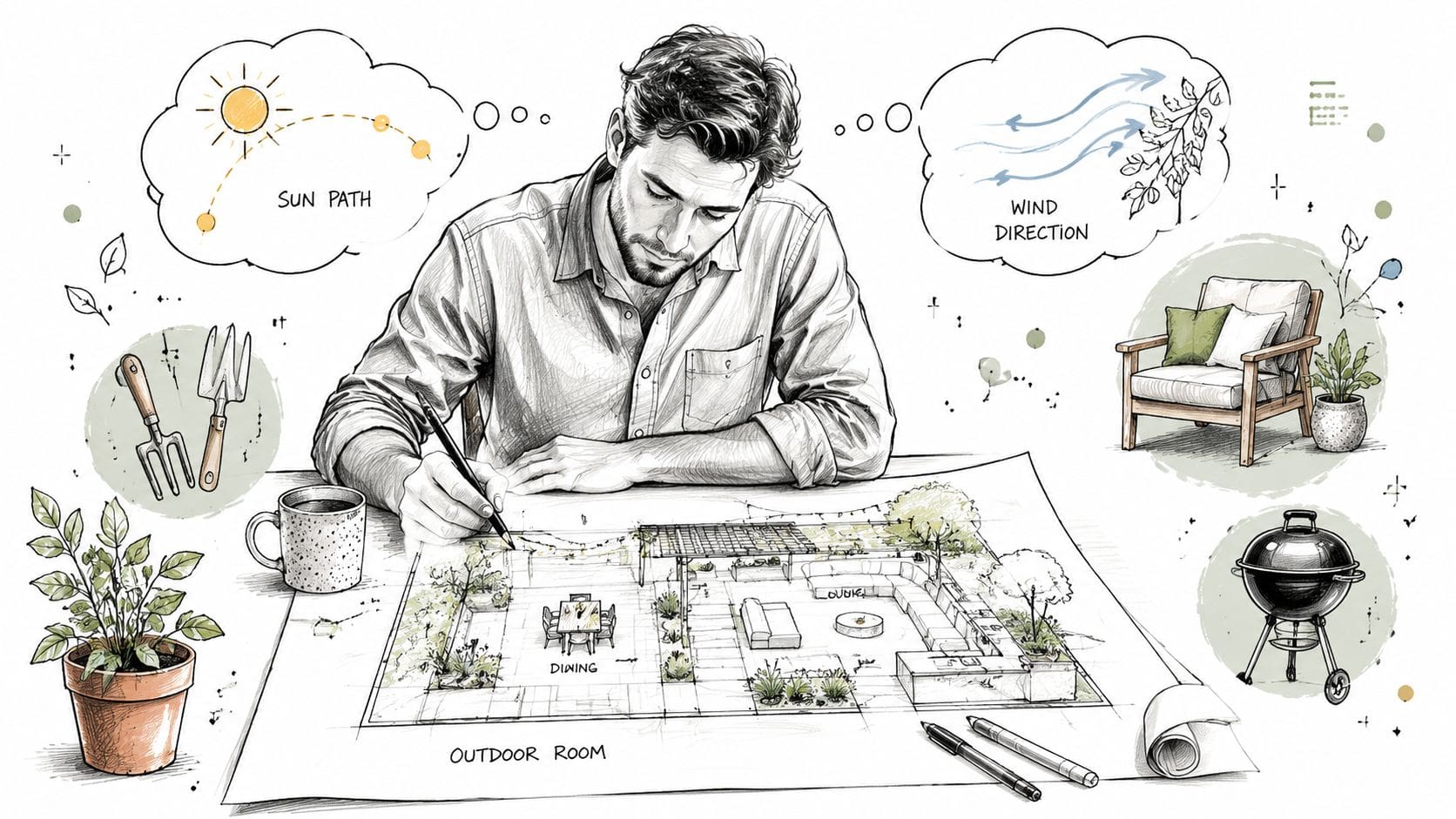
Stand in the space at different times of day. Early morning, mid-afternoon, and early evening tell you different things. If you only assess the site once, you'll miss the conditions that matter most.
Use a simple checklist:
Track the sun
Note where direct sun lands in summer and winter. Focus on the hours you'll use the space. Breakfast courtyards and late-afternoon entertaining zones need different shade responses.
Watch the wind path
Don't just note the direction. Notice how the wind enters, where it accelerates, and which seating positions become unpleasant. A corner that feels sheltered while standing may be uncomfortable once you sit down.
Check privacy lines
Look from neighbouring windows, decks, and driveways back into your proposed room. Privacy issues are easier to solve early with screen placement than later with makeshift fixes.
Measure threshold points
Door positions, floor levels, gutter lines, downpipes, and eaves often dictate what's realistic. Smooth indoor-outdoor flow depends on these existing constraints.
Identify service needs
If you want heating, lighting, cooking, audio, or spa equipment, mark where power and any other services will need to run. Retrofitting these after the frame goes in is messy and often more expensive.
For visual inspiration once you know your site constraints, the Lucas Furniture guide to outdoor living designs is useful because it helps people compare mood, furnishing style, and layout logic rather than jumping straight to structure alone.
A good brief should be short enough to use and specific enough to stop bad decisions. If you can't explain the room in a few clear points, suppliers and installers will all interpret it differently.
Include these basics:
A project brief isn't paperwork for its own sake. It's what stops you paying for features that don't solve the real problem.
People often ask for a single project price too soon. That's understandable, but it isn't the most useful starting point. Budget by categories instead: structure, side protection, flooring, lighting, heating, furniture, and site works. That shows quickly where the money is going and where trade-offs make sense.
A tight budget often still delivers a strong result if the brief is disciplined. A larger budget gets wasted fast when the project keeps changing after procurement starts.
By the time winter rain starts blowing across the deck at a low angle, the right structure is the one that still lets you use the space.
The roof form sets the project up for success or compromise. In NZ conditions, that decision is less about style than weather behaviour, attachment method, and how the structure will be delivered. A supply-only kit can suit a simple, sheltered site with clear fixing points and an experienced builder. A full install is usually the safer route for exposed sites, tricky waterproofing junctions, or projects that need roof, screens, lighting, and drainage to work as one system.
Traditional pergolas give shape and presence, but they are only a frame unless you add more layers. They suit clients who want architectural definition over a deck or courtyard and are prepared to handle shade, rain cover, and side protection separately.
Fixed-roof pergolas work well where the brief is straightforward overhead shelter. They are a practical choice over an outdoor dining table, spa entry, or transition zone beside the house. The trade-off is less control over summer heat and ventilation once the roof is built.
Louvre roof systems offer the most control on sites that deal with shifting sun, variable wind, and frequent showers. That matters in many parts of New Zealand, where a space can move from glare to drizzle to still humidity in the same afternoon. For clients weighing flexibility against a simpler fixed option, this comparison of louvre roof versus fixed roof pergola systems is a useful reference.
Awnings suit smaller footprints and attached-to-house layouts where posts would get in the way. They can be a good answer for compact patios and apartments, but they usually stop short of creating a true room with a defined edge and strong weather protection.
Umbrellas and lighter shade systems are best treated as seasonal sun control. They help on calm days. They rarely hold up as the foundation of an outdoor room on sites with wind exposure or regular side rain.
Cost matters, but cheap structure can become expensive once extras are added to fix its limitations. Kit pergolas can make sense for value-led projects, especially when the site is flat, access is easy, and the brief is modest. Bespoke systems cost more, but they solve more, particularly where drainage, lighting integration, screen fitout, or difficult attachment details are involved.
| Structure Type | All-Weather Protection | Typical Cost | Flexibility | Best For |
|---|---|---|---|---|
| Open pergola | Low on its own | Lower to mid | Moderate when paired with add-ons | Architectural framing, vines, light shade |
| Fixed-roof pergola | Strong overhead shelter | Mid to higher | Lower once built | Reliable cover over dining or access areas |
| Louvre roof | High when adjusted well | Mid to higher | High | Mixed weather, all-season entertaining |
| Retractable awning | Moderate | Lower to mid | High for sun control | Compact patios, attached house zones |
| Large umbrella | Limited | Lower | Moderate | Small seating areas, temporary shading |
Many outdoor rooms underperform because the roof gets all the attention. On NZ sites, the edges often decide whether the space works in spring and winter.
Wind comes from the side. Late sun comes from the side. Rain drift comes from the side too.
Blinds, shutters, and privacy screens help control the conditions that a roof alone cannot manage:
Apollo NZ supplies louvre systems, pergolas, and outdoor blinds for residential and commercial projects. That combined offer is useful in practice because roof and side protection should be specified together, especially when you want clean junctions, consistent finishes, and fewer surprises during install.
For projects that need to last, the structure also needs to align with the compliance path. Clause B2 durability affects how long key building elements are expected to perform, so the decision is not only about appearance and shade. It is also about whether the system, fixings, and finishes are suitable for the site and service life.
A coastal outdoor room can look great at handover and start showing its weak points within a few seasons. Salt settles on surfaces, UV breaks finishes down, and trapped moisture finds every shortcut in the detailing. Material selection affects maintenance, service life, and how smoothly the project performs against Clause B2 durability expectations.
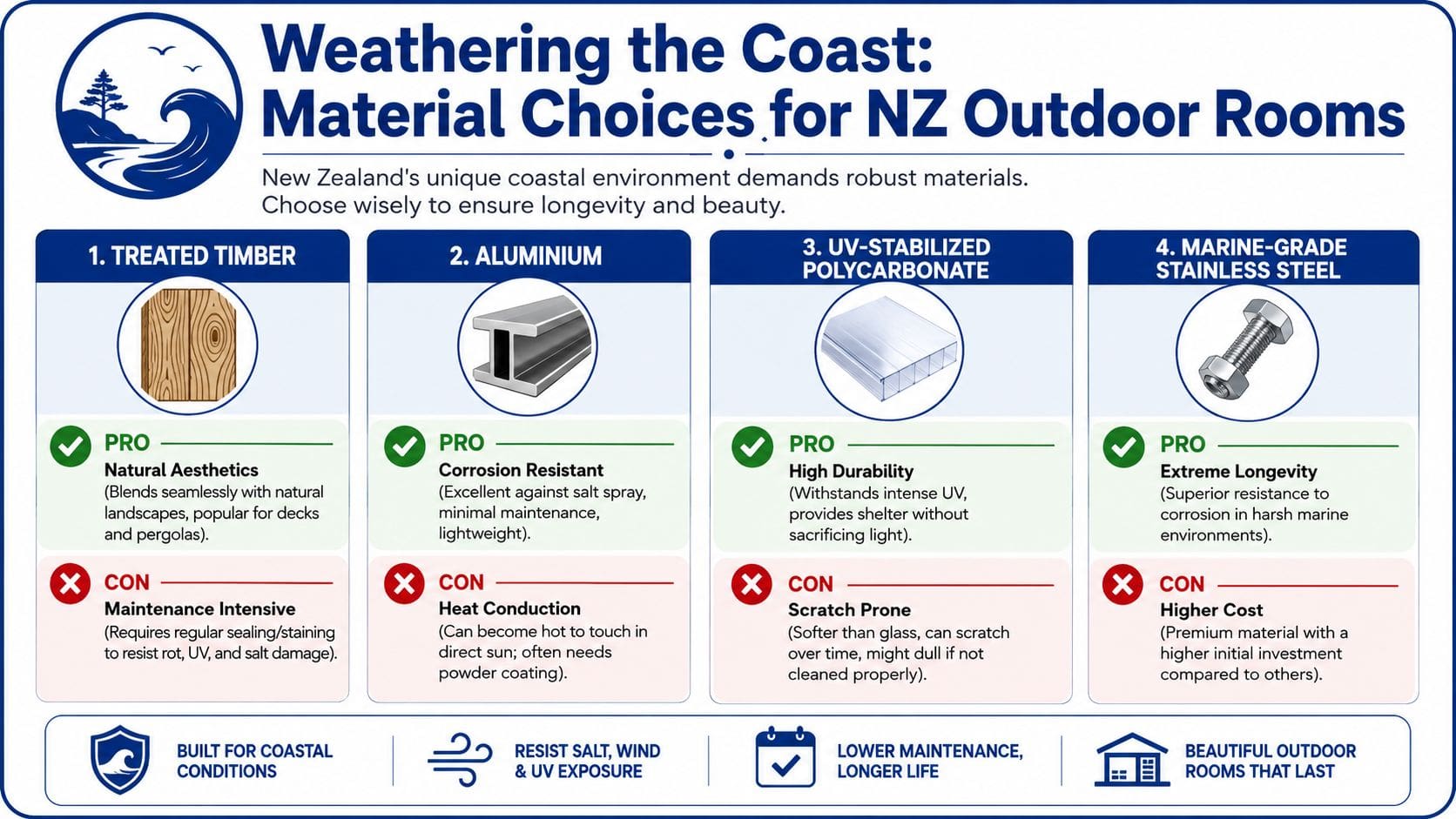
For many outdoor room NZ projects, powder-coated aluminium is the safest structural starting point. It does not absorb moisture, it stays dimensionally stable, and it suits louvre and framed systems where moving parts, clean lines, and low upkeep matter. On exposed sites, grade and coating quality matter just as much as the base material. This guide to T5-grade aluminium for NZ coastal properties explains why specification matters.
Failures usually start at the connections. Cheap fixings, mixed metals, unsealed cut edges, and poor drainage paths age faster than the main frame. On coastal builds, I specify the whole assembly, not just the visible surfaces, because the junctions decide whether the structure still looks sharp after years of salt, wind, and washdown.
Timber still earns its place on the right project. It brings warmth and can sit more naturally against villas, bungalows, and softer residential architecture. But it asks more of the owner and more of the installer.
Timber performs best where water can drain freely, end cuts are protected, and ongoing recoating is part of the plan. It becomes harder to justify on sites with frequent salt exposure, shaded damp corners, or lots of inaccessible joints where maintenance gets skipped.
That trade-off matters during procurement too. A supply-only package can look cheaper up front, but if the installer is left to solve junctions, fixings, and moisture detailing on site, the result depends heavily on their experience with coastal builds. Full install usually gives better control over interfaces, warranties, and finish consistency. On tougher sites, that control often saves money later.
A practical way to assess common material choices is:
Clause B2 is a useful filter here. The question is not only what looks right on day one. It is whether the materials, coatings, and fixings are suitable for the exposure zone and realistic for the maintenance level the owner will keep up with.
Materials rarely fail on their own. Water traps, dissimilar metal contact, blocked drainage, and exposed cut ends are usually where outdoor rooms start ageing badly.
A roof gives you shelter. Comfort comes from what you add after that. The best outdoor rooms feel easy to use because heating, lighting, seating, and cooking have all been thought through as one environment rather than purchased one item at a time.
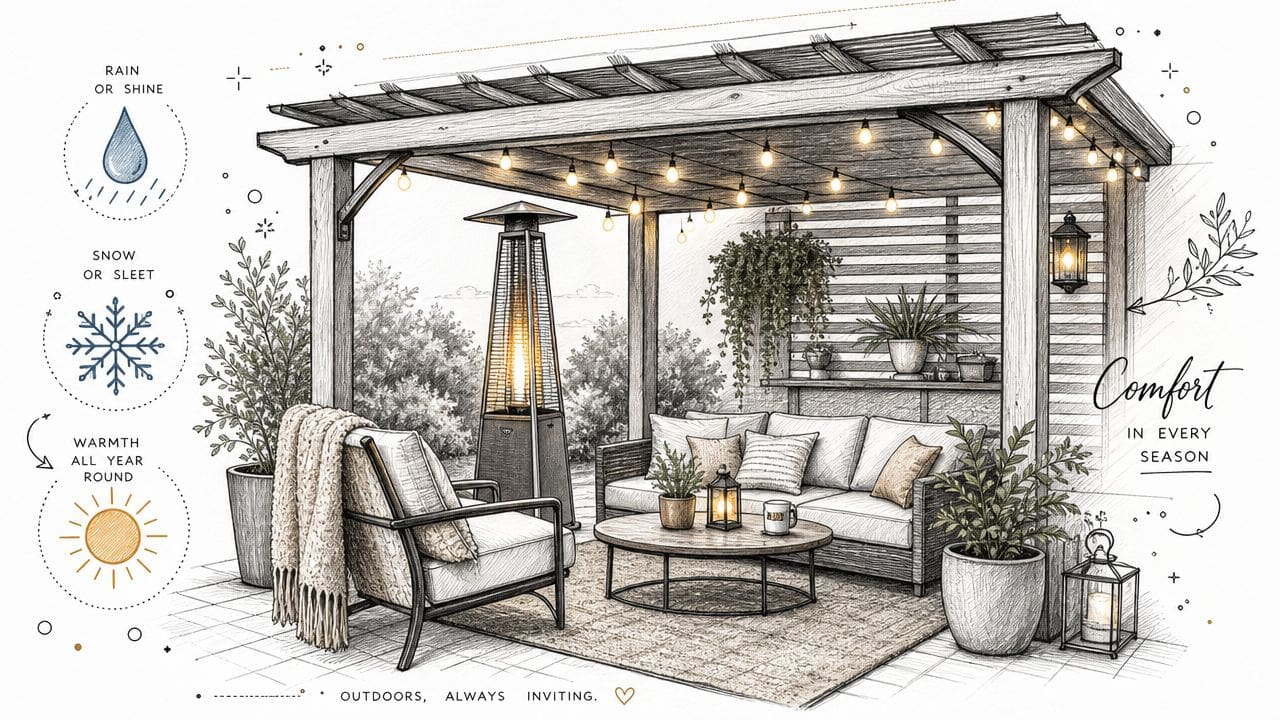
In many NZ regions, winter average temperatures sit around 8–12°C, and many regions get over 100 rainy days per year, according to The Outdoor Room Company. That's why year-round usability usually depends on combining shelter with heat and enclosure, not just adding a roof and hoping for the best. The same source notes that interest in “outdoor wellness zones” has risen by 35%, which matches what many clients are now asking for: spaces that support recovery, relaxation, and regular use rather than occasional entertaining.
The most successful setups don't rely on a single feature. They stack several moderate improvements that work together.
Start with these layers:
Heating where people sit
Infrared heaters are good when you want direct warmth without building around a fireplace. Firepits create atmosphere, but they need more room, more thought around smoke, and better separation from screens and furniture.
Lighting by task and mood
One bright fitting rarely works. Use functional lighting near steps, cooking areas, and thresholds, then add softer ambient lighting around seating.
Cooking that matches how you entertain
Some families only need a grill and prep bench. Others use pizza ovens, integrated BBQ shelters, or a full outdoor kitchen because the space functions like a second dining room.
Furniture that handles partial enclosure
Deep lounge seating is comfortable, but only if your wind control is good enough. In exposed spaces, upright dining or mixed modular seating often performs better.
For projects where comfort needs to be tuned more deliberately, this article on micro-climate engineering for 365-day patio comfort is worth reading. It's the right way to think about year-round use: not one product, but a managed micro-climate.
The room becomes useful when people stop checking the forecast before they decide to use it.
This walkthrough gives a good visual sense of how sheltered outdoor living can be layered beyond a simple roof:
The strongest shift I'm seeing is toward spaces that support daily use. Not just “somewhere to host”. More like somewhere to unwind after work, warm up in winter, or recover after training.
That's where wellness equipment changes the brief. A hot tub, spa, sauna, or even a compact pool setup changes what the room needs around it. Privacy becomes more important. Drainage matters more. Flooring needs more thought. So does access in wet weather.
A wellness-led outdoor room often combines:
That approach works especially well in homes where the backyard isn't huge but the owners want the space to deliver more than one function.
Most outdoor room projects feel complicated until you split them into two tracks. Compliance is one track. Procurement and installation is the other. When clients separate those early, the project gets much easier to manage.
Outdoor room structures in New Zealand must satisfy Clause B2 of the NZ Building Code, with a minimum 15-year durability requirement for elements like adjustable louvres and a 50-year lifespan for key structural components, as outlined in BRANZ guidance on durability practice in New Zealand. That's not just paperwork. It directly affects material selection, detailing, and the evidence needed to support a design.
In practice, the questions to ask early are simple:
If those answers are vague, pause the project. The structure may still be buildable, but it isn't ready to order.
There are two main delivery models.
Supply-only suits homeowners using their own builder, designers coordinating trades, and projects where local site knowledge matters. It can reduce cost and give you more control, but only if someone competent is managing measurements, foundations, service coordination, and installation quality.
Full install suits clients who want one team responsible for most of the process. It simplifies communication, which is valuable on busy household schedules or more technical sites.
The right choice depends on who's driving the job:
| Delivery Model | Works Well When | Trade-Off |
|---|---|---|
| Supply-only | You have a trusted builder or can manage trades confidently | More coordination sits with you |
| Full install | You want one lead point and less site management | Less flexibility in trade selection |
Maintenance should also be part of the handover conversation, not an afterthought. Ask what needs cleaning, what needs inspection, which components are serviceable, and what actions help preserve finish and function over time.
If you're planning an outdoor room and want to compare supply-only options, kitset structures, blinds, wellness additions, or a broader outdoor living package, Apollo NZ is one place to review those categories in one catalogue before you lock in your procurement path.
Generated with the Outrank tool


