
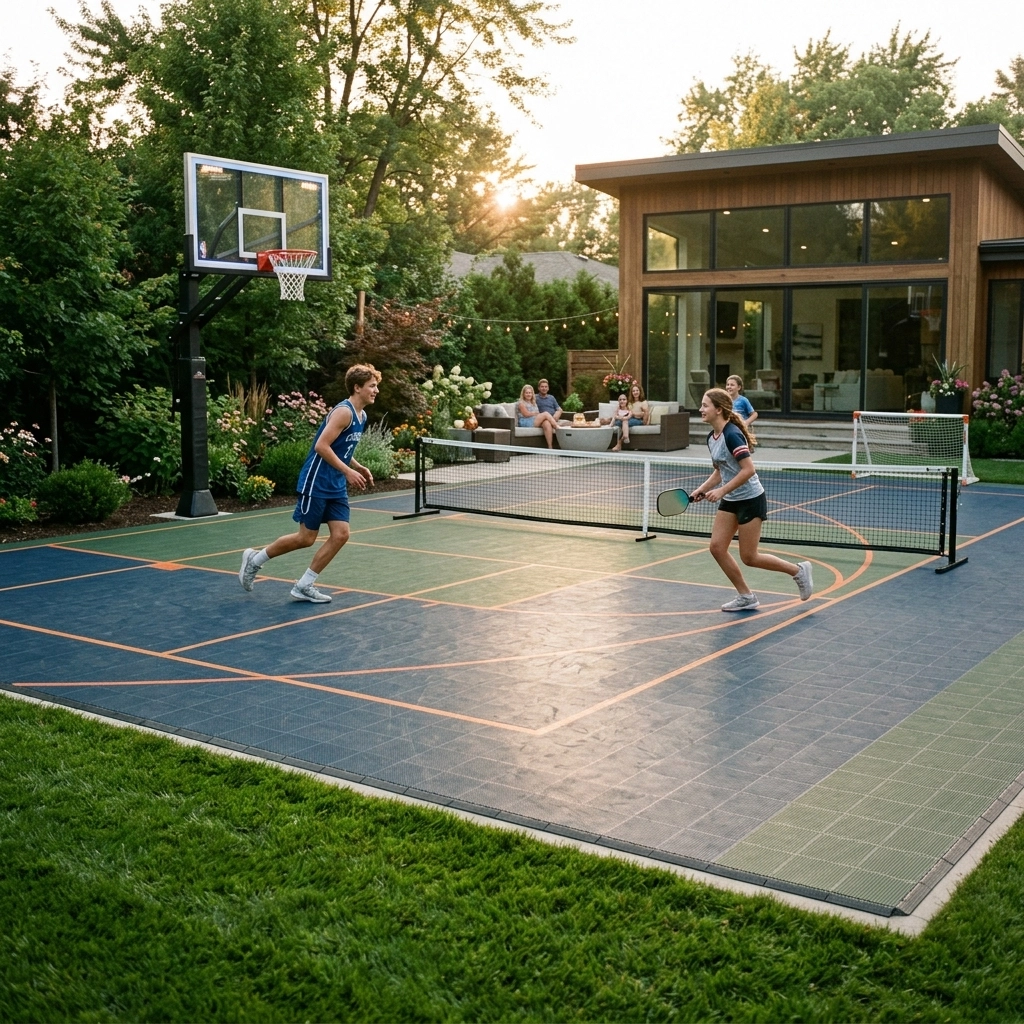
For decades, the "Kiwi Dream" was defined by a quarter-acre section, a rotary clothesline, and a rectangular patch of rye-grass that required more weekend attention than most family pets. But times have changed. As property footprints tighten and our schedules become increasingly packed, the traditional lawn is undergoing a quiet, suburban execution.
Homeowners are no longer content with a "keep off the grass" aesthetic that offers little more than a venue for weeds and the occasional weekend chore. In its place, a new trend is emerging that prioritizes high-impact activity, social connection, and: perhaps most importantly: zero maintenance. Welcome to the era of the backyard multi-sport court.
Maintaining a pristine lawn in the New Zealand climate is an uphill battle against the elements. Between the scorching summer droughts that turn grass into straw and the winter deluges that transform the backyard into a mud bath, the lawn is often a seasonal liability.
Beyond the aesthetics, the utility of a lawn is surprisingly low. It is a "single-use" surface that is often too wet to play on, too soft for balls to bounce, and too delicate for high-traffic social gatherings. When you calculate the cost of mowers, fuel, fertilizers, and the sheer volume of hours spent pacing back and forth on a Saturday morning, the Return on Investment (ROI) of a lawn starts to look remarkably poor.
The modern renovation focuses on "active spaces." A multi-sport court isn't just a basketball hoop on a driveway; it is a professionally engineered, multi-purpose surface designed to accommodate everything from the rapid-fire pace of Pickleball to a high-intensity 3x3 basketball game.
By consolidating various recreational activities onto a single footprint, homeowners are maximizing their square footage. A well-designed court can serve as:

The shift toward backyard courts is largely driven by the explosive growth of specific sports. Pickleball, once a niche activity, has become a global juggernaut. Its appeal lies in its accessibility; it is a multi-generational sport that is easy for children to learn yet competitive enough for seasoned athletes. Because a Pickleball court is significantly smaller than a traditional tennis court (roughly 6.1m x 13.4m), it fits comfortably into the average modern backyard.
Similarly, 3x3 basketball has seen a massive surge in popularity. It requires less space than a full court, making it the perfect candidate for a home renovation project. These sports aren't just hobbies; they are social catalysts that turn a backyard into the neighborhood’s primary gathering spot.
Gone are the days when a "court" meant a cracking, heat-retaining concrete slab that wreaked havoc on your knees. The modern standard utilizes interlocking polypropylene (PP) sports tiles. These tiles represent a significant leap forward in residential sports technology.
Unlike concrete or asphalt, modular sports tiles feature built-in lateral forgiveness and vertical cushioning. This shock-absorption technology reduces the strain on joints, making the surface safer for both high-leaping teenagers and older players looking to protect their knees.
New Zealand’s weather is notoriously unpredictable. Traditional lawns stay soggy for days after rain, but modular tiles are designed with a perforated open-grid surface. This allows water to drain through the tiles instantly, leaving the surface dry and ready for play within minutes of a downpour. No more mud, no more puddles, and no more "rain delays."
High-quality sports tiles are manufactured with UV stabilizers to prevent fading and brittle breakdown under the harsh Southern Hemisphere sun. These surfaces are designed to withstand years of intense play without the cracking or peeling associated with painted concrete.

One of the most compelling reasons for the "death of the lawn" is the ease of the transition. While a pool installation can take months and involve significant excavation, a multi-sport court can often be completed in a fraction of the time.
For the DIY-inclined Kiwi, modular tiles are a dream. Once a level base (such as a concrete pad or compacted fines) is prepared, the tiles simply click together like a giant puzzle.
When considering a renovation, the financial return is just as important as the lifestyle benefit. Real estate trends are showing a marked shift in what buyers value. A high-maintenance lawn is increasingly seen as a "chore list" for prospective buyers. Conversely, a professional sports court is viewed as a high-value, luxury amenity.

The most profound impact of replacing a lawn with a court isn't the property value: it's the social value. In an age where screen time is the primary competitor for our children’s attention, a backyard court provides an irresistible "analog" alternative.
It becomes the "hub" of the home. It’s where kids spend their afternoons practicing free throws, where parents play a quick game of Pickleball before dinner, and where friends gather for weekend tournaments. It is a multi-generational space that bridges the gap between ages, keeping families active and connected in their own backyard.
A sports court doesn't have to look like a commercial gym. With the right landscaping and perimeter design, it can blend seamlessly into a modern outdoor living area. Many homeowners are pairing their courts with louvre systems to create a spectators' gallery or a shaded area for post-game recovery.
By strategically placing the court near the main outdoor living zone, you create a flow between active and passive spaces. You can be grilling on the BBQ while keeping an eye on the game: a hallmark of the modern Kiwi lifestyle.

Before you tear up the turf, there are a few technical requirements to specify:
The transition from the traditional lawn to a multi-sport court is a reflection of our evolving priorities. We are choosing activity over maintenance, social hubs over empty green space, and long-term durability over seasonal struggle.
Key Takeaways:
The lawn isn't just dying; it’s being upgraded. By embracing the multi-sport court, you aren't just changing your backyard; you’re changing the way your family lives, plays, and connects.


