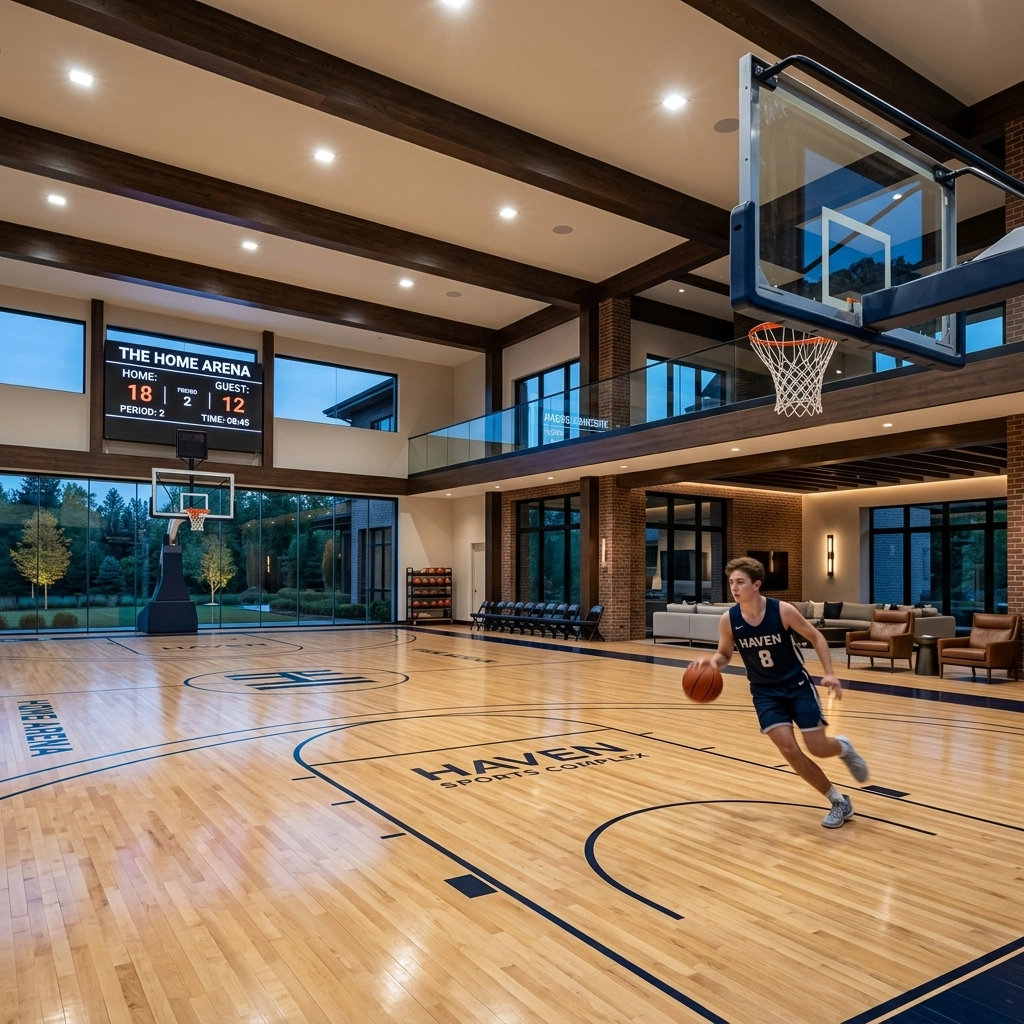
The Rise of the "Home Arena": Why Private Sports Facilities are Becoming Standard
April 21, 2026
Spread the love
The definition of residential luxury is undergoing a fundamental shift. For decades, a swimming pool or a home cinema was the hallmark of a high-end estate. However, as the boundaries between professional training, data-driven wellness, and residential life continue to blur, a new architectural standard has emerged: The Home Arena.
This is no longer just a basketball hoop at the end of a driveway. The modern Home Arena is a high-specification, multi-sport environment integrated directly into the master plan of the property. For architects and premium renovators, understanding this trend is essential to meeting the demands of a demographic that prioritizes performance, privacy, and long-term property value.
The Drivers Behind the Residential Sports Boom
Several macro-trends are converging to make private sports facilities a standard requirement in the luxury market. Understanding these "why" factors is the first step in designing a space that meets the client's needs.
The Professionalization of Youth Sports: Youth athletics has evolved into a multi-billion-dollar industry. Families are increasingly treating home facilities as essential training grounds for competitive athletes, requiring surfaces and technology that mirror professional standards.
The "Third Space" Integration: As people spend more time at home, the demand for high-quality recreational spaces that offer the same amenities as private clubs has spiked.
Privacy and Efficiency: For high-profile individuals, the ability to train or play in a secure, private environment without the commute to a public or semi-private facility is a significant lifestyle upgrade.
Technological Accessibility: Professional-grade tracking and analytics systems that were once reserved for elite franchises are now available for residential installation, making "smart" play a reality.
Defining the Multi-Sport Mandate
The most successful residential arenas are those that offer versatility without compromise. In the current market, dedicated single-use spaces are being replaced by multi-sport configurations that maximize footprint utility.
The Rise of Pickleball and Paddle Sports
While basketball remains a staple, Pickleball has become the most requested addition to private courts. Its smaller footprint: roughly one-third the size of a standard tennis court: makes it an ideal inclusion for urban or high-density luxury builds.
Multi-Functional Flooring
The core of a Home Arena is its surface. Architects must specify high-performance modular tiles or cushioned acrylics that offer:
Force Reduction: Protecting joints during high-impact sports.
Energy Restitution: Providing the "bounce" required for professional-level play.
Acoustic Dampening: Crucial for indoor installations to manage noise transfer to the rest of the residence.
Technical Infrastructure: The "Smart" Arena
The transition from a "court" to an "arena" is defined by its technological backbone. Modern homeowners expect their sports facilities to be as digitally integrated as their home automation systems.
AI-Driven Performance Tracking
Integrating high-definition optics and motion-tracking sensors is now a standard requirement. These systems allow athletes to:
Capture and Stream: Record sessions in 4K for review or live-streaming to coaches.
Automate Analytics: Use AI to track shooting percentages, sprint speeds, and movement heat maps.
Gamification: Connect with other private arenas globally for remote competition.
Integrated Lighting and Climate Control
Lighting for a Home Arena must be designed to professional lux levels to avoid shadows and glare that can interfere with both play and AI tracking.
Indirect LED Systems: These provide even illumination across the court surface.
HVAC Integration: For indoor arenas, high-volume, low-speed (HVLS) fans or dedicated climate zones are necessary to manage the thermal load of active training.
Engineering for Longevity and Aesthetics
A Home Arena must be visually cohesive with the rest of the property. This requires a departure from traditional "chain-link and asphalt" aesthetics in favor of architectural integration.
Materiality and Site Plan
Architects are now treating the arena as an extension of the home’s facade. Using marine-grade aluminum, sleek glass barriers, and integrated timber decking allows the sports zone to feel like a designed pavilion rather than an afterthought.
Drainage and Environmental Resistance
For outdoor facilities, professional-grade drainage is non-negotiable.
Sub-Base Precision: A laser-leveled concrete or asphalt sub-base is required to ensure consistent ball bounce and prevent water pooling.
Permeable Surfaces: High-end modular systems allow for rapid water dissipation, ensuring the arena is playable minutes after a heavy downpour.
The Evolution of the Recovery Zone
The Home Arena is rarely a standalone feature. It is increasingly paired with high-performance recovery zones. This holistic approach to design includes:
Contrast Therapy Stations: Dedicated areas for ice baths and infrared saunas positioned adjacent to the court.
Stretching and Mobility Decks: Using high-end synthetic turf or timber slats to create a transition zone between the high-impact arena and the rest of the home.
Hydration Stations: Integrated cabinetry and refrigeration to keep athletes within the facility during training.
Strategic Placement and Acoustic Privacy
One of the greatest challenges in residential sports design is acoustic management. The sound of a basketball or a tennis volley can carry significantly, potentially disrupting the household or neighbors.
Architectural Solutions for Noise:
Sunken Courts: Designing the arena 1.5 to 2 meters below grade uses the earth as a natural sound barrier.
Sound-Absorbent Barriers: Using perforated metal panels or acoustic-grade glass to contain sound without sacrificing the view.
Buffer Zones: Strategically placing garages, gyms, or storage units between the arena and primary living quarters.
Property Valuation and Future-Proofing
From a real estate perspective, the Home Arena is a powerful differentiator. In the ultra-high-net-worth (UHNW) market, a property with a professionally engineered sports facility is often viewed as more "complete" than one without.
Future-Proofing Considerations:
Adjustable Systems: Installing height-adjustable hoops and movable net systems ensures the court can evolve as the family’s interests change.
Power and Data Redundancy: Even if the client doesn't install AI tracking immediately, pre-wiring the space with Cat6 cabling and dedicated power outlets is a high-value move for the builder.
Lighting Zoning: Designing lighting that can be dimmed for social events allows the arena to double as a large-scale entertainment pavilion.
Summary of Key Takeaways
The Home Arena is a complex architectural undertaking that requires a blend of structural engineering, tech integration, and aesthetic sensitivity.
Prioritize Versatility: Design for multiple sports (Basketball, Pickleball, Fitness) to ensure long-term utility.
Lead with Tech: Integrated 4K optics and motion tracking are no longer "extras": they are expected.
Focus on Surface Integrity: Use modular, high-impact surfaces that prioritize joint health and acoustic dampening.
Integrate the Aesthetic: Use high-end materials like glass and marine-grade metals to ensure the facility complements the residence.
Plan for Recovery: Create a cohesive environment by placing wellness and recovery tools in close proximity to the play zone.
By treating the Home Arena as a core architectural element rather than a secondary amenity, designers can deliver a space that offers immense lifestyle value and a significant return on investment.