
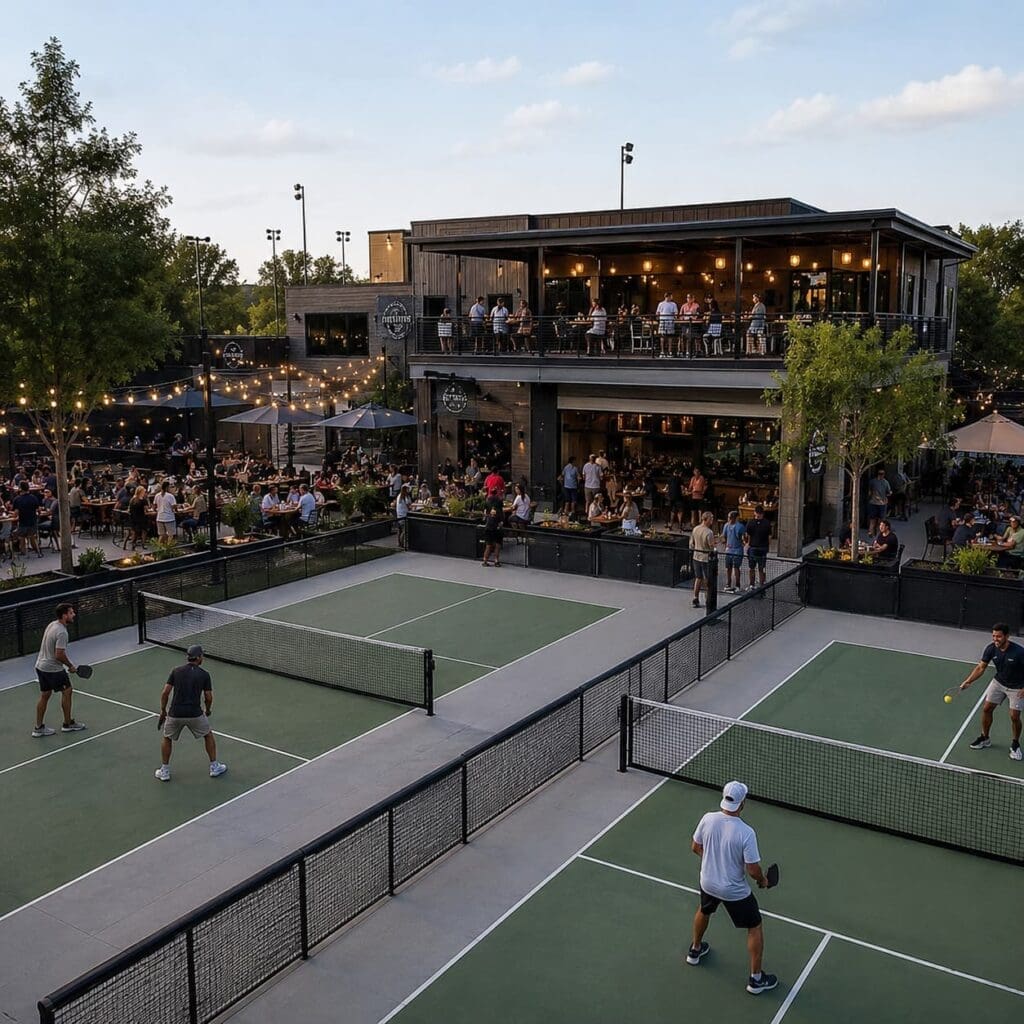
Over the past few years, pickleball has rapidly evolved from a niche recreational activity into one of the fastest-growing sports in the world. But alongside the sport itself, another trend has emerged just as quickly — the rise of the pickleball bar and entertainment venue.
Across the United States and increasingly internationally, developers, hospitality groups, and entertainment operators are investing heavily into a new category of venue that blends sport, food, nightlife, and social interaction into one experience.
The formula is simple:
• Play pickleball
• Socialise with friends
• Eat and drink on-site
• Stay longer than a traditional sports venue
This shift is turning pickleball from simply a sport into a lifestyle and hospitality-driven business model.
Unlike many traditional sports, pickleball naturally lends itself to social interaction.
Games are shorter, easier to learn, and less physically demanding than tennis, making the sport accessible across multiple age groups and skill levels.
This creates a unique environment where:
• Beginners can play immediately
• Mixed age groups can compete together
• Corporate groups can participate easily
• Casual players feel comfortable
• Spectators remain engaged
For hospitality operators, this is extremely important.
Traditional sports facilities often struggle to keep visitors on-site after activity ends. Pickleball venues, however, encourage people to remain in the space — eating, drinking, and socialising between games.
This creates significantly stronger commercial opportunities compared to many conventional sports environments.
Modern pickleball entertainment venues are increasingly being designed more like hospitality precincts than sports clubs.
Common features now include:
• Bars and restaurants overlooking courts
• Rooftop entertainment spaces
• Outdoor lounges and firepit areas
• Large-format sports screens
• Event spaces
• Live music areas
• Corporate function zones
• Integrated lighting and night play
• Multi-court social layouts
The courts themselves become part of the atmosphere rather than separate sports infrastructure.
In many cases, the courts are visually integrated directly beside dining areas to create constant activity and energy throughout the venue.
This concept mirrors the commercial success previously seen with:
• Topgolf
• Boutique bowling venues
• Indoor golf simulator lounges
• Axe throwing bars
• Entertainment arcades
Pickleball is now entering that same entertainment-driven category.
From a development perspective, pickleball offers an unusually efficient use of space.
A standard tennis court footprint can often accommodate multiple pickleball courts, allowing significantly higher player throughput and customer turnover.
This creates strong commercial advantages:
• More players per square metre
• Higher booking frequency
• Better food and beverage traffic
• Strong event capability
• Increased social engagement
• Day and night activation potential
For mixed-use developments, resorts, hospitality venues, and entertainment operators, this makes pickleball highly attractive.
The sport also appeals to a broad demographic range:
• Young professionals
• Families
• Retirees
• Corporate groups
• Tourists
• Fitness-focused consumers
Few recreational activities currently achieve this level of cross-market appeal.
Another major reason for the growth of pickleball entertainment venues is the advancement of modular sports flooring systems.
Modern pickleball tile courts now allow developers and venue operators to install courts faster and more efficiently compared to traditional acrylic systems.
Benefits include:
• Faster installation timelines
• Lower maintenance requirements
• Strong drainage performance
• Custom colour options
• Replaceable sections if damaged
• Multi-sport capability
• Reduced downtime during upgrades
This flexibility is especially valuable for commercial venues wanting to create visually striking entertainment spaces with minimal operational disruption.
Hybrid layouts are also becoming increasingly common, where venues combine:
• Pickleball courts
• 3x3 basketball courts
• Lounge spaces
• Dining areas
• Outdoor entertainment zones
within one integrated social venue.
The rapid growth of pickleball bars signals something much larger than simply a sporting trend.
Consumers increasingly want experiences rather than isolated activities.
They want places where recreation, hospitality, entertainment, and social interaction all exist together.
Pickleball happens to fit this model exceptionally well.
As a result, the next phase of the industry is likely to include:
• Dedicated pickleball entertainment precincts
• Rooftop pickleball venues
• Integrated resort and hotel courts
• Multi-sport social clubs
• Commercial franchise concepts
• Corporate event-focused facilities
• High-end residential entertainment developments
This trend is still in its early stages globally, but the momentum is already substantial.
The rise of pickleball bars demonstrates how modern recreation is evolving.
This is no longer simply about building sports courts.
It is about creating destinations.
Venues that combine activity, hospitality, atmosphere, and community are becoming some of the most commercially successful entertainment models in the market today.
Pickleball is simply the catalyst driving that change.


