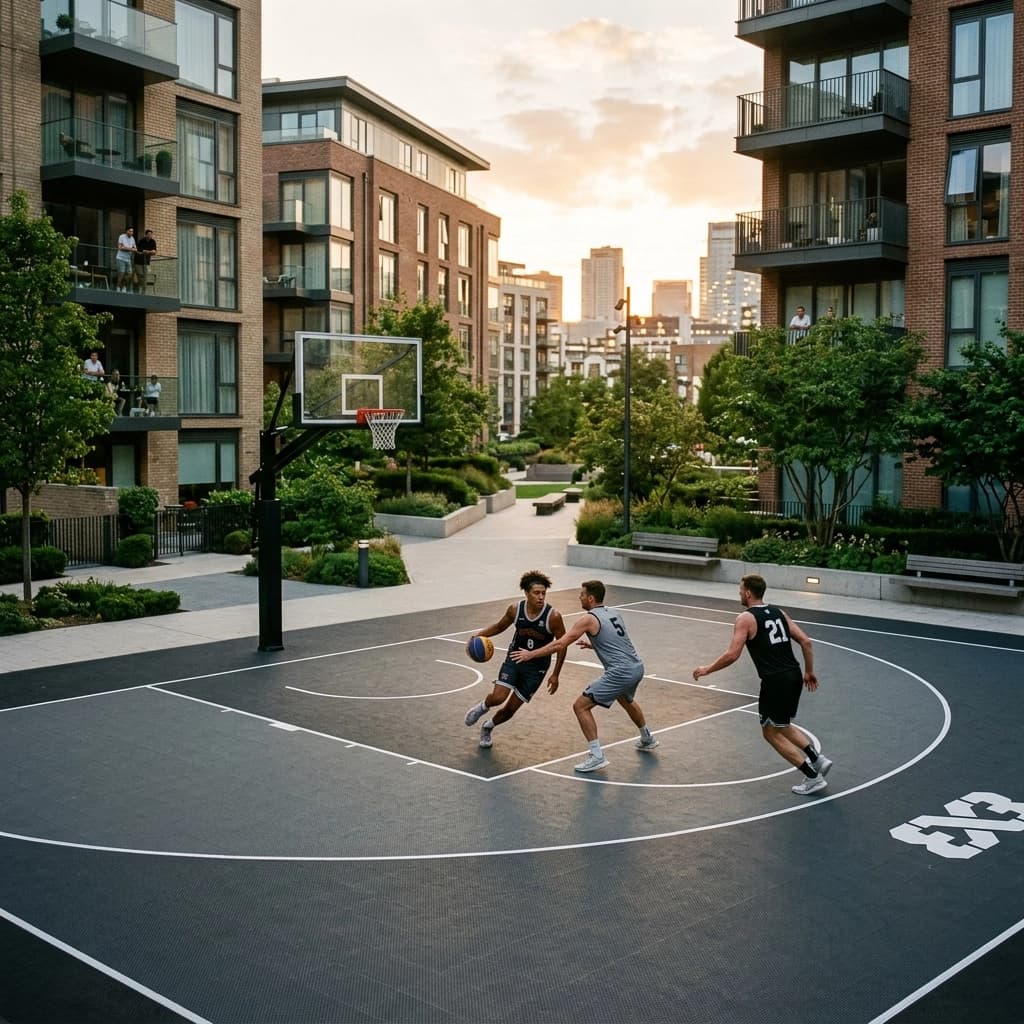
The Geometry of the Court: Optimizing space for 3x3 basketball in urban residential lots.
May 17, 2026
Spread the love
As urban density increases, the traditional "full-court" backyard dream is being replaced by a more surgical, high-intensity alternative: the 3 x 3 basketball court. Purpose-built for smaller footprints, 3x3 basketball is now an Olympic-recognized format that prioritizes speed, agility, and spatial efficiency.
For the homeowner or developer, the challenge lies in the engineering. Fitting a high-performance playing surface into a modern residential lot requires more than just a hoop and a slab; it demands a deep understanding of court geometry, subfloor mechanics, and drainage physics.
1. Defining the Playing Envelope
The first step in any urban court project is defining the "envelope": the total physical space available versus the actual playing area. While a standard FIBA 3x3 court is 15 meters wide by 11 meters long, most residential lots cannot accommodate these dimensions without sacrificing entire gardens or outdoor living zones.
Regulation vs. Reality
In an urban context, "optimization" means maintaining the integrity of the game while trimming the non-essential "run-off" zones.
The Goldilocks Zone: For a functional 3 x 3 basketball experience, aim for a minimum of 9m x 7m. This allows for a regulation-size key and a partial three-point arc.
The Skill Zone: If space is severely limited, a 5m x 5m "shooting station" is sufficient for individual skill work and free-throw practice.
The Buffer Zone: Engineering standards suggest a minimum of 1 meter of unobstructed space behind the baseline and sidelines to prevent player-to-wall collisions.
Technical diagram showing official 3x3 dimensions overlaid with a "compressed" residential layout.
2. Subfloor Engineering and Site Preparation
A basketball court is only as good as the ground it sits on. Unlike a standard driveway, a sports court requires a "dead-flat" finish (within industry-standard tolerances) to ensure a consistent ball bounce.
Excavation and Base Course
The longevity of the court depends on the stability of the sub-base.
Excavation: Remove all organic material (topsoil, grass) to a depth of at least 200mm–250mm.
Compaction: Utilize a heavy-duty plate compactor to achieve a 95% Proctor density on the sub-grade.
Base Layer: Apply a 100mm–150mm layer of GAP20 (General All Passing) crushed rock. This layer must be graded and compacted to provide a solid, non-shifting foundation for the concrete or asphalt.
The Concrete Slab Specs
For a residential 3 x 3 basketball court, a reinforced concrete slab is the gold standard.
Thickness: Minimum 100mm.
Strength: Use 25MPa to 30MPa concrete.
Reinforcement: Integrate 665 or 668 mesh to prevent structural cracking over time.
Vapor Barrier: In high-moisture urban areas, install a heavy-duty polythene vapor barrier beneath the concrete to prevent the "wick effect," where ground moisture rises through the slab and degrades surface coatings or modular tiles.
3. The Science of the Slope: Drainage Geometry
In a tight urban lot, water management is the most frequent point of failure. Because the court is a large, non-permeable surface, it creates significant runoff that must be managed to avoid flooding neighboring properties or the main residence.
The 1% Rule
A basketball court should never be perfectly level. To shed water effectively, a 1% slope (or 10mm of fall for every 1 meter of length) is required.
Direction of Fall: Always slope the court away from any buildings. Ideally, the fall should run from the baseline toward the half-court line to keep the area directly under the hoop: the highest traffic area: the driest.
Planar Accuracy: The slope must be a single, flat plane. "Dishing" or "birdbaths" (small depressions) are unacceptable, as they create puddles that halt play and attract algae.
Managing Runoff
In dense urban environments, consider these drainage solutions:
French Drains: A gravel-filled trench with a perforated pipe installed along the lowest edge of the court.
Catch Basins: For courts bordered by retaining walls, integrated grates can channel water directly into the municipal stormwater system.
Permeable Borders: Using decorative river stones or specialized drainage turf around the perimeter to absorb minor runoff.
4. Layout and Line Marking: The "Key" Components
The geometry of the lines dictates the "feel" of the game. Even on a compressed court, maintaining the regulation distances for the most critical markings is essential for muscle memory and skill development.
The Three-Point (Two-Point) Arc
In 3 x 3 basketball, the "three-point line" is technically the "two-point line" (shots inside are 1 point, outside are 2).
Regulation Radius:6.75 meters from the center of the hoop.
Optimization Strategy: If your lot isn't deep enough for a 6.75m arc, do not "shrink" the circle evenly. Instead, keep the radius true and let the arc "clip" off the sides or back. This ensures that the distance is accurate for the shots you can take.
The Key and Free Throw Line
The Key: Standard dimensions are 4.9m wide by 5.8m deep.
Free Throw Line: Must be exactly 4.6 meters from the face of the backboard (or 5.8m from the baseline).
Consistency Check: Ensure the hoop is installed at exactly 3.05 meters (10 feet) high. Even a 50mm variance can disrupt a player's shot mechanics.
Architectural sketch demonstrating how to integrate a 3x3 key into a modern backyard with surrounding landscaping.
5. Surfacing and Acoustic Mitigation
In urban settings, noise is a primary concern. The "thump" of a basketball on concrete can travel through nearby walls and fences, potentially leading to neighbor disputes.
Modular Sports Tiles
The modern solution for 3 x 3 basketball is the high-performance polypropylene tile.
Impact Absorption: These tiles are engineered with a vertical suspension system that reduces strain on the players' joints.
Acoustic Reduction: The honeycomb structure of the tiles breaks up sound waves, significantly dampening the "pop" of the ball compared to bare concrete.
Fast Drainage: Perforated tiles allow water to flow through the surface and down the pre-engineered slope of the slab, meaning the court is playable minutes after a rainstorm.
Surface Friction Dynamics
Choose a surface with a high Grip Index. In outdoor settings, the surface must provide traction even when slightly damp. Look for UV-stabilized materials that won't fade or become brittle under the intense sun exposure typical of New Zealand and Australian summers.
6. Urban Constraints: Fencing and Lighting
Building a court in a small lot means interacting with boundaries.
Ball Containment
Traditional chain-link fencing is often too industrial for residential aesthetics. Modern alternatives include:
Nylon Perimeter Netting: Soft, nearly invisible mesh that stops the ball without blocking views or sunlight.
Rebounder Systems: Specialized heavy-duty nets that return the ball to the player, maximizing practice time in tight spaces.
Lighting the Court
To maximize the utility of a 3 x 3 basketball court, lighting is essential. In urban areas, Light Spill must be strictly controlled.
Asymmetric Optics: Use LED floodlights with asymmetric lenses that direct light downward onto the court and prevent "spill" into neighbors' bedroom windows.
Lumens: Aim for 150–200 lux for recreational play.
Mounting Height: Ideally, lights should be mounted at 4m–6m to minimize glare.
Summary Checklist for 3x3 Court Optimization
Successfully integrating a 3 x 3 basketball court into an urban lot requires a balance of sporting requirements and civil engineering. Prioritize these technical takeaways:
✅ Verify Sub-grade: Ensure 95% compaction to prevent slab sinking.
✅ Standardize the Key: Keep the hoop-to-free-throw distance at 4.6m, regardless of total court size.
✅ Engineered Fall: Maintain a 1% slope for moisture management.
✅ Acoustic Planning: Use modular tiles to dampen noise in high-density zones.
✅ Boundary Safety: Allow for a 1m buffer zone to ensure player safety against fences and walls.
By focusing on these geometric and structural fundamentals, a residential 3x3 court becomes more than just a backyard addition: it becomes a professional-grade training environment that maximizes every square inch of available urban land.