
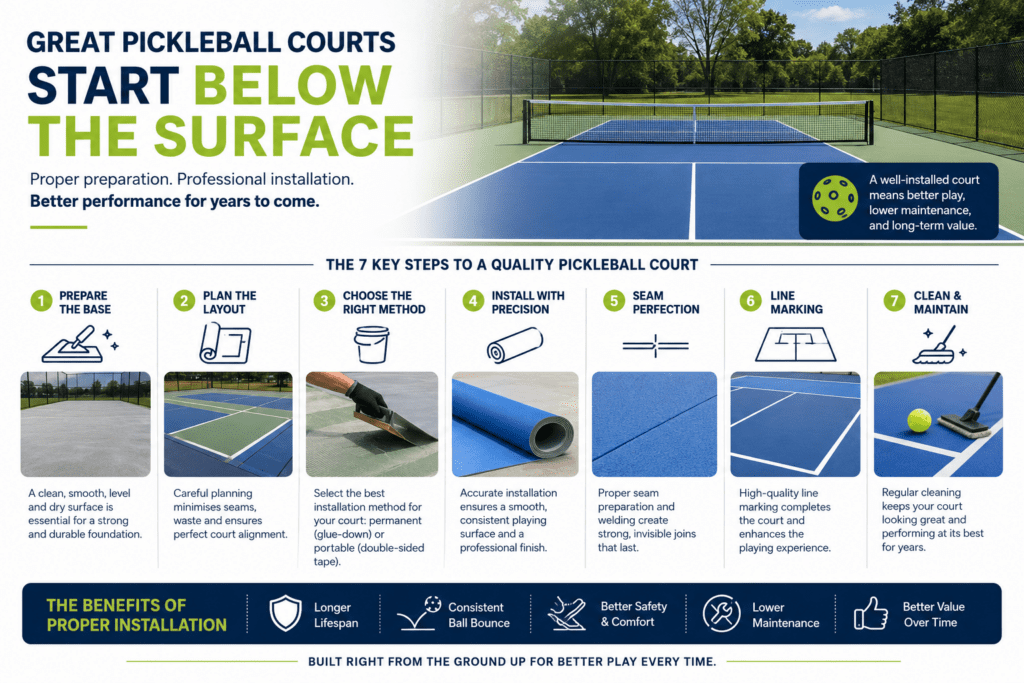
Pickleball has become one of the fastest-growing sports across New Zealand, Australia, and many parts of the world. As more clubs, schools, retirement villages, and homeowners invest in dedicated pickleball courts, attention often focuses on the playing surface itself.
Questions such as "Which flooring is best?" or "What thickness should I choose?" are common.
However, one factor can have an even greater impact on the long-term performance of a pickleball court:
The quality of the installation.
Even premium pickleball flooring can struggle to perform if it is installed over an unsuitable base or fitted incorrectly. A well-installed court not only looks better on day one but continues to deliver consistent ball bounce, player comfort, and durability for years to come.
The foundation beneath a pickleball court is often the difference between a court that performs exceptionally and one that develops problems over time.
A quality surface should be installed over a substrate that is:
An uneven foundation can create visible ridges, soft spots, inconsistent ball bounce, and unnecessary stress on the flooring system.
Think of it this way: no matter how good the flooring is, it can only perform as well as the surface beneath it.
One of the most important characteristics of any pickleball court is predictable ball response.
Players quickly notice when a court has:
These issues affect the quality of play and can become frustrating for both casual and competitive players.
A properly prepared base helps create a consistent playing surface where the ball reacts as expected throughout the court.
Professional court installations involve much more than simply rolling out flooring.
Before installation begins, careful planning is required to:
The best courts are often the result of thorough planning before the first piece of flooring is laid.
Not every pickleball project has the same requirements.
Some courts are designed as permanent facilities for clubs, schools, and recreation centres. Others may need flexibility for multi-use spaces or temporary installations.
Permanent installations provide maximum stability and are ideal for:
Portable and semi-permanent installations offer flexibility for:
Selecting the correct installation method can significantly influence both performance and lifespan.
One of the most overlooked aspects of pickleball flooring is the quality of the seams.
Poorly finished joins can lead to:
Professional seam preparation and finishing help create a cleaner, stronger, and more durable playing surface.
For players, this means a court that feels more uniform underfoot and maintains its appearance over time.
Temperature and environmental conditions play a surprisingly important role during installation.
Flooring materials naturally expand and contract with temperature changes. Allowing materials to acclimatise before installation helps reduce future movement and improves the overall finish.
This is particularly important for outdoor pickleball courts where the surface may experience significant seasonal temperature variations.
While pickleball flooring systems are designed to be durable, achieving a professional result requires experience, specialised tools, and attention to detail.
Professional installers understand how to:
The result is a court that performs better, lasts longer, and requires less maintenance throughout its life.
One of the advantages of modern pickleball flooring is its relatively low maintenance requirements.
However, a poorly installed court often requires more attention over time.
Common issues associated with poor installation include:
A properly installed court helps minimise these problems and keeps maintenance costs under control.
Whether you're building a backyard pickleball court, a school facility, a retirement village recreation area, or a commercial sports venue, the goal is the same:
Create a surface that players enjoy using.
A quality pickleball court should deliver:
✔ Consistent ball bounce
✔ Comfortable player movement
✔ Reliable grip and traction
✔ Long-term durability
✔ Professional appearance
✔ Low maintenance requirements
Achieving these outcomes depends just as much on installation quality as it does on the flooring product itself.
As pickleball continues to grow, expectations around court quality are rising.
Players notice the difference between an average court and a great one. They notice how the ball bounces, how the surface feels underfoot, and how well the court holds up after months and years of use.
The most successful pickleball courts aren't simply built with quality flooring—they are built on quality foundations and installed with care.
When the installation is done correctly from the start, the result is a court that looks better, performs better, and provides a superior playing experience for years to come.


