
One of the most common questions clubs, schools, retirement villages and lifestyle communities ask is:
“Can we turn an existing tennis court into pickleball courts?”
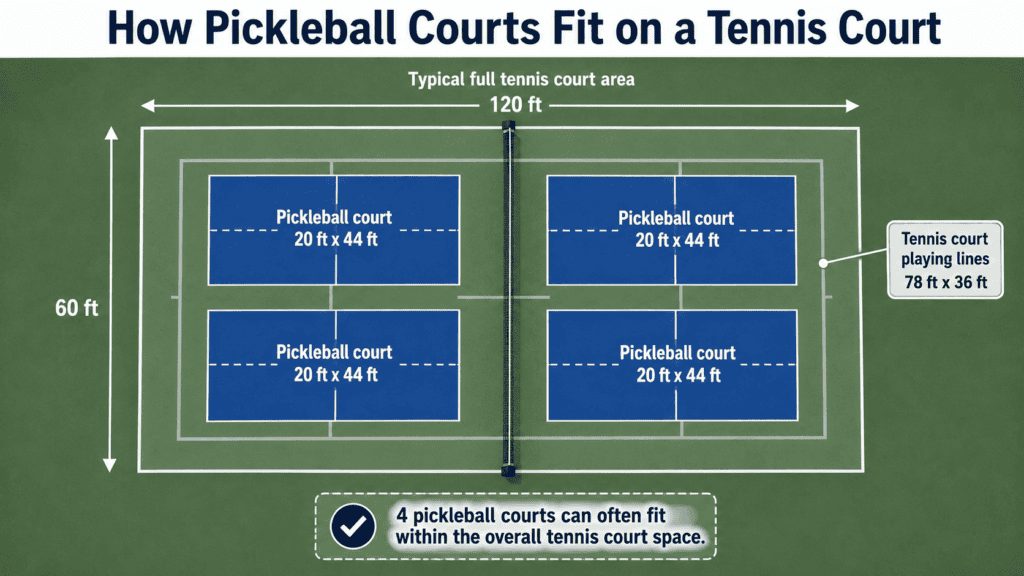
The answer is yes — and in many cases, one full-size tennis court can fit up to four pickleball courts.
That is one of the big reasons pickleball is growing so quickly across existing sports facilities. Instead of building from scratch, many venues can use underused tennis court space and create a higher-use, more social, multi-court pickleball area.
A standard tennis court can usually be converted into:
4 pickleball courts for club and social play
or
2 pickleball courts for more generous spacing and comfort
The right option depends on how the court will be used, how much run-off space is available, and whether the venue wants casual, social, club or tournament-style play.
A pickleball court is much smaller than a tennis court.
A standard pickleball court playing area is 20 ft x 44 ft, or approximately 6.10 m x 13.41 m. However, the actual playing surface should be larger than the marked lines because players need space around the outside of the court to move safely. USA Pickleball lists 30 ft x 60 ft as the recommended minimum total playing surface, with 34 ft x 64 ft preferred.
A standard tennis court is 78 ft x 36 ft for doubles play, or approximately 23.77 m x 10.97 m.
The full fenced area around a tennis court is usually larger than the marked tennis lines, which is why four pickleball courts can often fit inside the overall tennis court enclosure.
Pickleball courts are shorter and narrower than tennis courts, so the space can be divided more efficiently.
The most common conversion layout places four pickleball courts inside one tennis court area, usually with two courts on each side of the original tennis net position.
This works well for:
For clubs with underused tennis courts, this can create a much better return from the same space. Instead of one tennis match using the court, four pickleball games can be played at the same time.
That means more players, more activity, more bookings and more social energy around the facility.
Not always.
While four pickleball courts can fit on many tennis court areas, it is important not to only look at the line markings. The space between courts matters.
If the courts are packed too tightly, players can feel crowded, balls can roll between games, and safety becomes a concern.
For social club use, four courts can work well if there is enough surrounding space. For more comfortable play, some venues may choose to install only two pickleball courts on one tennis court area.
This option is best when the goal is to maximise participation.
Four courts are ideal for:
The advantage is simple: more people can play at once.
Two courts may be the better choice when the venue wants a more spacious layout.
This option suits:
Two courts give players more room around the baseline and sidelines, which can make the experience feel better and less crowded.
There are several ways to handle the tennis net when converting to pickleball.
Some venues keep the tennis court as a multi-use space and add temporary pickleball nets. Others install semi-permanent or permanent pickleball nets depending on how often the space will be used.
For multi-use venues, portable pickleball nets are often the most flexible option. This allows the same court area to still be used for tennis, casual sport or events.
For dedicated pickleball use, permanent posts and nets create a cleaner and more professional setup.
A tennis court can be converted in different ways depending on the surface and the long-term plan.
Common options include:
Temporary lines are useful for testing demand before committing to a full conversion.
Permanent lines are better when the court will be used regularly for pickleball.
Modular tiles or roll-out court systems can also be considered when the existing surface is tired, slippery, cracked or not suitable for regular play.
The main reason is simple: pickleball makes better use of space.
One tennis court can serve a small number of players at a time. The same space can often support several pickleball games, making it more active and more commercially useful.
For clubs, this can help with:
This is especially important for bowls clubs, tennis clubs and community facilities that already have outdoor court space but want to bring in new activity.
Yes. This is one of the reasons pickleball works so well in retirement villages, lifestyle communities and bowls clubs.
The court is smaller than a tennis court, the game is easier to learn, and doubles pickleball is very social. Players do not need to cover as much ground as they would in tennis, but the game still provides movement, coordination and fun competition.
That makes it a great sport for mixed-age communities and venues looking for a low-impact activity that still feels active and engaging.
Before turning a tennis court into pickleball courts, check:
The best layout is not always the one that fits the most courts. The best layout is the one that gives players a safe, enjoyable and practical playing experience.
In most cases, one tennis court can fit four pickleball courts.
For maximum participation, four courts is the popular club layout.
For more comfort and safety, two courts may be the better option.
For clubs, schools, retirement villages and lifestyle communities, converting an existing tennis court into pickleball courts can be one of the most cost-effective ways to add a high-demand sport without major construction.
Whether the goal is social play, club growth, extra revenue or better use of underused space, pickleball is a smart option for many existing tennis court areas.


