
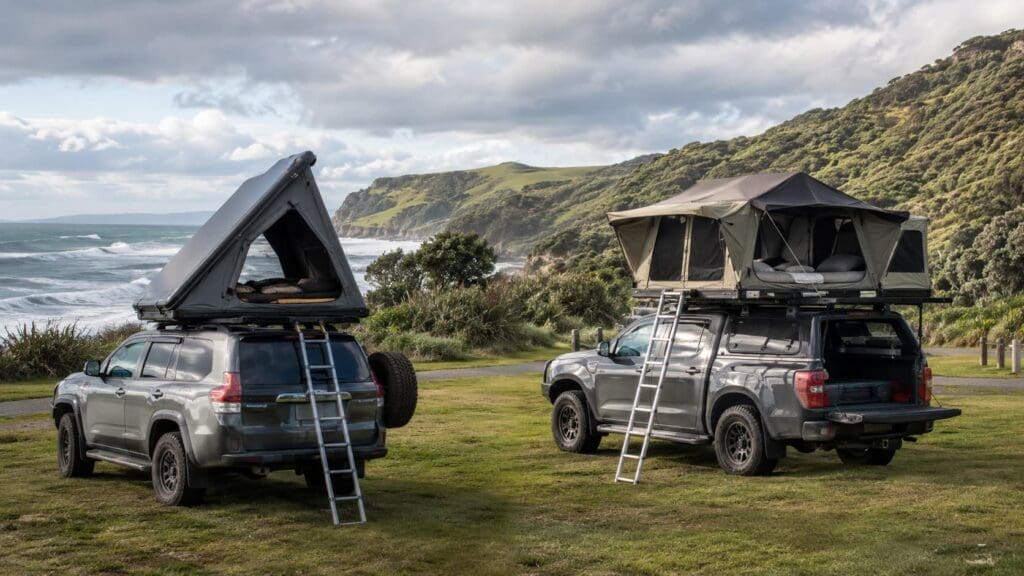
Rooftop tents have become increasingly popular with New Zealand travellers who want the freedom to explore without towing a caravan or setting up a conventional ground tent at every stop.
However, choosing between a hard-shell rooftop tent and a soft-shell rooftop tent is not simply a matter of appearance. New Zealand’s changeable weather, exposed campsites, strong UV, coastal conditions and winding roads can all influence which design will work best.
New Zealand sits within a strong westerly wind system, contributing to frequent weather changes, wind and rain across many parts of the country. Our sunlight also contains particularly high levels of ultraviolet radiation, making fabric quality and UV protection important considerations for equipment that may spend years mounted outdoors.
So which rooftop tent is better for New Zealand conditions?
The answer depends on how often you travel, where you camp, how many people need to sleep inside and what your vehicle can safely carry.
A hard-shell rooftop tent is enclosed inside a rigid aluminium, fibreglass, ABS or composite outer shell.
Depending on the design, the tent may:
The rigid shell forms the roof of the tent when it is open and protects the tent fabric, mattress and internal components while travelling.
Hard-shell tents are generally designed for travellers who value fast setup, compact storage and regular touring.
A soft-shell rooftop tent normally folds open from a base mounted to the vehicle’s roof rack or tray rack.
When stored, the folded tent is protected by a heavy-duty travel cover. At the campsite, the tent unfolds to create a sleeping platform that may extend beyond the side or rear of the vehicle.
Soft-shell models often provide more floor space for their purchase price and are available in larger family-friendly configurations.
| Feature | Hard-Shell Rooftop Tent | Soft-Shell Rooftop Tent |
|---|---|---|
| Setup time | Generally faster | Generally takes longer |
| Packed profile | Usually lower and more streamlined | Often taller and bulkier |
| Sleeping space | Usually more compact | Often larger |
| Weather protection when packed | Excellent | Depends heavily on travel cover |
| Wind performance | Usually less fabric movement | More exposed fabric and fly material |
| Purchase price | Generally higher | Generally more affordable |
| Weight | Can be heavy, although lightweight models are available | Varies widely |
| Family suitability | Best for one or two people in many models | Larger models can suit families |
| Packing away wet | Usually easier | Can be more difficult |
| Bedding storage | Often limited by the shell depth | Frequently allows more bedding inside |
Specifications vary significantly, so the individual tent’s construction is more important than the category alone.
Wind is one of the most important considerations for rooftop camping in New Zealand.
Exposed coastal sites, elevated areas, open farmland and South Island campsites can experience strong winds even when the wider forecast appears manageable.
A wedge-style hard-shell tent generally presents less fabric to the wind than a large fold-out design. Its rigid roof can also reduce flapping and movement during gusty conditions.
This can make a well-built hard-shell tent:
However, the large solid surface of a hard shell can still catch wind. The tent should be parked with the lower or narrower end facing the prevailing wind whenever possible.
Soft-shell tents typically have more external canvas, a larger fly and a sleeping platform extending away from the vehicle.
This provides excellent internal space, but it can also create more movement and noise in exposed conditions. Correct guying, pole installation and vehicle positioning become particularly important.
Neither design should be considered suitable for remaining open in extreme winds. Manufacturer wind guidance should always be followed, and the tent should be closed if conditions become unsafe.
Wind advantage: Hard shell, particularly a low-profile wedge design.
Persistent rain can make rooftop tent ownership challenging, particularly during multi-day trips.
A hard-shell tent can usually be collapsed quickly, reducing the amount of time the interior is exposed during pack-up.
The rigid upper shell also provides direct overhead protection. In many designs, less external fabric must be folded and handled before departure.
However, any damp canvas stored inside the closed shell still needs to be opened and dried as soon as practical.
A soft-shell tent may include a separate fly, support poles, skirts and a travel cover. Packing these components during rain can take longer and may result in more wet fabric being folded together.
The external cover must also be fitted correctly. A damaged, loose or poorly sealed cover can allow road spray and water into the packed tent.
Rain and wet-pack advantage: Hard shell.
Condensation can affect both hard-shell and soft-shell tents.
When warm, moisture-filled air from occupants meets cold fabric, poles or shell surfaces, water can form inside the tent. This is particularly noticeable during cold South Island mornings, winter camping and humid coastal trips.
Hard-shell tents with exposed aluminium components may experience thermal bridging around cold frames or roof surfaces. Soft-shell tents are not immune, especially when windows are fully closed.
To reduce condensation:
A completely sealed tent is rarely a dry tent. Even in cold weather, controlled ventilation remains essential.
Condensation advantage: No automatic winner. Ventilation and insulation matter more than the shell type.
Anything mounted above a vehicle changes its aerodynamics and raises its centre of gravity.
Hard-shell tents are often lower and more streamlined when closed. This can reduce wind noise and aerodynamic drag compared with a tall soft-shell tent, although the actual result depends on the tent, vehicle and mounting position.
Soft-shell tents are commonly deeper when packed because the folded sleeping base, ladder, fabric and mattress are stacked together under the travel cover.
On long-distance journeys, a lower packed profile can be useful for:
Drivers should still adjust their speed and cornering for the additional roof-mounted weight.
Touring advantage: Hard shell.
This is where soft-shell tents often perform particularly well.
Because the tent unfolds beyond the roof rack, a soft-shell design can create a sleeping platform much larger than its packed footprint. Some models can accommodate two adults and children while also providing an entrance canopy or covered ladder area.
Many hard-shell tents are limited approximately to the dimensions of the closed shell. Larger fold-out hard-shell designs are available, but they are generally more expensive and may also be heavier.
Space advantage: Soft shell.
For travellers who move every day, setup time can significantly affect the camping experience.
A hard-shell tent may open using gas struts or powered lifting mechanisms. In many cases, setup involves releasing several latches and allowing the roof to rise.
A soft-shell tent generally requires:
That process is not necessarily difficult, but it can become frustrating during bad weather or when arriving after dark.
Setup advantage: Hard shell.
New Zealand’s strong UV can gradually affect tent canvas, stitching, seals, plastic components and travel covers.
Hard-shell tents protect most of their fabric while closed, which can reduce its exposure during everyday driving and outdoor storage.
Soft-shell tents rely heavily on the quality of their travel cover. The cover may be exposed to sunlight, rain, road grime and wind movement for long periods.
For either type, look for:
Coastal users should regularly rinse salt residue from the shell, frame, hinges, brackets and fasteners.
Long-term weather-exposure advantage: Hard shell, provided its hinges, seals and shell materials are high quality.
The tent must be compatible with both the vehicle and its roof-rack system.
Waka Kotahi recommends checking the vehicle manual to determine how much weight the vehicle can safely carry above its roof and also checking the load rating of the roof rack itself. The combined travelling weight of the tent, roof bars, mounting hardware and accessories must remain within the applicable limits.
Two different load situations need to be considered:
This is the weight carried while the vehicle is moving.
It normally includes:
This is the weight supported while the vehicle is parked.
It may include:
Do not assume that a strong aftermarket rack increases the load capacity of the vehicle roof. The lowest-rated component in the complete system determines the practical limit.
This is particularly important with heavier hard-shell tents.
A hard-shell model is often the strongest all-round option for frequent New Zealand road trips.
A soft-shell model can provide excellent comfort and space, particularly for families and occasional campers.
Regardless of the design, a rooftop tent intended for New Zealand should include:
A thick mattress and stylish shell are useful, but weather sealing, ventilation and structural quality are more important over the long term.
For frequent touring across New Zealand, a well-built hard-shell rooftop tent will usually provide the best combination of fast setup, weather protection, compact travel and reduced wind movement.
For families, occasional campers and buyers wanting the most sleeping space for their budget, a quality soft-shell rooftop tent may be the better choice.
Neither option is automatically suitable for every vehicle or every campsite. Before purchasing, confirm:
The best rooftop tent is not necessarily the most expensive or the largest. It is the tent that fits your vehicle safely, suits your travelling style and can handle the type of New Zealand conditions in which you genuinely intend to camp.


