
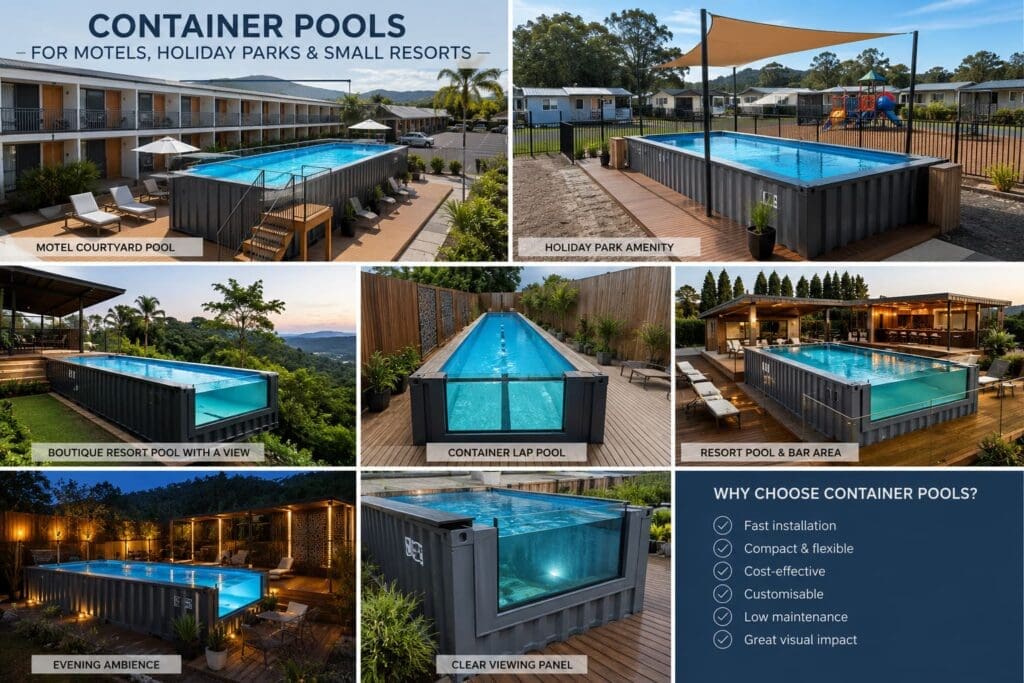
A swimming pool can significantly improve the appeal of a motel, holiday park or small resort. However, constructing a conventional in-ground pool may involve extensive excavation, concrete work, drainage changes and disruption to guests.
Container pools offer another option. These factory-built swimming pools use a reinforced steel container-style structure that can be transported to the property and positioned on a prepared foundation. They are particularly well suited to accommodation businesses that want a distinctive pool without committing to a large resort-style development.
A container pool is a self-contained swimming pool built within a reinforced steel structure. Some are created from modified shipping containers, while others are purpose-built to similar dimensions.
Common configurations are based around 20-foot and 40-foot container formats. Depending on the supplier, the pool may arrive with its liner or fibreglass shell, filtration equipment, plumbing, lighting and equipment compartment already installed. Once positioned, it must still be connected to the required services, completed around the perimeter and commissioned correctly.
Container pools can be installed:
Their simple rectangular shape can work particularly well with modern motels, modular cabins and landscaped holiday parks.
A conventional pool is largely constructed on site. A container pool is manufactured before delivery, reducing the amount of specialised pool construction required at the property.
The site still needs suitable foundations, drainage, services and safe access. Nevertheless, much of the pool structure and equipment can be completed before it reaches the accommodation property.
This can be valuable for businesses that need to schedule work around seasonal occupancy. Major site preparation can potentially be undertaken during a quieter period, followed by delivery and finishing work within a more controlled programme.
Many motels and boutique accommodation businesses do not have enough land for a large freeform pool.
A long, narrow container pool can fit into spaces such as:
The pool can become a focal point without occupying the entire outdoor space.
A well-designed pool can appear prominently in listing photographs, social-media content and direct-booking promotions.
Container pools are visually distinctive. Exposed steel walls, timber decking, transparent viewing panels and integrated landscaping can create a recognisable feature that separates a smaller property from competing accommodation.
The strongest results generally come from treating the pool as part of the wider guest environment rather than placing a standard container in an empty yard.
The initial pool can form the centre of a wider recreational zone. Decking, shade structures, seating, outdoor showers and food-service areas can be added as budgets allow.
This phased approach may be useful for independent operators who cannot complete an entire resort-style redevelopment at once.
For motels, the pool should be easy for guests to find but separated from bedrooms sufficiently to reduce noise.
A compact courtyard pool can refresh an older property and create a more family-friendly identity. Privacy screening may be required where rooms or neighbouring properties overlook the pool.
Because motel sites often have limited unused land, equipment access, delivery routes and crane positioning should be investigated early.
Holiday parks can use container pools as part of a communal recreation area near playgrounds, barbecue facilities and shared kitchens.
A pool may help broaden the appeal of a park that already provides powered sites, cabins and glamping accommodation. Operators should carefully manage the relationship between the pool and children’s play areas so that pool access remains controlled and the surrounding space does not become congested.
A larger park might use separate pools for different purposes, such as a shallow family pool and a longer swimming pool.
Boutique resorts can use the industrial form of the container as part of the design.
Options include:
The visual simplicity of the structure works particularly well with contemporary cabins, eco-retreats and modular accommodation.
An above-ground installation can make the container character more visible. It may also reduce excavation, although engineered foundations and safe access remain necessary.
Raised decking can be constructed around the pool so that guests approach it at water level. The space below the deck may accommodate pipes, equipment or storage, subject to safe access and ventilation.
Partially recessing the structure can soften its appearance and help it sit naturally within sloping ground. However, retaining, drainage, waterproofing and corrosion protection become especially important where soil is placed against or near the steel structure.
Fully recessing the pool can create a more conventional appearance, but it may remove some of the practical advantages associated with an above-ground modular installation.
The pool itself is only one part of the project. Guest satisfaction will also depend on the surrounding facilities.
Provide enough space for guests to walk safely around the pool without squeezing past furniture. Wet routes between the pool, accommodation and changing areas should be slip resistant and well drained.
Accessibility should be considered from the start. Official New Zealand building guidance notes that swimming facilities should provide convenient ways for people with disabilities to enter and exit the pool, along with suitable circulation areas, handrails and slip-resistant routes.
Depending on the property and jurisdiction, suitable access might include gentle steps, handrails, a transfer area, ramped access or a pool lift.
Container pools can become hot in exposed summer locations. Shade sails, umbrellas, pergolas or retractable roof systems can improve comfort and encourage guests to remain in the area longer.
Shade should be positioned without creating climbing opportunities beside a required pool barrier.
Use a mixture of loungers, upright chairs and shaded tables. Holiday parks may need robust, easily cleaned furniture, while boutique resorts may place greater emphasis on private daybeds and landscaped seating areas.
Keep furniture clear of circulation routes and pool edges.
Screening can be provided with planting, vertical battens, louvre panels or acoustic fencing.
Pool operating hours should reflect the proximity of guest rooms. A pool immediately outside accommodation may look attractive during the day but create complaints if guests gather there late at night.
Provide functional lighting for access routes, steps, gates and pool edges. Underwater lighting can improve appearance, but it should not be the only source of illumination.
Lighting should be directed carefully so it does not shine into guest rooms or neighbouring properties.
A motel or holiday-park pool is not simply a large residential pool. Guest numbers can change quickly during weekends, school holidays and events, placing additional demand on the filtration and treatment system.
The filtration, circulation and chemical-control equipment should be selected for the expected commercial bathing load rather than only the pool’s water volume.
The CDC’s current Model Aquatic Health Code covers the design, construction, operation and management of aquatic venues open to the public, including those operated by hotels and motels. Although it is a US guidance document rather than New Zealand law, it demonstrates the higher level of operational planning expected for publicly accessible pools.
Water testing, cleaning and maintenance procedures should be documented. The CDC advises that disinfectant and pH are primary controls against swimming-related illness and recommends checking them at least twice daily, with more frequent testing during heavy use. Local rules and the pool specialist’s operating requirements must take priority.
Pool chemicals also need secure, ventilated and appropriately separated storage. WorkSafe guidance emphasises storing hazardous substances correctly, keeping incompatible materials apart and ensuring containers are suitable and clearly labelled.
Accommodation operators need to allocate responsibility for:
Poorly maintained accommodation pools can create significant health risks. CDC data covering 2015–2019 recorded 208 outbreaks associated with treated recreational water in the United States, with 34% linked to hotels or resorts.
A separate investigation into a 2023 hotel-pool outbreak linked inadequate chlorine maintenance and monitoring with illness among guests.
The lesson is straightforward: the pool should be treated as an actively managed guest facility, not a passive amenity.
Before selecting a container pool, investigate:
Confirm whether a truck and crane can reach the installation area. Overhead wires, trees, carports, narrow driveways and occupied accommodation blocks can complicate delivery.
A filled swimming pool is extremely heavy. The supplier or project engineer should specify the required foundation, bearing capacity, level tolerances and anchoring.
Do not assume that an existing concrete parking area is automatically suitable.
Rainwater and pool splash-out must be directed away from accommodation, foundations and neighbouring properties. Overflow routes should be planned before decking and landscaping are installed.
Confirm electrical capacity, equipment location, plumbing routes, filling arrangements and backwash or wastewater disposal requirements.
Coastal motels and island resorts should pay particular attention to corrosion protection. Steel preparation, coating systems, fixings, equipment enclosures and ongoing inspection programmes should be appropriate for the local environment.
An above-ground pool and its surrounding deck, screens and shade structures must be designed for site conditions. Low-lying holiday parks should also consider flood paths, stormwater and the vulnerability of electrical or filtration equipment.
A prefabricated pool is not automatically exempt from building, safety, health or accessibility requirements.
Depending on the location and property type, approval may be required for:
New Zealand guidance confirms that pool barriers are intended to prevent unsupervised access by young children, while the precise provisions applicable to a commercial accommodation property should be confirmed with the relevant council and project professionals.
Safety equipment, depth markers, rules signage and emergency procedures should be included in the operating plan.
The dimensions may fit on a site plan while delivery access, foundations or drainage make the proposed location impractical.
A pool shared by paying guests requires more robust equipment, operational procedures and oversight than a lightly used private pool.
Visible steel can be attractive when it is intentional. Unfinished foundations, exposed pipes and temporary fencing can make the installation look cheap rather than contemporary.
Guests need dry seating, shade, circulation space and somewhere to supervise children. A pool squeezed tightly between buildings may be difficult to manage.
Pools naturally become gathering places. Consider room layouts, neighbouring properties and operating hours before finalising the location.
Budget for foundations, lifting, transport, barriers, decking, drainage, services, landscaping, approvals, furniture and ongoing operation.
A container pool may be a strong option where the property:
It may be less suitable where access is extremely restricted, the property cannot manage daily pool operation, or the narrow rectangular format does not suit the expected guest market.
Container pools can give motels, holiday parks and small resorts a practical way to introduce a memorable swimming facility without attempting to replicate a large conventional resort pool.
Their success depends on much more than the container itself. Site preparation, filtration, accessibility, shade, landscaping, safety systems and daily management determine whether the finished pool feels like an integrated guest amenity or an isolated piece of equipment.
When the pool is planned as part of the complete accommodation experience, it can become a valuable focal point for families, couples and group travellers—and a powerful visual feature for marketing the


