
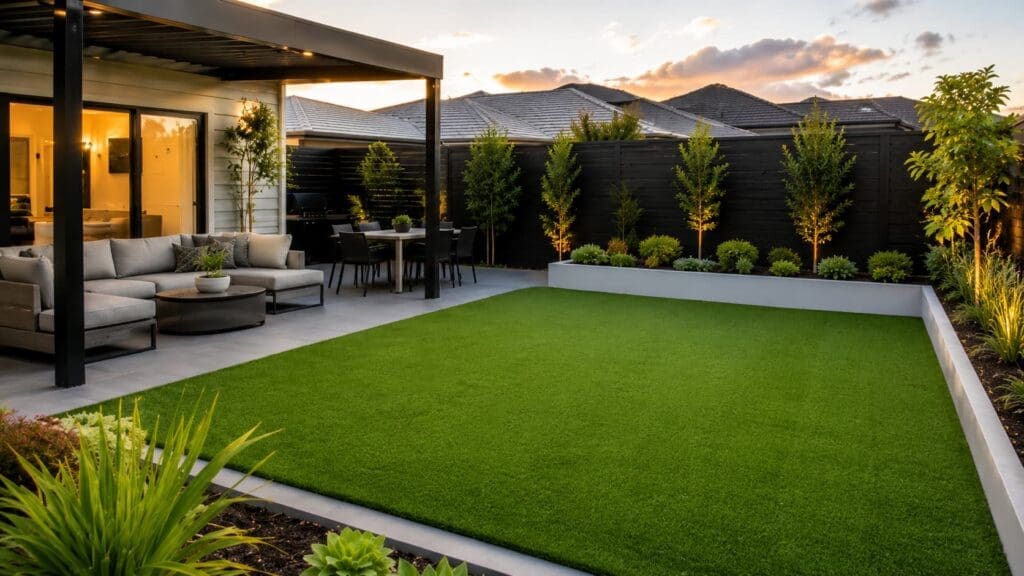
Artificial turf has become a popular option for residential and commercial landscaping, especially where people want a clean, green look without the ongoing maintenance of natural grass. It can be a smart choice in the right setting, but it is not the perfect answer for every outdoor area.
The key is knowing where artificial turf adds real value — and where natural grass, paving, planting, bark, gravel, or other landscaping options may be a better long-term solution.
Artificial turf works well for small home lawns where mowing, watering, and mud are constant issues. In compact backyards, side areas, townhouses, and low-maintenance homes, it can provide a neat green surface all year round.
This is especially useful for people who want the look of grass but do not want the time and cost involved in lawn care. It also suits properties where natural grass struggles because of shade, poor soil, or heavy foot traffic.
Artificial turf can be a good fit around patios, pergolas, decks, outdoor kitchens, pool areas, and entertainment spaces. It softens the look of hard surfaces and helps create a more finished outdoor area.
For homes with louvre pergolas, outdoor blinds, spa zones, or covered entertaining spaces, turf can provide a clean transition between the house and the outdoor area. It gives the space a more relaxed feel without the mess of soil, bark, or patchy lawn.
For dogs and pets, artificial turf can be useful when the right product and drainage base are used. It can help reduce mud being walked into the house and can make smaller pet zones easier to clean.
However, pet turf needs good drainage, regular rinsing, and proper maintenance. Poor-quality turf or badly prepared bases can hold odours, especially in warm weather.
Artificial turf can work well in children’s play zones, early learning centres, schools, and childcare areas where natural grass may wear out quickly. It provides a softer-looking surface than concrete and can handle frequent use better than many natural lawns.
For these spaces, product choice matters. The turf system should be selected for safety, drainage, UV resistance, and comfort underfoot. It should also be installed over a properly prepared base, not simply laid over uneven ground.
Commercial properties often use artificial turf because it stays tidy with less maintenance. It can be useful for:
Hotels and motels
Retail centres
Office courtyards
Display areas
Apartment complexes
Body corporate spaces
Rooftop and balcony landscaping
Showrooms and event areas
In these settings, the main benefits are appearance, durability, and reduced maintenance. Artificial turf can help keep a commercial site looking presentable without regular mowing or irrigation.
Some places simply receive too much traffic for natural grass to survive. Narrow access paths, entrance zones, outdoor dining areas, and shared apartment lawns often become muddy or patchy. Artificial turf can be a practical solution where the goal is a clean, stable, green surface.
It is not always about replacing a full lawn. Sometimes artificial turf works best as a targeted surface in the problem areas only.
Artificial turf is not always the best choice for large residential lawns or garden spaces where natural planting could do the job better. A mix of real lawn, native planting, trees, garden beds, gravel paths, and mulch can provide better cooling, habitat, and long-term landscape value.
For large areas, artificial turf can also become expensive upfront, especially once base preparation, edging, drainage, and installation are included.
Artificial turf can become hot in direct summer sun. This matters for children, pets, bare feet, and outdoor entertaining areas. In exposed north-facing spaces, around pools, or areas with little shade, it is worth thinking carefully before using turf across the whole surface.
Shade structures, trees, umbrellas, pergolas, or a mix of materials can help reduce heat. In many cases, artificial turf works better when it is combined with planting and hard landscaping rather than used wall-to-wall.
Although artificial turf systems can be built with drainage layers, they are still not the same as natural soil and lawn. In areas where stormwater soakage, garden health, or natural permeability is important, other landscaping options may be better.
Good drainage design is essential. Without it, water can pool, the base can move, and the surface can fail over time.
Artificial turf does not support insects, soil life, birds, or garden ecosystems in the same way as natural planting. If the goal is to create a cooler, greener, more natural garden, then trees, shrubs, groundcovers, and real lawn should remain part of the design.
A better approach is often a hybrid landscape: artificial turf for functional use areas, and natural planting around the edges.
Artificial turf is only as good as the preparation underneath it. A cheap product laid over uneven ground will often look poor and fail early. Common problems include ripples, sinking, weeds through joins, poor drainage, odour, and visible seams.
For a good result, the base needs to be compacted, level, free draining, and properly edged. The turf should also suit the intended use, whether that is pets, play, sports, landscaping, or commercial presentation.
Artificial turf makes the most sense when it solves a real problem. That could be mud, high maintenance, poor grass growth, heavy use, or a space that needs to stay tidy all year.
It makes less sense when it is used simply to cover a large area that could be better handled with planting, natural lawn, or a more sustainable landscape design.
The best projects usually combine artificial turf with other materials such as pavers, decking, gravel, garden beds, shade structures, and native planting. This creates a more balanced outdoor space that looks good, performs well, and feels more natural.
Artificial turf can be a smart landscaping product when used in the right place. It is practical, low maintenance, clean, and useful for many residential and commercial applications.
However, it should not be treated as a one-size-fits-all replacement for natural landscaping. Heat, drainage, environmental impact, product quality, and end-of-life disposal all need to be considered.
For homeowners, schools, commercial sites, and outdoor living spaces, the best result comes from choosing the right surface for the right area. Artificial turf works best when it is part of a well-planned landscape — not the whole landscape.


