
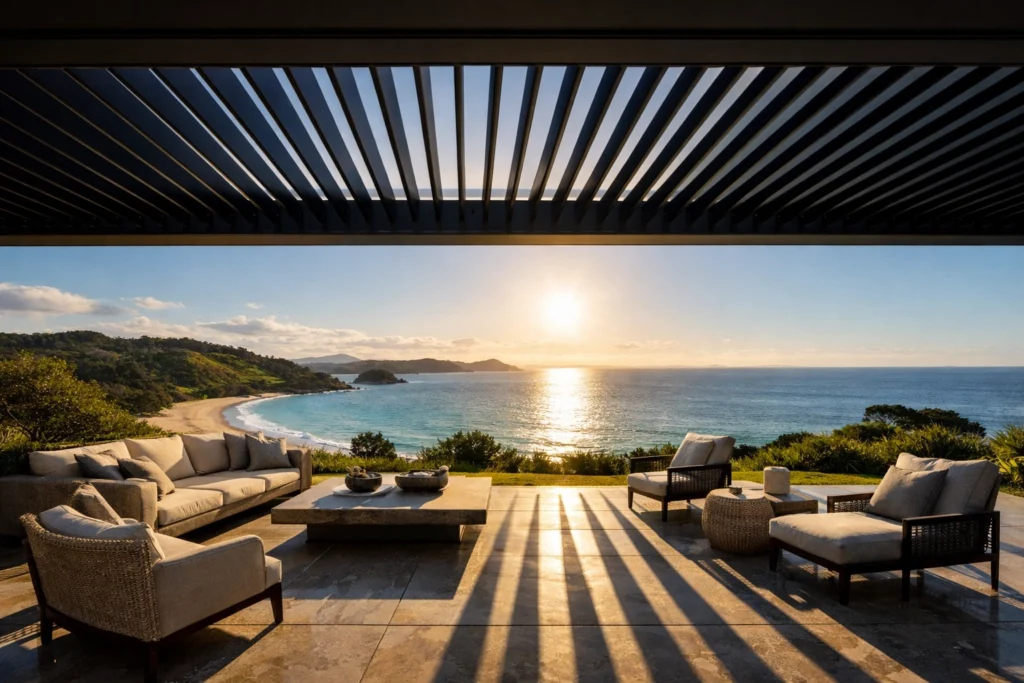
or years, the standard "backyard upgrade" in New Zealand followed a predictable path: a timber pergola, some shade cloth, or perhaps a basic kit-set aluminum structure. But as our outdoor living expectations have shifted toward year-round functionality and high-end architectural aesthetics, the limitations of basic systems have become glaringly obvious: especially when dealing with large footprints.
When you start looking at covering areas over 30m², you move out of the realm of "casual DIY" and into the world of serious structural engineering. This is where high-end, made-to-measure louvre systems: often referred to as flagship systems: separate themselves from the pack.
If you are planning a significant outdoor extension, understanding the technical "why" behind premium systems is the difference between a structure that lasts five years and one that lasts fifty.
In New Zealand, the scale of your project dictates the rules you must follow. Under current building legislation, many small carports or shades might fall under exemptions, but once a structure exceeds 30m², the game changes.
For large-scale residential or commercial projects, a Producer Statement (PS1) is often a non-negotiable requirement for council compliance. High-end made-to-measure systems are engineered specifically to meet these rigorous standards.
A PS1 is essentially a professional guarantee from an engineer that the design meets the New Zealand Building Code. Cheap, off-the-shelf kits rarely come with this level of documentation. When you opt for a made-to-measure flagship system, you aren’t just buying aluminum and motors; you are buying the peace of mind that the structure is legally compliant and structurally sound for its specific location.

Not all aluminum is created equal. Most entry-level louvre systems use 6063-T5 aluminum. While 6063 is a fine "architectural grade" for window frames or small decorative trim, it often lacks the tensile strength required for massive spans or high-wind environments.
High-end made-to-measure systems typically utilize 6005-T6 high-grade aluminum. This alloy offers significantly higher strength and better resistance to bending under load.
One of the primary reasons homeowners choose a premium made-to-measure system is the desire for uninterrupted views. In a standard kit-set system, the structural limitations of the aluminum mean you often need a support post every 3 or 4 meters. For a large deck or patio, this can result in a "forest of posts" that ruins the connection between the indoor and outdoor spaces.
Flagship systems are designed to push the boundaries of physics. By using reinforced internal beams and the aforementioned 6005-T6 aluminum, these systems can achieve spans of up to 8.4 meters or more without requiring middle support posts.
Achieving an 8.4m+ span is a feat of engineering that requires precision manufacturing. It allows for a completely open floor plan underneath, making it ideal for large dining areas, outdoor kitchens, or poolside lounging. When you are investing in a high-end property, you shouldn't have to compromise your view because the louvre system wasn't strong enough to hold its own weight.
When comparing louvre systems, most people look at the blades and the color. However, the most important parts are the ones you can't see. In New Zealand’s coastal environment, salt spray and high humidity are the enemies of mechanical systems.
Many budget systems use plastic or low-grade alloy internal components for the louvre rotation mechanism. Over time, UV exposure makes plastic brittle, and salt air causes cheap alloys to seize up.
In contrast, high-end systems utilize Brass H59 internal components. Brass is the gold standard for moving parts in harsh environments for several reasons:
If you are located anywhere near the coast, choosing a system with brass internals is not an "extra": it is a necessity.
New Zealand is one of the windiest countries on earth. From the "Wellington Wind" to the sudden gales of the Hauraki Gulf, outdoor structures take a beating. A standard pergola might survive a breezy afternoon, but it won't stand up to a serious storm.
Premium made-to-measure systems are tested and rated for extreme weather. Some flagship models boast high-wind ratings of up to 234 km/h. To put that in perspective, that is equivalent to a Category 4 or 5 cyclone.
This level of protection is achieved through:
When the weather turns, you want to know that your investment is secure. You can even pair these systems with Titan Outdoor Blinds to create a fully enclosed, wind-resistant room.

The hallmark of a high-end system is that it doesn't look like a "system" at all: it looks like part of the house. Achieving this requires a level of detail that mass-produced kits simply cannot match.
In 2026, a louvre system shouldn't just be manual. High-end systems integrate seamlessly into the modern smart home. Most flagship systems now utilize Tuya smart integration, allowing you to control your outdoor environment from your smartphone or through voice commands.
With smart integration, your louvre system becomes proactive rather than reactive:
This level of automation is particularly useful for large systems over 30m², where manually adjusting several bays of louvres would be a chore.
Once you have the structural foundation of a high-end louvre system, the possibilities for the space expand. Because these systems are so robust, they can handle the addition of lighting, heating, and even glass sliding doors.
For those looking to create a true outdoor culinary center, the stability of a high-end system provides the perfect environment for a Vulcan Fire Grill or a Flamma Dominus Pizza Oven. When you aren't worried about the roof leaking or the wind blowing your umbrella over, you can focus on enjoying the space.
Choosing a high-end made-to-measure louvre system is an investment in both property value and lifestyle. If you are planning a space over 30m², remember these essential points:
By focusing on these technical benchmarks, you ensure that your outdoor living area is not just a seasonal addition, but a permanent, high-performance extension of your home.


