
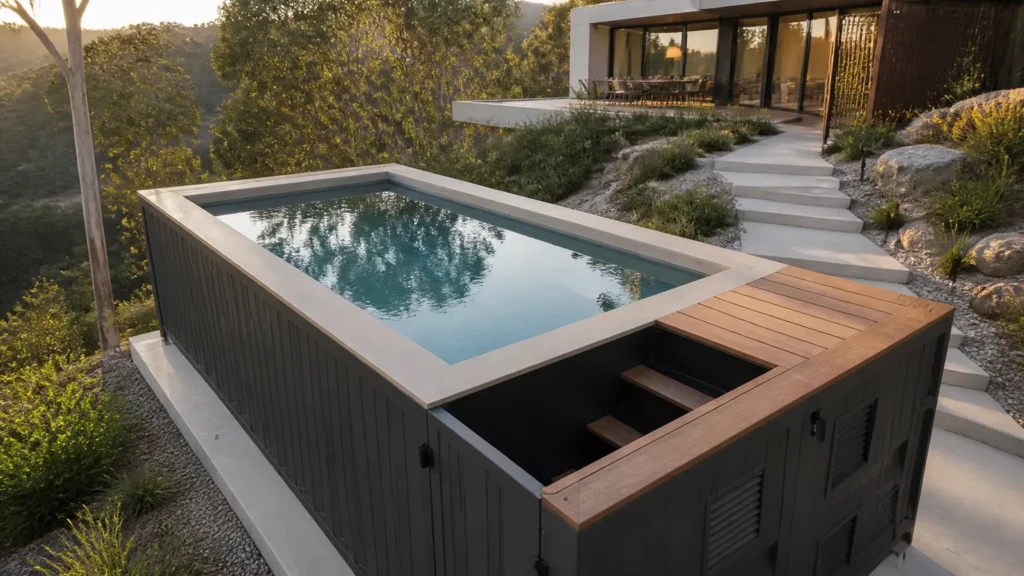
Container pools are becoming increasingly popular across New Zealand due to their modern appearance, fast installation potential, and flexibility in difficult locations. One of the biggest advantages of a container pool is that it can often be installed in places where traditional in-ground pools become expensive or complicated.
However, installing a container pool on a sloped site requires careful planning.
While slopes can create incredible elevated pool designs and views, they also introduce structural, drainage, engineering, and access challenges that must be addressed properly before installation begins.
The first thing that needs to be assessed is the actual slope of the site.
Not all slopes are the same. A gentle fall across a backyard is very different from a steep hillside section. The direction of the slope also matters significantly. A pool running across the slope may require different support methods compared to a pool running downhill.
Important things to determine include:
The more information available early in the process, the easier it becomes to determine the best installation method.
A container pool may appear lightweight when empty, but once filled with water, it becomes an extremely heavy structure.
Water weighs approximately 1 tonne per cubic metre. When combined with the steel shell, internal reinforcements, filtration systems, and occupants, the total weight can become substantial.
Because of this, the pool must sit on a properly engineered and level support system.
On a sloped site, this usually means additional structural work compared to a flat installation.
The correct foundation depends on the slope, soil conditions, and pool size.
Common support solutions include:
A reinforced concrete pad is one of the most common methods for flatter sloped sites or partially excavated areas.
This creates a stable and level platform capable of supporting the full weight of the pool.
For steeper sites, piles are often used to transfer the load deeper into stable ground.
The container pool can then sit on steel beams or reinforced supports attached to the piles.
Some installations use structural steel platforms to create a suspended or elevated pool effect.
This can work particularly well for modern homes built into hillsides or coastal properties.
In some cases, retaining walls may be required to create a level installation area.
These walls must be engineered properly and include drainage systems to manage groundwater pressure.
Drainage is one of the most important aspects of any sloped installation.
Without proper drainage, water can build up around the support structure or retaining systems, potentially causing movement or instability over time.
A proper drainage plan may include:
This is particularly important in regions with high rainfall or changing ground conditions.
One of the biggest overlooked factors with container pools is access.
Container pools are large prefabricated structures and often require:
Things like narrow driveways, steep accessways, powerlines, trees, fencing, or neighbouring buildings can all affect installation feasibility and cost.
Sometimes the site itself is suitable for the pool, but access limitations may require a larger crane or alternative lifting strategy.
Depending on the project, a sloped container pool installation may require:
Requirements can vary depending on the local council and complexity of the installation.
In many cases, early engineering input can save significant time and cost later in the project.
While sloped sites add complexity, they can also create some of the most visually impressive container pool installations.
Elevated pools overlooking landscapes, partially suspended pools, infinity-edge concepts, and integrated deck systems are all possible with the right planning and engineering.
With proper structural support and drainage design, container pools can work exceptionally well on challenging terrain.
For many properties, a slope is not a limitation — it becomes part of the overall design feature itself.


