
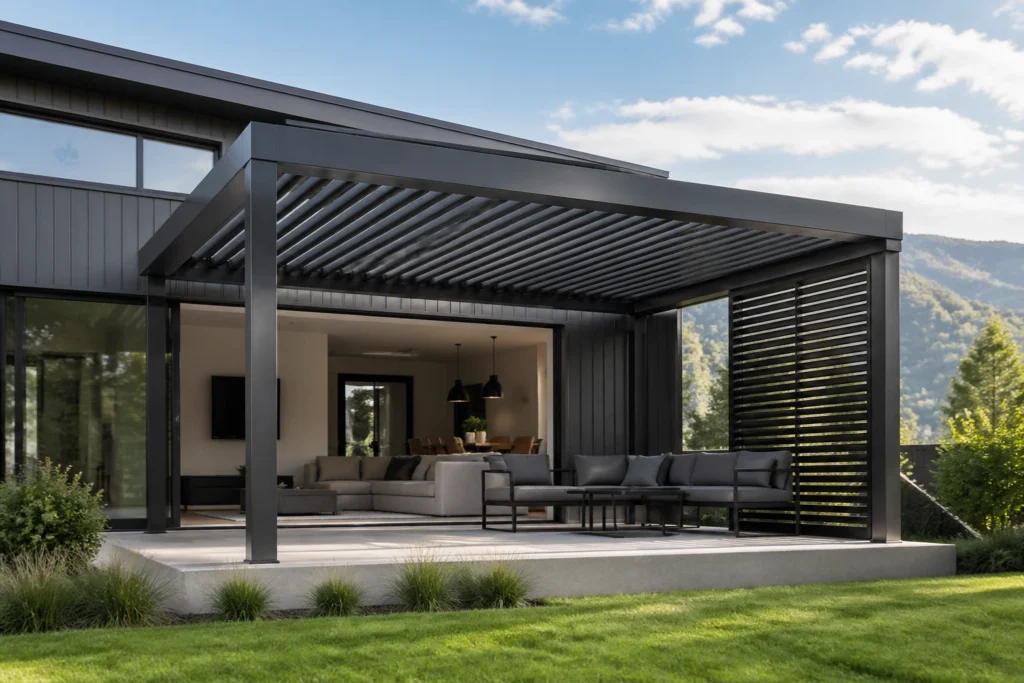
The evolution of residential architecture in New Zealand has shifted significantly toward seamless indoor-outdoor flow. Central to this movement is the louvre system, a functional structural element that provides climate control and aesthetic value. Historically, the market was divided into two distinct tiers: high-end bespoke installations offering a full spectrum of architectural colors, and DIY louvre kitsets restricted to a handful of standard colors like white or generic silver.
The introduction of custom architectural color integration into the kitset model marks a significant market shift. By making established New Zealand palettes — specifically Flaxpod, Grey Friars, and Ironsand — available in kitset formats, the industry is closing a long-standing gap between standardized supply and architectural specification. These finishes were previously associated with custom-engineered solutions, where project-specific powder-coating, fabrication scheduling, and longer lead times were accepted as part of the process. Their movement into kitset supply changes what is considered achievable in a pre-configured system.
This matters because color is not a cosmetic afterthought in exterior architecture. It is a specification variable that controls how well a secondary structure integrates with the primary building envelope. When a kitset can align with established joinery, roofing, and cladding palettes, it can achieve architectural neutrality — meaning the addition reads as intentional, coordinated, and structurally resolved rather than visually separate.
New Zealand’s light is uniquely harsh and clear. In this environment, colors that work in Europe or North America often appear garish or washed out. The local residential landscape is dominated by a specific palette designed to harmonize with the rugged coastline, dense bush, and volcanic soil.
For a louvre system to be successful in an NZ context, it must match the existing joinery, roofing, and cladding. When a kitset is only available in a color that "almost" matches, the visual friction is immediate. The structure looks like an afterthought: a secondary addition that detracts from the home's value.
Architectural neutrality is the concept of a structure existing in harmony with its surroundings. This is achieved through:
In New Zealand, three specific colors have come to define modern residential design. Bringing these to the DIY louvre kitset market is what makes recent developments groundbreaking.
Flaxpod is a deep, earthy black with a hint of warmth. It has rapidly become the most requested color for new builds across the country.
A charcoal grey with a slight blue undertone, Grey Friars is a staple of mid-to-high-end residential architecture.
Ironsand is a sophisticated, olive-tinted black/brown inspired by the volcanic sands of the West Coast.
Offering these colors in a kitset format is a significant technical achievement. In the traditional manufacturing model, aluminum louvres are mass-produced in neutral white or silver to minimize inventory risk, simplify batch scheduling, and reduce production downtime.
Architectural dark neutrals such as Flaxpod, Grey Friars, and Ironsand were historically tied to custom-engineered projects for several reasons:
Custom colors require a controlled powder-coating process. This involves:
The market shift is not simply that these colors now exist in kitset supply. The shift is that finishes once associated with custom-engineered specification are being integrated into a more standardized delivery model. That changes buyer expectations. It raises the baseline from basic weather protection to coordinated architectural performance.
The primary driver for choosing a DIY louvre kitset with custom color options is the balance between cost-efficiency and high-end results.
Most modern New Zealand homes utilize aluminum joinery for windows and doors. These are almost exclusively finished in the architectural palette mentioned above. When the louvre frame matches the window frames exactly, the outdoor room feels like an extension of the interior living space.
A mismatched outdoor structure can be seen as a liability during a property appraisal. Conversely, a color-integrated louvre system is viewed as a permanent architectural feature. It suggests a level of planning and quality that standard "off-the-shelf" kits do not.
Architectural-grade powders (like those used for Flaxpod or Ironsand) are formulated for the high-UV environment of the Southern Hemisphere. They are designed to resist chalking and fading, ensuring that the louvre systems maintain their structural and visual integrity for decades.
When selecting a kitset, the goal is to identify the "anchor color" of your home. Follow these steps for successful integration:
The wider availability of architectural colors signals a structural change in the kitset market. End users no longer view pre-configured outdoor systems as separate from architectural intent. They expect them to align with the same color logic, material hierarchy, and finish quality used across the rest of the building.
This shift is important because it redefines what kitset supply is expected to deliver. Previously, the trade-off was straightforward: choose standardization for speed and simplicity, or choose custom engineering for finish control and palette accuracy. As architectural powders such as Flaxpod, Grey Friars, and Ironsand move into kitset formats, that trade-off becomes less rigid. The gap between off-the-shelf supply and architecturally integrated outcomes narrows.
This trend is also likely to influence adjacent categories of exterior design, particularly where secondary structures must visually connect with the main building envelope. As more exterior components adopt coordinated powder-coat options, the expectation of a unified architectural language will continue to strengthen.

By prioritizing color integration, specifiers and homeowners can move beyond basic shade provision and evaluate outdoor structures as part of a coordinated architectural system. The key shift is clear: finishes once associated primarily with custom-engineered delivery are now influencing expectations within the kitset market.


