
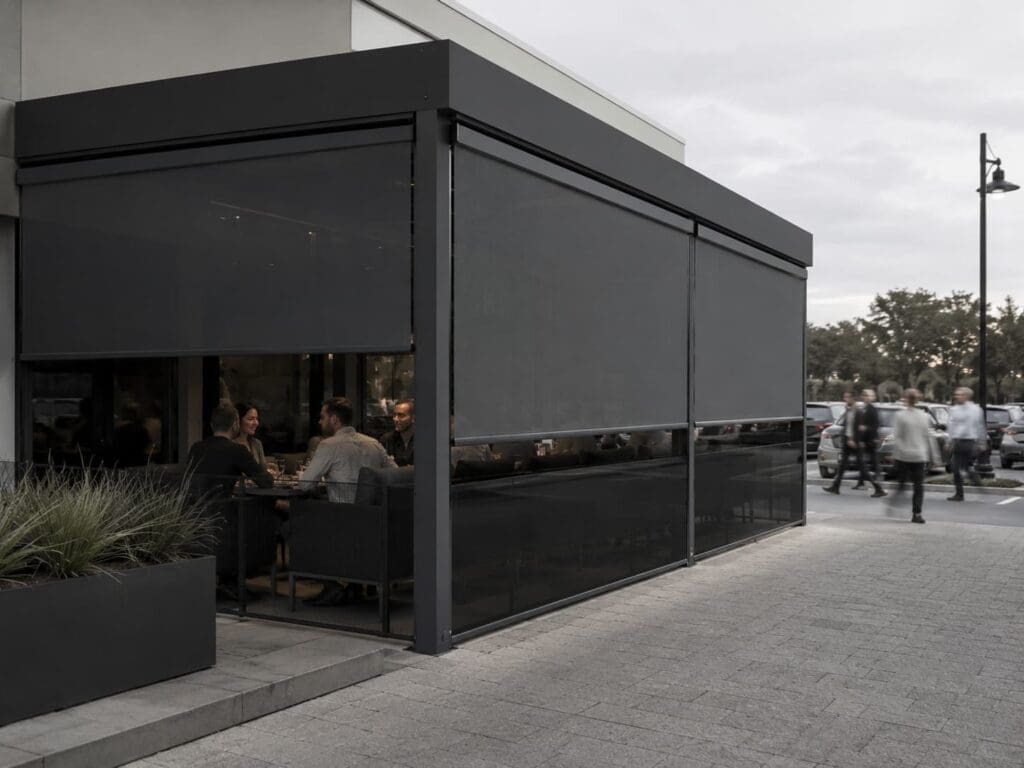
Outdoor entertaining areas are designed for relaxing, dining and spending time with family and friends. However, noise can quickly affect how comfortable these spaces feel—particularly in urban neighbourhoods, townhouse developments, roadside properties and homes positioned close to neighbours.
Outdoor blinds are primarily installed for weather protection, privacy and shade, but the right blind system can also help manage noise around a patio, deck, pergola or outdoor dining area.
They will not completely soundproof an outdoor space. However, well-fitted outdoor blinds can create an additional barrier that softens some external noise, reduces direct sound paths and helps contain activity noise within the entertaining area.
Outdoor blinds can help reduce the amount of sound travelling directly into or out of an outdoor area, but their effectiveness depends on several factors:
Noise control does not mean complete silence, and the term “soundproof” should be used carefully. Even purpose-built building systems must manage sound through a combination of barriers, seals, materials and construction methods.
Outdoor blinds should therefore be viewed as one part of a broader outdoor noise-management strategy.
One of the most important principles of noise control is placing a continuous barrier between the sound source and the listener.
When an outdoor blind is lowered, it interrupts the direct path between the noise source and the people using the area. This can help soften sounds from:
Noise barriers generally work more effectively when they completely interrupt the line of sight between the source and the listener. Gaps and openings allow sound to travel around or through the barrier, reducing its effectiveness.
An outdoor blind is much lighter than a purpose-built acoustic wall, so it should not be expected to achieve the same performance. However, the same basic principle applies: a full-height blind with minimal gaps generally provides better noise control than a partial screen.
Sound travels easily through open spaces. A patio may have a solid roof and side walls, but one completely open elevation can still allow noise to enter and leave freely.
Zip-guided outdoor blinds can provide better coverage than loose hanging screens because the blind material is retained inside side channels. A weighted or secured bottom rail also helps keep the blind positioned closer to the ground or supporting structure.
For improved noise management, the blind should:
Openings are typically weak points in sound-control systems, which is why seals and continuity are important in building acoustics.
The tighter and more complete the enclosure, the less opportunity there is for sound to pass directly through the area.
Outdoor blind fabrics are available in different weights, thicknesses and openness levels.
Highly open mesh fabrics allow more airflow and visibility, but the openings within the weave also allow more sound to pass through. A denser screen or solid outdoor-grade material is generally more useful when noise control is a priority.
Potential options include:
A tightly woven mesh can provide a balance between privacy, airflow, sunlight control and some noise softening. It may reduce the sharpness of voices and other higher-frequency sounds without completely enclosing the space.
Screen fabrics with a lower openness percentage have fewer open spaces in the weave. They can provide greater privacy and weather protection while creating a more substantial barrier than highly open mesh.
Solid PVC does not contain the open weave found in mesh fabrics. This allows it to form a more continuous physical barrier while maintaining visibility through the blind.
PVC may be particularly useful for areas exposed to wind and rain, although its reflective surface may not absorb internal sound in the same way as a softer fabric.
The best material will depend on whether the main priority is noise control, ventilation, weather protection, visibility or privacy.
Noise control is not only about stopping sound from entering an outdoor area. Homeowners may also want to reduce the amount of noise leaving their property.
Outdoor dining areas can generate sound from:
Lowering blinds around the sides facing neighbouring homes can interrupt the direct path of this sound.
This does not guarantee that neighbours will no longer hear the activity. Sound can still travel over the roof, around the ends of the blind and through other openings. However, a more enclosed outdoor area can help reduce the direct transmission of voices and entertainment noise.
For the best result, install the blinds on the sides closest to neighbouring properties or other noise-sensitive areas.
Wind can make an outdoor space sound louder by moving through openings, disturbing furniture and creating turbulence around structures.
Outdoor blinds can help manage this by:
A well-tensioned zip blind is generally quieter and more stable than a loose sheet-style screen. Correct installation and suitable use during strong winds remain essential.
Outdoor blinds may also make conversations easier by reducing background distractions.
When road noise, wind and neighbouring activity are softened, people may not need to speak as loudly to hear one another. This can indirectly reduce the overall amount of noise generated within the space.
The result can be a more comfortable environment for:
Installing one blind on the side facing the main noise source can provide a degree of protection. However, sound may still travel around the edges of the blind.
Enclosing two or three sides can create a more protected zone, especially when combined with a solid pergola or louvre roof.
For example, a property beside a busy road may benefit from:
Noise-control barriers need sufficient height and length because sound can bend around their edges.
Outdoor blinds usually work best when combined with other practical measures.
These may include:
Landscaping alone usually needs significant depth and density before it produces meaningful acoustic reduction, but it can still improve privacy and make a space feel more sheltered.
It is important to set realistic expectations.
Outdoor blinds cannot normally:
Low-frequency sounds from trucks, heavy equipment, subwoofers and industrial machinery are especially difficult to control. These sounds may require heavier barriers, specialist construction or advice from an acoustic consultant.
Outdoor blinds can be a useful addition where the goal is to create a quieter, more private and more comfortable outdoor area.
Their strongest noise-related benefits come from:
The greatest improvement is generally achieved with full-height, well-fitted blinds using denser fabric and minimal gaps.
Outdoor blinds should not be sold as a complete soundproofing solution. They are better described as a practical way to help manage noise while also improving privacy, shade, wind protection and weather control.
Apollo NZ supplies Titan outdoor blind systems for residential and selected commercial outdoor spaces.
Available configurations can include:
For customers concerned about noise, the opening size, blind material, side-track coverage and surrounding structure should all be considered before selecting a system.


