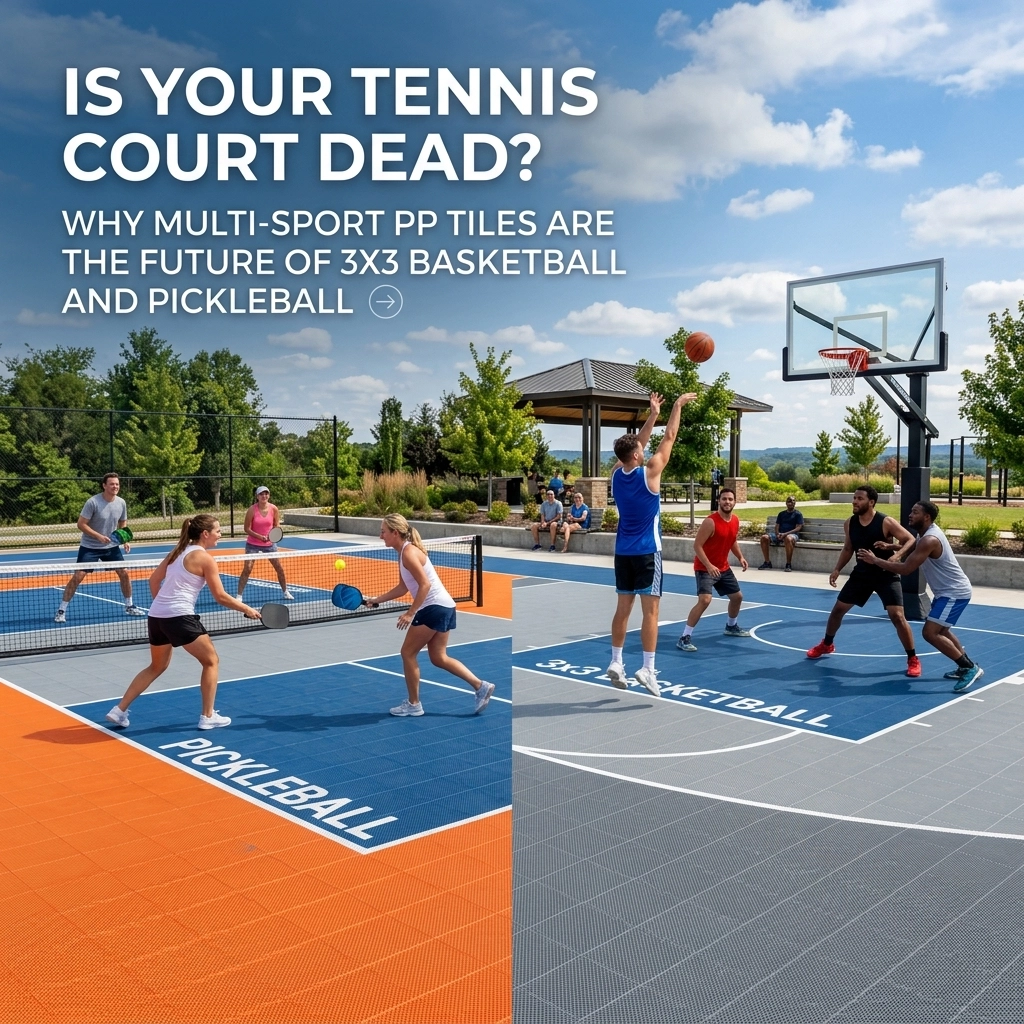
Is Your Tennis Court Dead? Why Multi-Sport PP Tiles are the Future of 3x3 Basketball and Pickleball

April 6, 2026
Spread the love

For decades, the full-sized concrete or asphalt tennis court was the ultimate status symbol in New Zealand backyards and local clubs. However, as property sizes evolve and leisure time becomes more precious, many of these expansive surfaces have fallen into disrepair. Cracked concrete, fading lines, and pooling water are common sights across the country.

The reality is that a standard tennis court requires a massive footprint: roughly 260 square metres: for a game that many find difficult to master or play frequently. Meanwhile, sports like Pickleball and 3x3 Basketball are surging in popularity, offering faster gameplay, lower barriers to entry, and a significantly better use of space.

If you have a "dead" tennis court, you are sitting on a goldmine of recreational potential. The solution isn’t a costly demolition and re-pour; it is the adoption of Multi-Sport Polypropylene (PP) Tiles.

The Shift: Why Tennis is Giving Way to Multi-Sport Hubs

The decline of the traditional backyard tennis court isn't just about the sport itself; it's about utility. A tennis court is a single-use space. In contrast, a modern multi-sport hub allows for a variety of activities on a smaller, more manageable footprint.
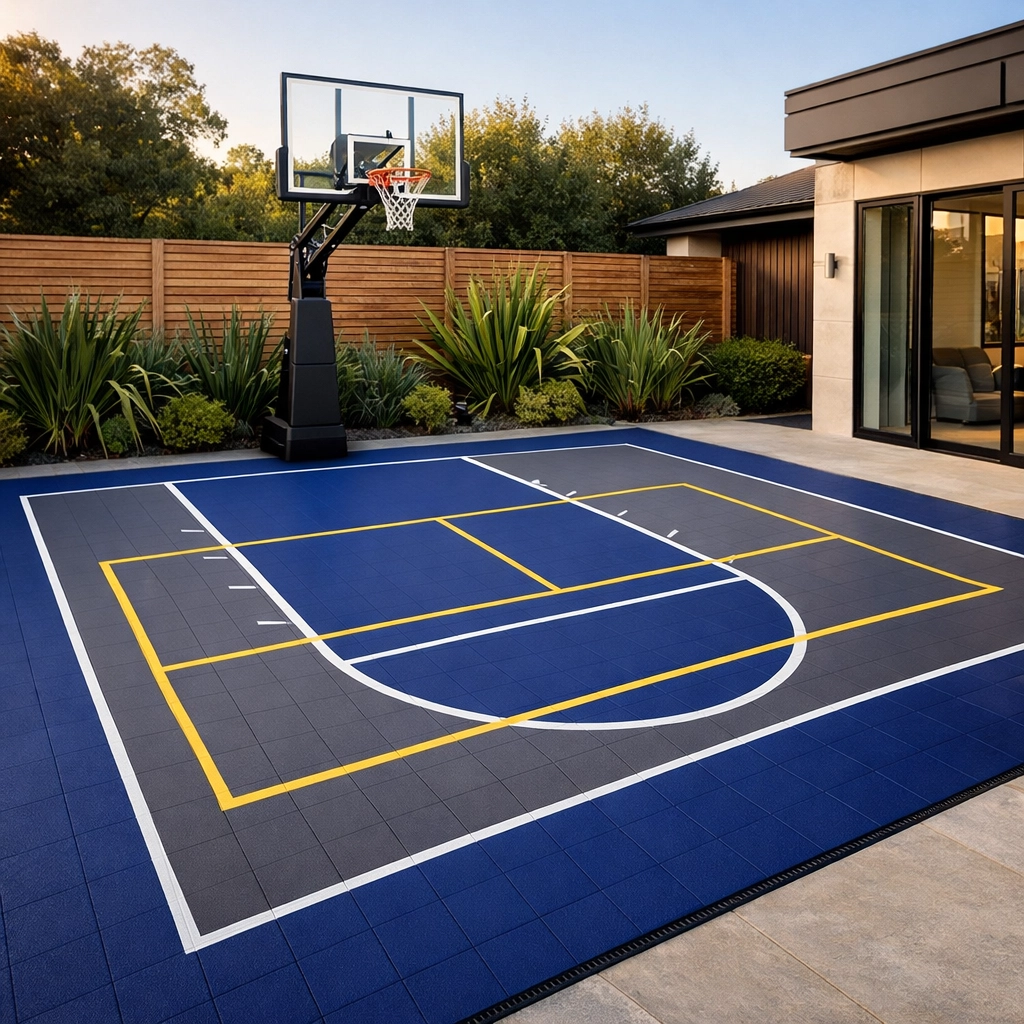
  • Pickleball: Often described as a mix of tennis, badminton, and table tennis, Pickleball is the fastest-growing sport globally. It is played on a court roughly one-third the size of a tennis court, meaning you can fit two or even three Pickleball courts into the space of one unused tennis court.
  • 3x3 Basketball: With its recent inclusion in the Olympic Games, 3x3 basketball has moved from the street to the professional arena. It requires only a half-court and a single hoop, making it the perfect addition to a multi-purpose surface.
  • Space Efficiency: By converting an old court into a multi-sport area, you increase the "play-per-square-metre" ratio, making the investment far more valuable for families, schools, and community hubs.

Multi-sport backyard court with blue PP tiles and markings for 3x3 basketball and pickleball in NZ.
High-end residential backyard in New Zealand featuring a vibrant multi-sport court with both 3x3 basketball markings and a pickleball net setup.

What are PP (Polypropylene) Sports Tiles?

Polypropylene (PP) tiles are modular, interlocking flooring units engineered specifically for high-performance athletic use. Unlike traditional poured surfaces like acrylic or asphalt, these tiles are "floating" floors. They are designed to sit on top of an existing hard sub-base, such as your old tennis court’s concrete or asphalt.

Technical Specifications and Performance

  • Material: High-impact polypropylene, a thermoplastic polymer known for its incredible toughness and resistance to chemical solvents and acids.
  • Surface Geometry: Most high-end tiles feature a perforated or "open-grid" design. This allows for immediate vertical drainage, ensuring the court is playable minutes after a heavy Kiwi downpour.
  • Shock Absorption: Unlike the unforgiving nature of concrete, PP tiles are engineered with a slight vertical and lateral "give." This reduces the impact on joints: knees, ankles, and lower backs: allowing for longer play sessions with less fatigue.

The Advantages of Modular Surfaces in the NZ Climate

New Zealand’s weather is famously unpredictable. From the intense UV rays of the North Island to the damp, frosty conditions of the South, outdoor surfaces take a beating.

1. Superior Drainage and All-Weather Play

Traditional courts often suffer from "puddling" where the sub-base has settled unevenly. PP tiles solve this through their perforated structure. Water drains directly through the surface and flows along the sub-base, keeping the playing area dry and slip-resistant. This makes them ideal for the New Zealand outdoor lifestyle, where we want to maximize our time outside regardless of the season.

2. UV Stability and Colour Retention

The UV index in New Zealand is among the highest in the world. Standard court paint often flakes, fades, or "chalks" within a few years. Professional-grade PP tiles are infused with high-level UV stabilizers during the manufacturing process, ensuring the vibrant blues, greens, or terracotta reds stay bright for a decade or more.

3. Thermal Expansion Management

Concrete cracks because it cannot expand and contract effectively with temperature changes. Modular tiles are designed with expansion gaps between the interlocking teeth. This "breathing" room prevents the surface from buckling or warping during the height of summer or the depths of winter.
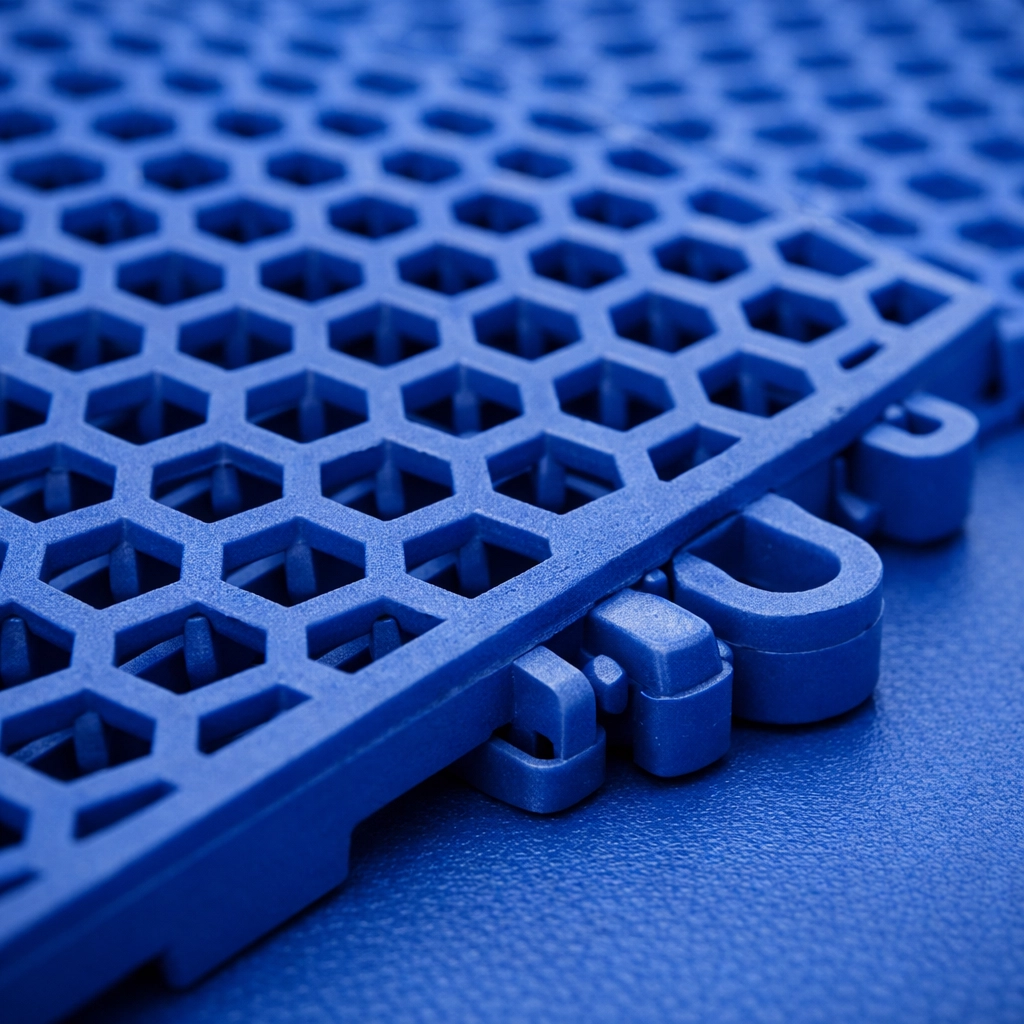
Close-up of interlocking PP sports tiles showing the perforated drainage grid and locking mechanism.
Close-up detail of interlocking PP sports tiles showing the perforated grid pattern for drainage and the robust locking mechanism.

Converting Your Existing Court: A Step-by-Step Guide

The beauty of sports and gym equipment like modular tiles is the ease of installation. You don’t need a construction crew for weeks; you need a solid plan.

Step 1: Sub-Base Assessment

Before laying tiles, evaluate your existing tennis court. While the tiles will cover cracks and stains, they require a structurally sound, flat surface.

  • Clean the surface: Remove moss, mold, and debris.
  • Patch major cracks: Use a concrete filler to ensure the tiles sit level.
  • Check levels: Ensure there is a slight gradient for water to run off the underlying concrete.

Step 2: Designing the Layout

Because you are likely moving from a single-sport (tennis) to a multi-sport environment, planning your lines is critical. Use a primary colour for the main sport (e.g., White for Basketball) and a secondary, high-contrast colour for the subordinate sport (e.g., Yellow for Pickleball).

Step 3: Installation

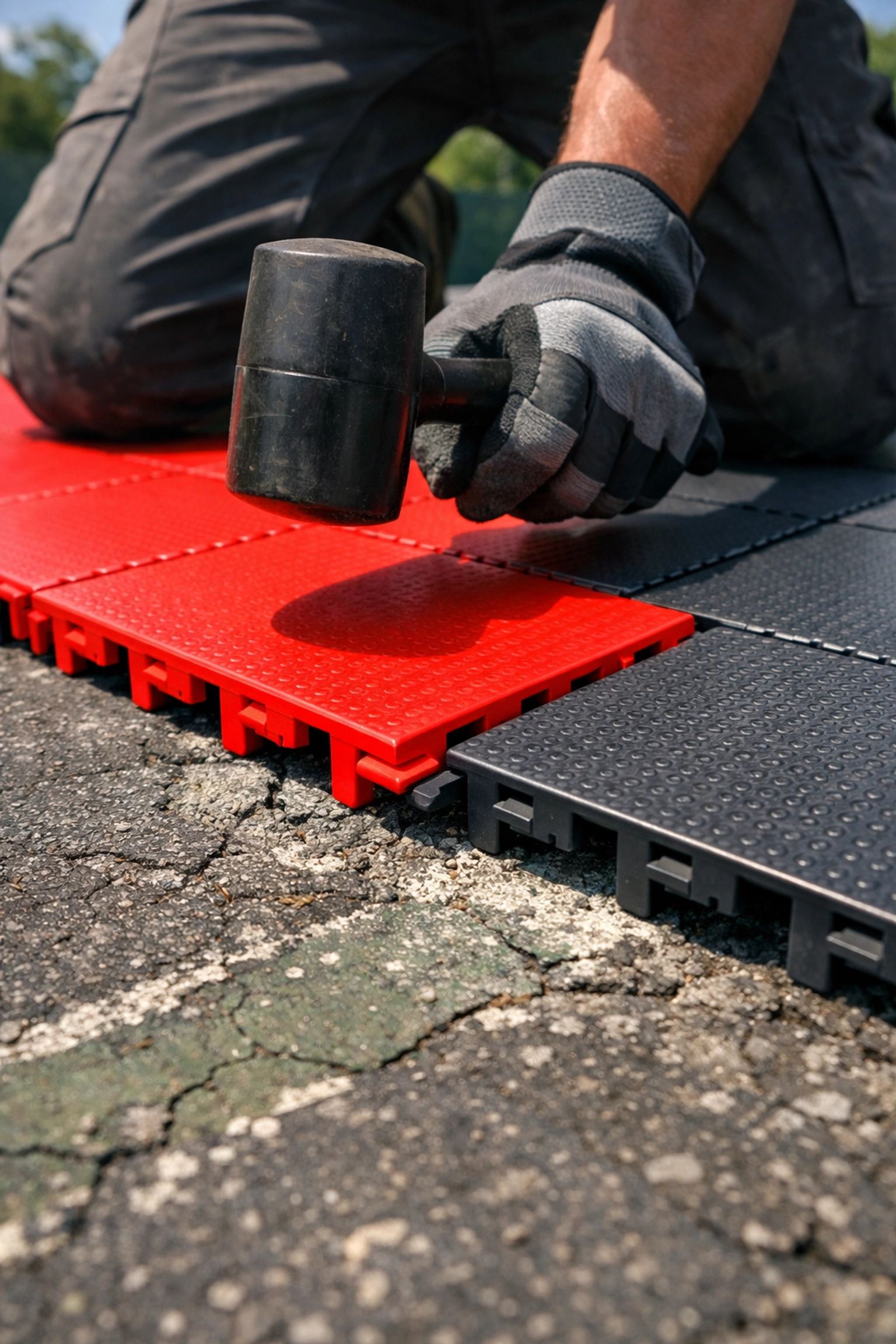
Installation is a mechanical process. Tiles typically "click" together using a mallet.
  • Start from the centre: Work outwards to ensure the court is perfectly squared.
  • Edge finishing: Use ramped edge pieces to prevent tripping hazards and provide a professional, finished look.
  • Professional Help: For large-scale projects or complex multi-sport layouts, using approved installers ensures the expansion joints and line markings are precision-aligned.

Installing red modular PP tiles over an old asphalt tennis court surface for a sport court conversion.
A worker installing interlocking tiles over an old asphalt surface, demonstrating the "click" mechanism and the rapid transformation of the space.

Aesthetics: Elevating Your Property Value

An old, grey, cracked tennis court is a liability during a property appraisal. A vibrant, modern multi-sport hub is a massive asset.

Customization options include:
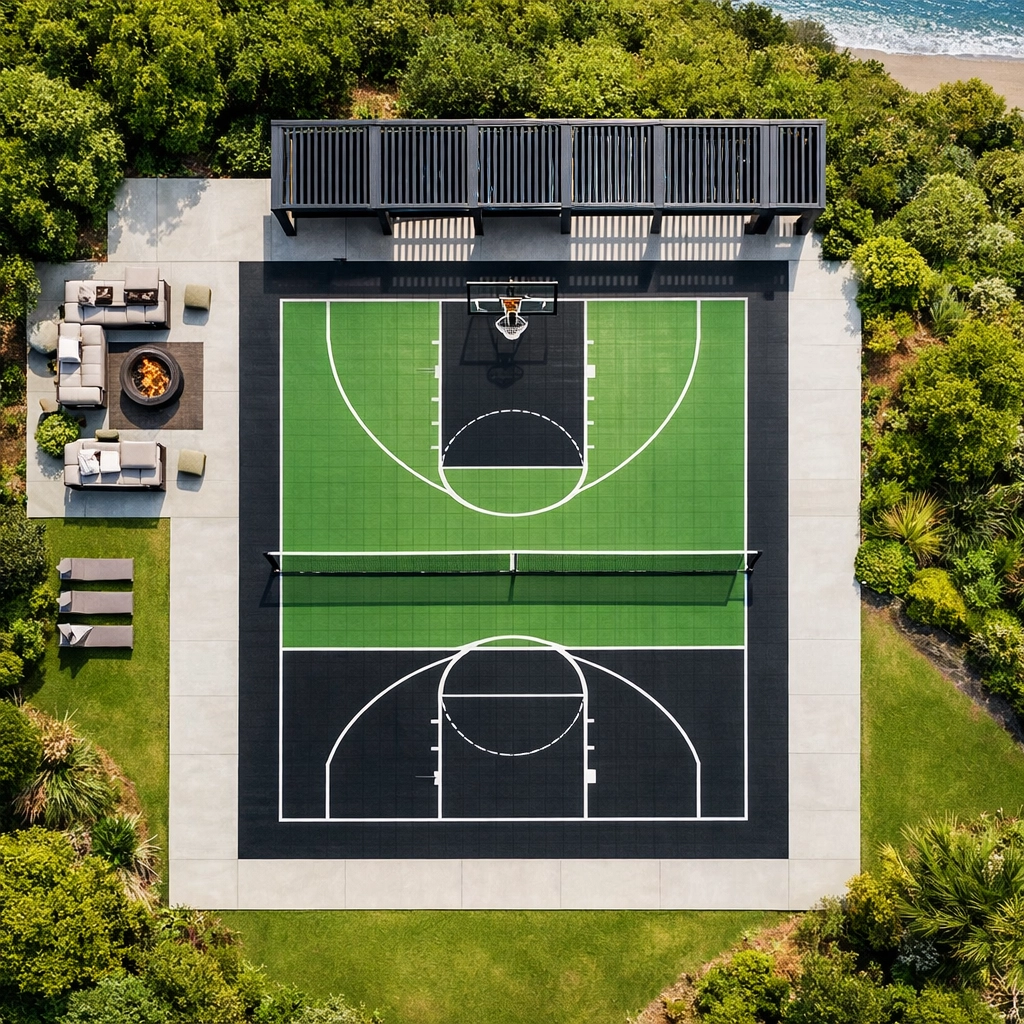
  • Two-Tone Designs: Using a different colour for the "in-bounds" and "out-of-bounds" areas creates a professional, stadium-like feel.
  • Team Branding: Many homeowners choose colours that reflect their favourite sports teams or even incorporate custom logos into the centre of the court.
  • Integration with Landscaping: Because the tiles have a clean, geometric aesthetic, they pair perfectly with modern architectural elements, such as louvre systems, glass balustrades, and minimalist gardens.

Aerial view of a modern multi-sport court with green PP tiles integrated into a luxury NZ backyard.
An aerial view of a designer property where a converted court serves as a focal point, surrounded by modern landscaping and outdoor seating areas.

Maintenance: Low Effort, High Reward

One of the primary reasons tennis courts "die" is the high maintenance cost of resurfacing every 5-7 years. PP tiles flip this script.

  • Cleaning: A simple hose down or a leaf blower is usually all that’s required to remove organic matter.
  • Repairability: If a single tile is damaged (for example, by a heavy dropped object), you don't need to resurface the whole court. You simply pop out the damaged tile and click in a new one.
  • Longevity: Most professional-grade PP tiles come with significant warranties, often exceeding 10 years, making them a "set and forget" solution for property owners.

Summary: Key Takeaways for Court Conversion

If your tennis court has become a wasted space, it is time to reconsider its purpose. Converting to a multi-sport hub using PP tiles offers a range of benefits that traditional surfaces simply cannot match:

  • Versatility: Play 3x3 basketball, Pickleball, volleyball, and more on a single surface.
  • Durability: High-impact polypropylene stands up to NZ’s harsh UV and rain.
  • Safety: Integrated shock absorption protects players’ joints and reduces injury risk.
  • Efficiency: Perforated tiles provide instant drainage, allowing for year-round use.
  • Cost-Effective: Avoid the massive expense of tearing up concrete by using a modular "floating" floor system.

Whether you are a homeowner looking to provide a safe play area for the family or a facility manager wanting to revitalize a community asset, multi-sport tiles are the definitive future of the New Zealand backyard.


Return to insights

Charities We Support

cart
barttong pizza em alcântara | menu €5 10 | reserve. Enjoy your moist strawberry muffins & try these variations. top irrigation materials suppliers in kenya.