
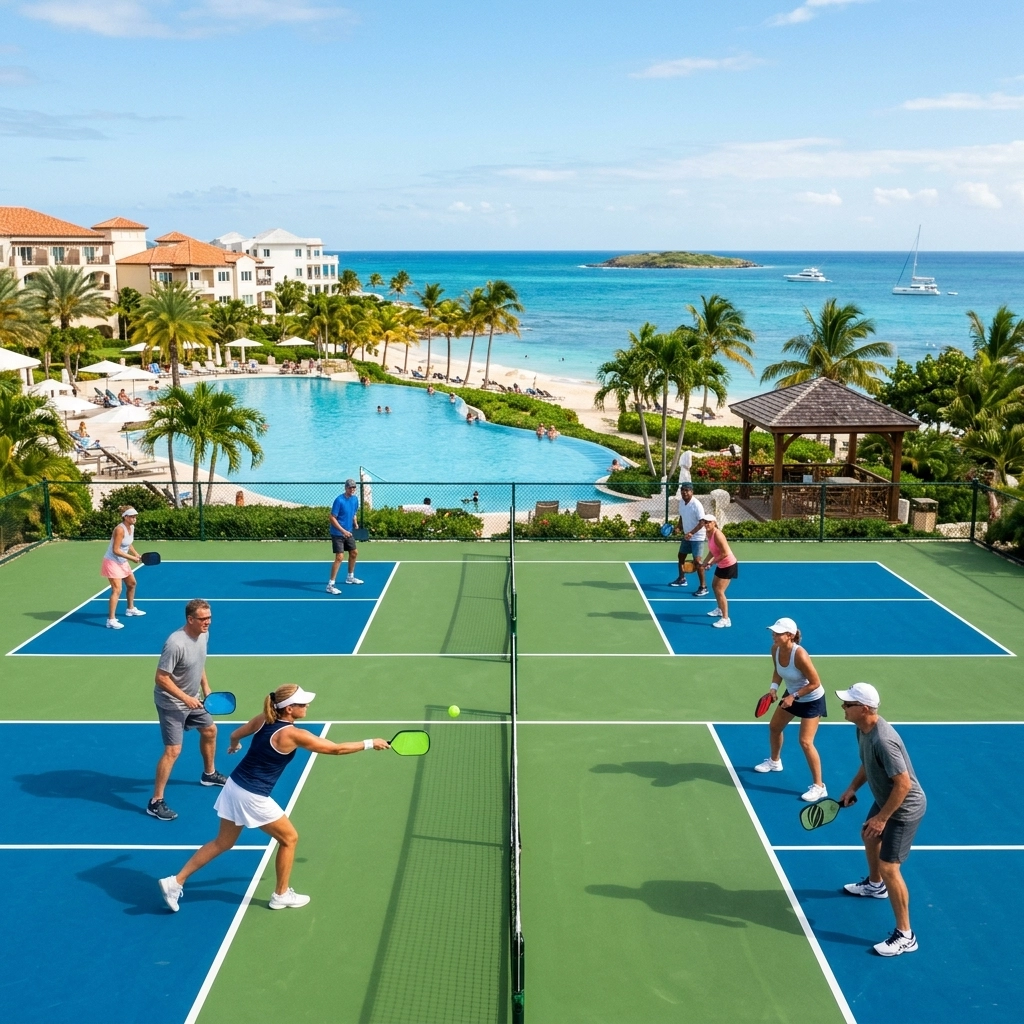
Walk past the tennis courts of almost any high-end resort in the Pacific today, and you’ll likely see a familiar sight: a vast, sun-baked expanse of blue or green asphalt, a sagging net, and: more often than not: absolutely no one playing on it.
For decades, the tennis court was the crown jewel of resort amenities, a symbol of country-club luxury that signaled "prestige." But times change, and so do the ways people want to move their bodies while on vacation. Across the globe, and specifically within the luxury hubs of the Pacific Islands, a quiet revolution is happening. Resort owners are taking a hard look at those underutilized acres of "prestige" and realizing they are sitting on a goldmine of wasted space.
The solution? Ripping out the singles lines and embracing the "thwack" of the fastest-growing sport on the planet: Pickleball.
From a property management perspective, the most compelling argument for the switch isn't just about the hype: it’s about the spatial efficiency.
A standard tennis court requires a footprint of approximately 60 by 120 feet (including the out-of-bounds area). In that same space, a savvy developer can comfortably fit four professional-sized pickleball courts.
Let’s look at the "Guest Throughput" math:
For a resort owner, this represents a 400% increase in capacity without clearing a single extra square meter of land. In island environments where usable, flat land is at a premium and environmental regulations are strict, being able to quadruple your amenity offering within the existing footprint is a massive operational win.

It isn't just about the numbers; it’s about the shift in guest behavior. Tennis is a high-skill, high-exertion sport. If you haven't played in years, trying to chase a fuzzy yellow ball across a 78-foot court in 30-degree tropical heat feels less like a holiday and more like a cardio-induced existential crisis.
Pickleball levels the playing field. The smaller court, the perforated plastic ball, and the underhand serve make the game accessible to almost everyone, regardless of athletic ability.
Historically, resort activities were split: the kids went to the pool, and the adults went to the gym or the bar. Pickleball is one of the few activities that naturally bridges the gap.
The real magic of pickleball for resort owners lies in its social density. Because the courts are smaller and players are physically closer to one another, the game is inherently conversational.
In a traditional tennis match, players are separated by nearly 30 meters of space. In pickleball, you are close enough to chat with your opponents at the kitchen line. This social atmosphere turns a "sporting facility" into a "destination."
Resorts that have converted to pickleball facilities often report a significant uptick in secondary revenue. Players don't just finish a set and head back to their room. Because it’s social, they tend to:
✔️ Stay for multiple games with different partners.
✔️ Gather at the court-side seating to watch others.
✔️ Order refreshments and snacks to the court area.
✔️ Book group clinics or "social mixer" events hosted by the resort.
By creating a high-energy social hub, the resort encourages guests to stay on-property longer, directly impacting the bottom line of the food and beverage department.

In regions like Fiji, Vanuatu, and the Cook Islands, the transition to pickleball makes even more sense. The tropical climate often dictates that high-intensity outdoor activities need to happen in the early morning or late afternoon.
Because pickleball matches are shorter and slightly less aerobically taxing than a full three-set tennis match, the "playability window" in heat is much wider. Guests who wouldn't dream of a midday tennis match are often happy to squeeze in a quick 20-minute pickleball game before lunch.
Maintaining a pristine tennis court: especially grass or clay: is an expensive, uphill battle in humid, coastal environments. While pickleball courts still require quality surfacing, the smaller area makes maintenance schedules more manageable. Furthermore, the specialized equipment (paddles and balls) is more durable and easier to manage as a rental or complimentary guest "grab-and-go" item than tennis rackets and high-pressure balls.
Modern resorts are no longer just looking at the "individual traveler." The MICE (Meetings, Incentives, Conferences, and Exhibitions) market is a huge revenue driver.
Tennis is notoriously difficult to turn into a corporate team-building event because of the skill gap: one semi-pro player will dominate the rest of the office. Pickleball, however, is the ultimate "equalizer."

Transitioning from tennis to pickleball isn't just about painting new lines. To do it right and maintain a premium feel, property managers should consider several structural and aesthetic factors:
While the game is fun, the "pop" of the paddle can be loud. Savvy resort owners are using specialized acoustic-dampening fencing or strategic landscaping to ensure the sound of play doesn't disturb guests in nearby "quiet zones" or villas.
For those hesitant to fully "rip out" tennis, many are opting for hybrid courts. By using different colored lines, a single court can accommodate both sports. However, the industry trend is leaning heavily toward dedicated pickleball spaces. A dedicated court allows for permanent nets, which are more stable and look significantly more professional than portable versions.
To maximize the ROI of the space, high-quality LED lighting is essential. In paradise, some of the best games happen after the sun goes down and the temperature drops. Well-lit courts allow for "Night Owl" tournaments, extending the facility's usage hours well into the evening.

The shift from tennis to pickleball isn't a fad; it’s a response to a global change in how people socialize and exercise. For resort owners, the benefits are clear:
As the "Tennis Ghost Town" becomes a thing of the past, the sound of the pickleball paddle is becoming the new soundtrack of the modern luxury resort. Whether you are managing a boutique island getaway or a massive international hotel chain, the math is simple: more courts, more players, and a more vibrant guest experience.
It’s time to trade the racket for a paddle: your guests (and your bottom line) will thank you.
The global rise of pickleball is reshaping resort amenities, particularly in the Pacific Islands. By replacing underused tennis courts with four times the number of pickleball courts, resorts can significantly increase guest engagement, cater to all ages, and create high-energy social hubs that drive secondary revenue. The switch represents a strategic move toward spatial efficiency and modern guest preferences.


