
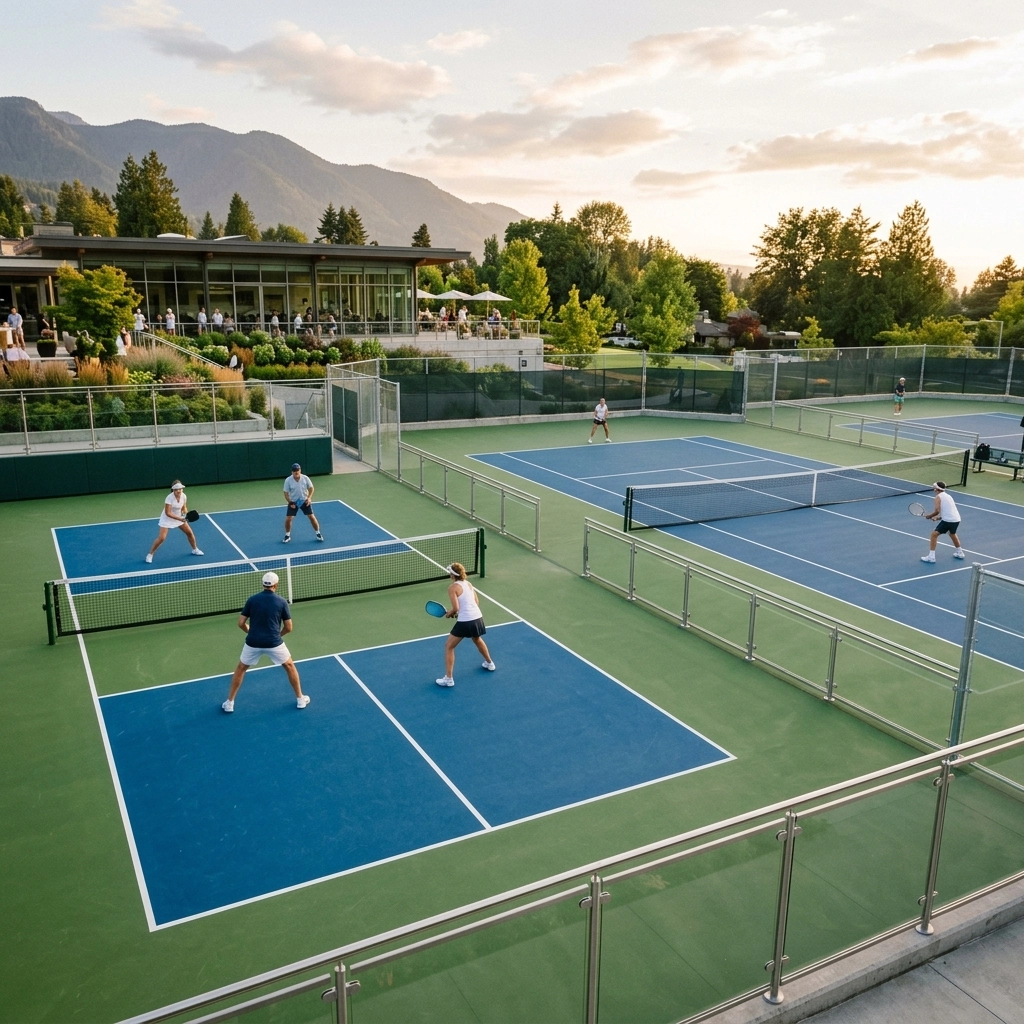
As recreational trends shift, facility managers, urban planners, and residential developers are increasingly faced with a spatial dilemma: how to maximize the utility of existing or planned sports surfaces. The surge in popularity of pickleball has introduced a new variable into the equation of facility planning. While tennis has long been the gold standard for court-based recreation, its expansive footprint is now being scrutinized for its efficiency relative to player throughput.
Understanding the technical footprint comparison between a standard tennis court and a pickleball court is essential for informed decision-making. This guide breaks down the dimensions, buffer zones, and the "4-to-1" ratio that is currently reshaping the landscape of sports infrastructure.
To understand the comparison, one must first establish the technical requirements of a regulation tennis court. While the "play area" or the lines of a doubles court measure 78 feet in length and 36 feet in width, the functional footprint required for safe and competitive play is significantly larger.
Facility planners must account for "run-off" or "out-of-bounds" zones. According to international standards, a regulation tennis court footprint typically requires an area of 60 feet by 120 feet, totaling 7,200 square feet. This buffer is critical to prevent player injury during high-speed lateral movements and deep baseline play.

In contrast, pickleball is designed for compact efficiency. A regulation pickleball court measures 20 feet by 44 feet: the same size as a doubles badminton court. However, like tennis, the total footprint required for safe play must include a buffer zone.
For a standalone pickleball court, the recommended footprint is 30 feet by 60 feet, totaling 1,800 square feet. When comparing this to the 7,200 square feet required for a single tennis court, the math reveals a stark difference in spatial efficiency.
The most compelling argument for pickleball in facility planning is the 4-to-1 ratio. Mathematically, the footprint of one standard tennis court (60' x 120') can perfectly accommodate four regulation pickleball courts (each 30' x 60').
This conversion or planning strategy offers a massive increase in player density. On a single tennis court, a maximum of four players can participate at once (doubles). By repurposing that same 7,200-square-foot footprint for four pickleball courts, a facility can host 16 players simultaneously. For community centers or private clubs, this represents a 300% increase in capacity without expanding the physical property borders.

Beyond the raw dimensions, there are structural differences that planners must account for when designing these spaces.
The net heights for both sports are not interchangeable. A tennis net is significantly higher at the posts (42 inches) to account for the wider span of the court. A pickleball net is lower, sitting at 36 inches at the posts and 34 inches at the center. When converting space, facilities often utilize specialized "multi-sport" net systems or portable nets that can be adjusted to the correct height, as playing pickleball with a tennis-height net fundamentally alters the game’s physics.
Unique to pickleball is the Non-Volley Zone (NVZ), commonly referred to as "The Kitchen." This is a 7-foot area on both sides of the net where players are prohibited from hitting the ball in the air (volleying).
From a planning perspective, the lines of the Kitchen are critical for court safety and professional standards. While tennis relies on a service box and baseline, the Kitchen creates a concentrated area of play near the net, which dictates how the surface wear and tear will distribute over time.
When fitting four pickleball courts into a tennis footprint, there are two primary layout configurations:
For professional-grade facilities, it is recommended to have physical barriers: such as low-profile fencing or specialized netting: between the four courts. This prevents balls from rolling into adjacent matches, a common logistical issue when high-density court layouts are implemented.

Regardless of the footprint chosen, the quality of the subfloor and the surfacing material is paramount. Both sports typically utilize acrylic-coated concrete or asphalt, but the friction requirements can differ.
For facility owners, the footprint is more than just a measurement; it is a metric for Return on Investment (ROI).
By prioritizing spatial efficiency through informed footprint comparisons, planners can create modern, high-capacity recreational hubs that meet the growing demand for court sports without requiring additional land acquisition. Proper planning ensures that whether a court is designed for tennis or pickleball, it remains safe, regulation-compliant, and durable for years to come.


