
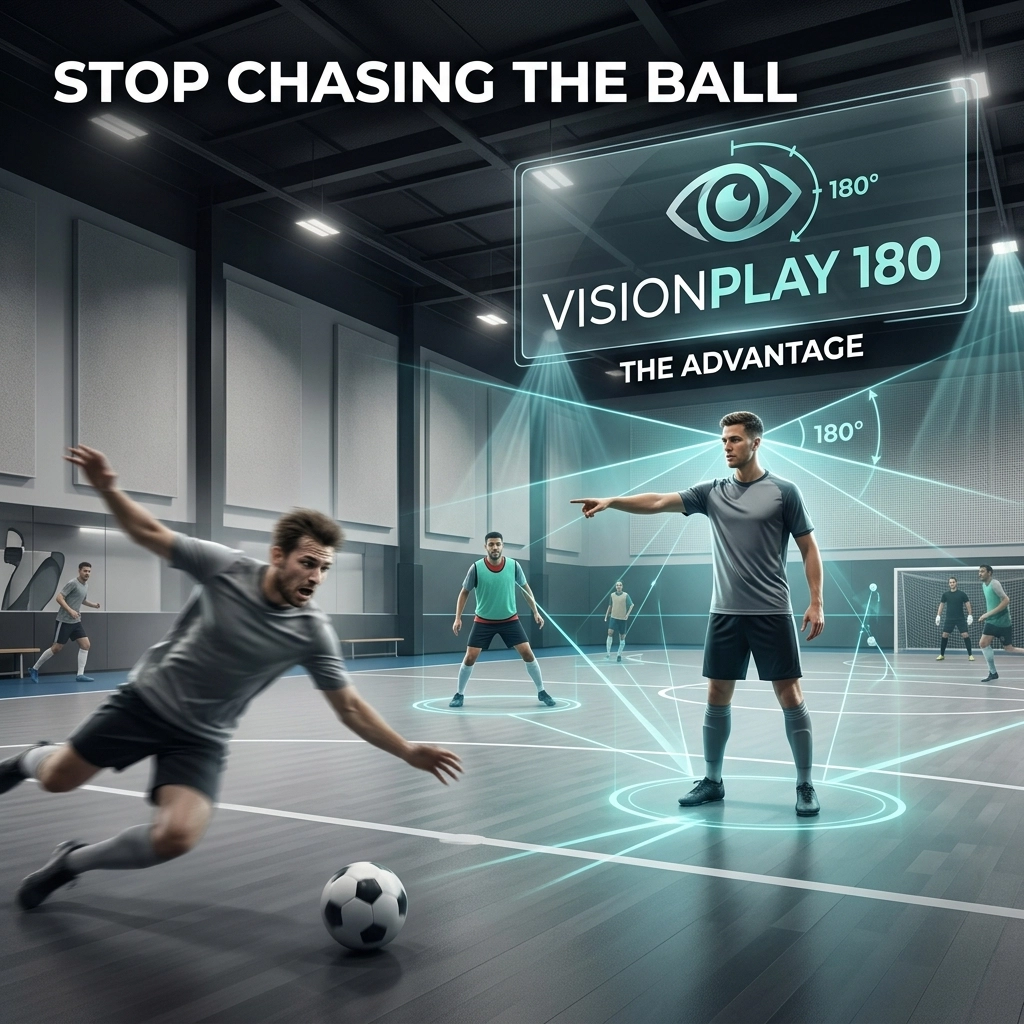
If you’ve ever spent your Sunday evening screaming at a computer screen because your "smart" sports camera decided to follow a seagull instead of your star striker, you’re not alone. We’ve entered an era where AI is supposed to make our lives easier, yet in the world of sports recording, it often feels like we’ve just traded one set of problems for another.
For years, the industry standard for clubs and schools has been the AI Auto-Tracking Camera. These systems use complex algorithms to "predict" where the action is, cropping into a wide frame to follow the ball. It sounds great on paper, but in practice, it’s often like watching a game through a straw.
It’s time to stop chasing the ball and start seeing the whole game. Enter the VisionPlay AI 180 4K, a system that ditches the "follow-the-leader" guesswork in favor of total, unblinking coverage.
The core concept of a typical AI sports camera is simple: capture a wide shot, then use software to digitally zoom in and follow the ball. While this creates a broadcast-style "feel," it introduces a massive margin for error.
AI tracking is only as good as its last update. If a player blocks the camera’s view of the ball, or if two balls enter the frame during a warmup, the AI gets confused. We’ve seen cameras zoom in on the referee’s shiny bald head or get stuck on a corner flag while the winning goal is scored on the other side of the pitch.
The VisionPlay AI 180 4K Sports Live Camera takes a fundamentally different approach. Instead of trying to guess where the action is, it captures the entire 180° field simultaneously in 4K panoramic view. There is no "tracking" because there is no need to move. When you capture everything, you miss nothing.

One of the biggest frustrations for school sports departments and local clubs is the delay between the final whistle and actually seeing the footage.
Typical AI systems often require a "Record → Upload → Process" workflow. You record the game, lug the camera back to the office, upload massive files to a cloud server, and wait hours (sometimes days) for the AI to "stitch" the tracking together. If you wanted to review a play at halftime to show your players what to adjust? Forget about it.
The VisionPlay system is designed for instant gratification. Because it doesn't rely on heavy post-processing to "find" the ball, the video is ready when you are. It features built-in direct streaming capabilities, allowing clubs to broadcast live to their community without jumping through hoops. Whether you are using the fixed version for a stadium or the motion-ready version, the result is the same: live, high-definition sports without the wait.
Let’s talk about the elephant in the room: subscription models.
Many typical AI camera companies have adopted a "razor and blade" business model. They sell you the camera at a reasonable price, but then lock the footage behind a mandatory monthly or yearly subscription. If you stop paying, your expensive camera becomes a very high-tech paperweight.
At a certain point, schools and facilities need to look at the long-term ROI. The VisionPlay AI 180 requires no mandatory subscription. You buy the hardware, you own the footage, and you control the stream. For a local club or a school athletic department working on a tight budget, the difference between a one-off investment and a perpetual bill is game-changing.
In sports like rugby, football, or hockey, the most critical moments often happen at the edges of the field. A desperate dive for the try line, a contentious out-of-bounds call, or a quick throw-in: these are the moments where typical AI tracking cameras frequently fail.
When a camera is "zoomed in" on the ball, it loses the context of the rest of the field. If the ball moves faster than the digital pan can keep up, you get a blurred mess or a shot of empty grass.
Because the VisionPlay AI 180 4K captures a continuous 180° stitched view, "edge play" is no longer a gamble. You can see the winger sprinting down the touchline while the ball is still in the air. For coaches, this is a goldmine. You’re not just seeing who has the ball; you’re seeing the defensive line, the off-ball movement, and the tactical positioning that a "follow-cam" would completely ignore.
While full-field sports are an obvious fit, the VisionPlay 180 shines specifically in fast-paced, small-court environments.
The speed of 3x3 basketball is legendary. The ball moves from one end to the other in seconds, and the physical intensity under the hoop is constant. Typical AI cameras often struggle with the verticality and the rapid direction changes of 3x3. The VisionPlay’s 4K panoramic view ensures that every block, every crossover, and every long-range shot is captured in crisp detail, making it the perfect tool for outdoor sports facilities looking to provide professional-level highlights for their players.
Pickleball is currently the fastest-growing sport in the world, and facilities are racing to keep up. The game is played on a compact court where fast-twitch reactions are everything. Because the VisionPlay is plug-and-play, a facility manager can mount it once and provide a high-quality stream for every court session. There’s no need for a "cameraman" or a complex calibration process every time someone wants to record a match.

Typical tracking systems often require a specific "calibration" routine. You have to stand in the middle of the field, wave your arms, wait for the camera to recognize you, and hope the lighting is just right for the sensors to lock on.
The VisionPlay AI 180 is designed for the busy volunteer or the time-poor teacher. It is a plug-and-play solution. Mount it, power it up, and you’re recording. Since it isn't trying to move or track, there’s no mechanical wear and tear, and no calibration errors to troubleshoot five minutes before the game starts.
The shift from "following the ball" to "capturing the field" represents a major leap in sports technology. By removing the guesswork of AI tracking, the VisionPlay AI 180 4K provides more reliable footage, a faster workflow, and a significantly better financial model for clubs and schools.
Whether you are looking to provide live streams for parents who can’t make the game, or you need high-fidelity 4K footage for tactical coaching analysis, the focus should be on the sport, not the software.
Key Takeaways:


