
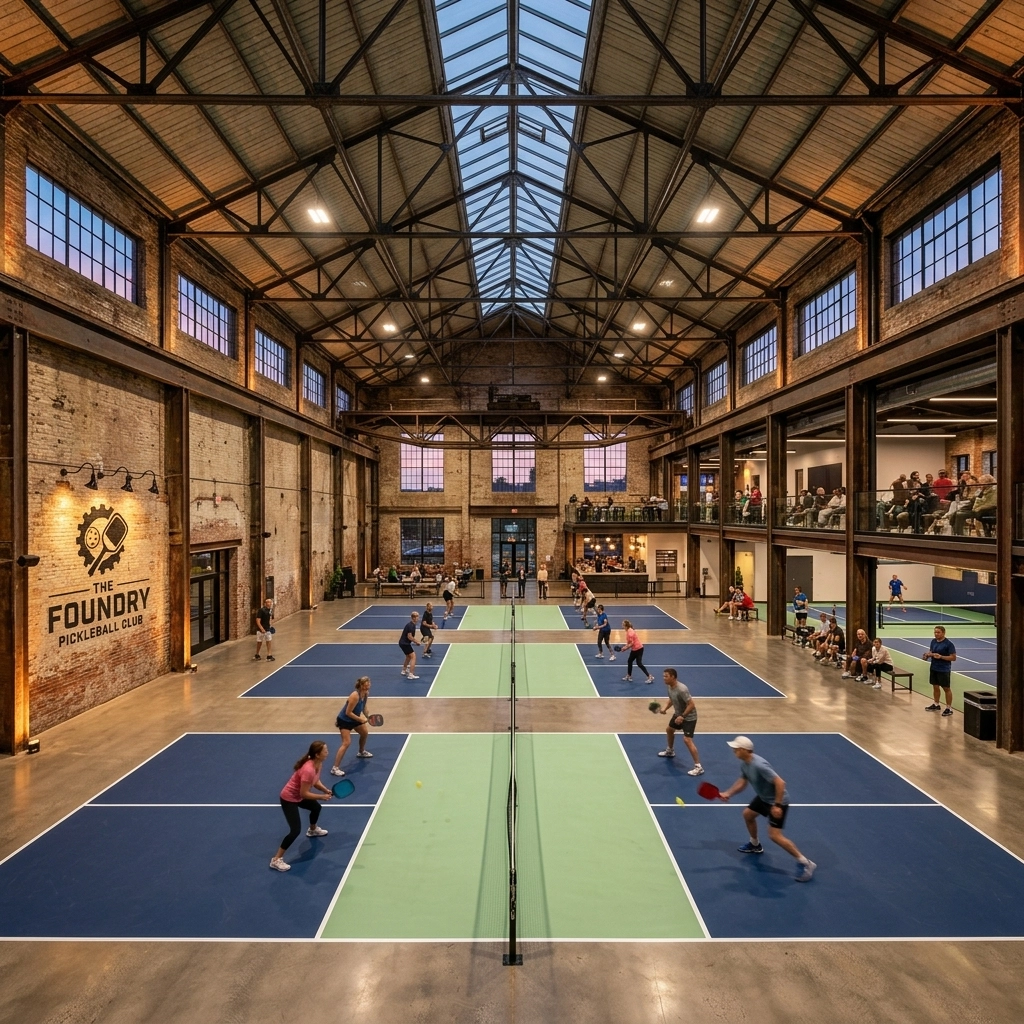
The commercial real estate landscape is undergoing a fundamental shift. As traditional industrial requirements migrate toward purpose-built logistics hubs, a vast inventory of mid-to-large-scale industrial shells: warehouses, factories, and distribution centers: now sits underutilized. Simultaneously, the rapid ascent of pickleball has outpaced the development of specialized infrastructure.
For developers and architects, the convergence of these two trends represents a significant opportunity. Converting an industrial shell into a premier pickleball facility is not merely a matter of painting lines on a concrete floor; it is a complex exercise in adaptive reuse engineering. It requires a sophisticated understanding of spatial dynamics, acoustic mitigation, and environmental control to transform a empty box into a high-performance athletic ecosystem.
The success of a conversion project is dictated by the existing building’s geometry. While a standard pickleball court measures 20 by 44 feet, the architectural requirements for a professional-grade facility are far more expansive.
Specify a minimum vertical clearance of 18 to 20 feet from the finished floor to the lowest hanging obstruction (trusses, lighting fixtures, or HVAC ducting). While casual play can occur in lower volumes, premier facilities catering to competitive play must accommodate the high-arcing "lob" shot.
The ideal industrial candidate features a clear span design. Internal columns are the primary antagonist in court layout optimization. If columns exist, they must be integrated into the "buffer zones" between courts rather than interfering with the play area or safety margins.
Do not design based on the 20x44-foot dimensions alone. Allocate a total footprint of 30 by 60 feet per court to provide the necessary out-of-bounds safety zones. This 1,800-square-foot "envelope" ensures player safety during high-velocity lateral movements and allows for official officiating and spectator movement.

Industrial floors are designed for static loads and heavy machinery, not necessarily for the high-friction, repetitive lateral impact of sport.
Conduct a comprehensive slab assessment before specifying the sports surface. Industrial slabs often feature expansion joints, cracks, or "birdbaths" (low spots). These must be remediated with high-compression leveling compounds. Any moisture vapor transmission from the sub-slab must be mitigated; high moisture levels will cause the specialized acrylic or modular sports flooring to delaminate or bubble.
Analyze the building's structural grid to determine the maximum court density. In many 20th-century warehouses, column spacing is set at 20, 30, or 40 feet.
The transition from a storage facility to a high-intensity sports hub places extreme demands on the building's mechanical and environmental systems.
The defining sound of pickleball is a sharp, percussive "pop" generated by the paddle impacting the ball. In a raw industrial shell: characterized by hard, reflective surfaces like concrete and metal: this sound amplifies through reverberation, leading to a chaotic acoustic environment that is fatiguing for players and potentially non-compliant with local noise ordinances.
Implement a multi-layered acoustic strategy:
Industrial lighting (typically high-pressure sodium or basic LED high-bays) is insufficient for high-speed racquet sports.
Specify a lighting plan that delivers 500 to 750 lux at the floor level. The critical factor is not just brightness, but uniformity and glare reduction.
Industrial shells are often poorly insulated and under-ventilated. Once filled with 50-100 active athletes, the latent heat and humidity levels will skyrocket.
Calculate the "Metabolic Heat Gain." A standard warehouse HVAC system designed for two employees and a forklift will fail in a pickleball context.
The most successful industrial conversions are those that view the court not as the product, but as the anchor for a broader social ecosystem. This is the "Eatertainment" model: merging high-end hospitality with competitive sport.
Designate 20-30% of the total floor area for non-sporting use. This includes:

To ensure the viability of an industrial-to-pickleball conversion, follow this technical sequence:

Successful conversion of industrial assets into premier pickleball hubs requires a move away from "aesthetic" design toward performance engineering.
By treating the industrial shell as a structural canvas and applying these technical rigors, developers can create high-demand, high-performance recreational assets that stand the test of both market trends and intensive athletic use.


