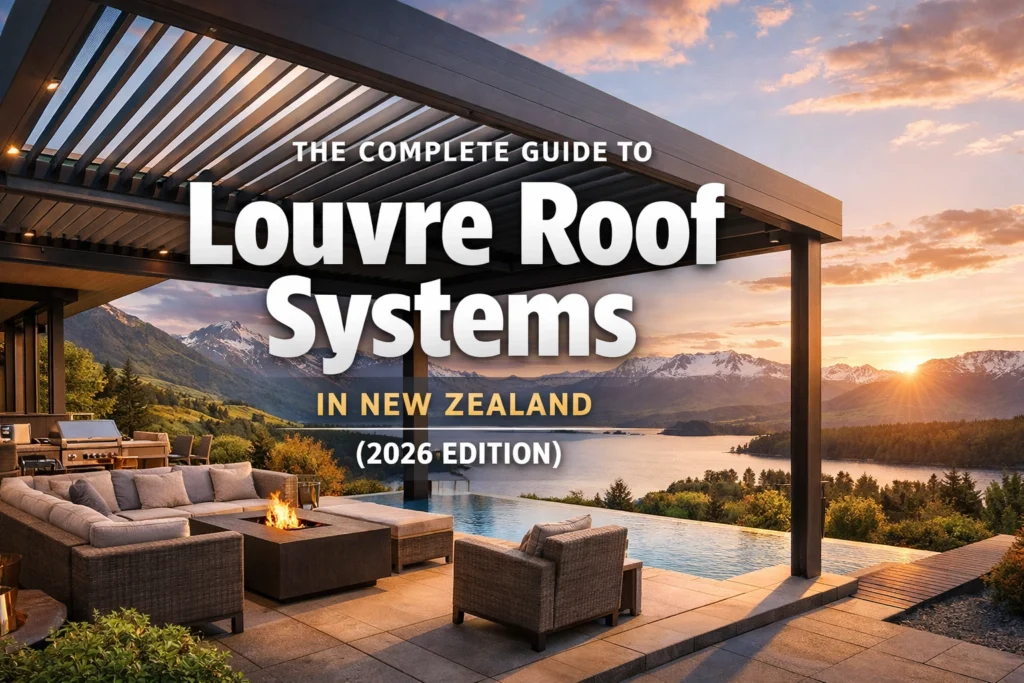
Louvre roof systems have become one of the fastest-growing outdoor upgrades across New Zealand.
What was once considered a premium feature is now becoming a standard part of modern homes—transforming decks, patios, and outdoor areas into fully usable, year-round spaces.
But not all louvre systems are the same.
This guide breaks down everything you need to know—from how they work to what actually matters in New Zealand conditions—so you can make the right decision.
A louvre roof system is an outdoor structure with adjustable slats (louvres) that can open and close to control:
• Sunlight
• Airflow
• Rain protection
When open, they allow light and ventilation.
When closed, they form a sealed roof that directs water into an integrated drainage system.
This flexibility is what makes them one of the most practical outdoor solutions available today.
Outdoor living in New Zealand isn’t seasonal—it’s part of daily life.
From Auckland to Queenstown, homeowners are using outdoor spaces for:
• Dining
• Entertaining
• Working from home
• Transition spaces between indoors and outdoors
Louvre systems allow these areas to function in:
• Strong sun
• Sudden rain
• Wind exposure
Instead of being limited by weather, the space becomes usable year-round.
A simple crank system opens and closes the louvres.
Best for:
• Cost-conscious projects
• Smaller areas
• Low-maintenance setups
Operated by remote, wall switch, or app.
Features can include:
• Rain sensors
• Smart home integration (Tuya systems)
• Timed automation
Best for:
• Everyday convenience
• Larger outdoor areas
• Integrated outdoor setups
The roof fully retracts rather than just tilting.
Best for:
• Maximum openness
• High-end residential or commercial use
• Flexible light control
A non-opening roof, often using insulated panels or polycarbonate.
Best for:
• Lower cost
• Permanent weather protection
• Simpler installations
Not all systems are built for New Zealand’s environment.
Look for:
• 6063-T5 or 6063-T6 aluminium
• Powder-coated finishes
Why it matters:
• Corrosion resistance
• Structural strength
• Long-term durability
• 304 stainless steel = standard
• 316 stainless steel = ideal for coastal areas
Avoid lower-grade materials like 201 stainless, especially near the coast.
A proper system should include:
• Internal gutters
• Hidden downpipes inside posts
This prevents visible overflow and improves performance in heavy rain.
A well-built louvre system should handle:
• High UV exposure
• Heavy rain events
• Wind zones (especially coastal and elevated areas)
Key things to check:
• Wind ratings
• Water channeling design
• Structural beam sizes
Not all systems are engineered equally—this is where quality differences show.
• Pre-engineered sizes
• Faster installation
• Lower cost
• Expandable with add-ons
Ideal for most residential applications.
• Fully tailored design
• Higher cost
• Longer lead times
Best suited for:
• Architectural builds
• Complex layouts
Modern louvre systems are no longer just roofs.
They can be upgraded with:
• Track blinds (wind + privacy control)
• LED lighting systems
• Sliding or frameless glass doors
• Heaters and sound systems
These additions turn a pergola into a fully functional outdoor room.
• Choosing price over structure quality
• Ignoring wind and coastal conditions
• Overcomplicating with unnecessary automation
• Not planning for future add-ons
• Poor installation or foundation setup
A louvre system is a structural product—not just a shade solution.
Pricing varies based on:
• Size
• Material quality
• Manual vs motorised
• Add-ons
General ranges:
• Entry-level kitsets: Lower cost, basic functionality
• Mid-range systems: Best balance of price and performance
• High-end custom systems: Premium pricing with full customization
The key is understanding what you actually need—not just what’s available.
There’s a clear shift happening.
People are moving away from overly complex, expensive systems—and toward:
• Practical designs
• Scalable systems
• Performance-focused materials
The goal isn’t just to build an outdoor space.
It’s to create something that works—every day.
Louvre roof systems are no longer a luxury—they’re becoming part of how homes are designed and used in New Zealand.
The best system isn’t the most expensive or the most advanced.
It’s the one that:
• Matches your environment
• Fits how you actually use your space
• Performs over time
Get those three things right, and everything else follows.