
n the rapidly evolving world of racquet sports, pickleball has carved out a unique niche that demands a specific balance of speed, strategy, and physical endurance. As players move from improvised driveway setups to professional-grade facilities, the conversation inevitably turns to surface performance. Central to this discussion is a technical metric known as the ball bounce rate.
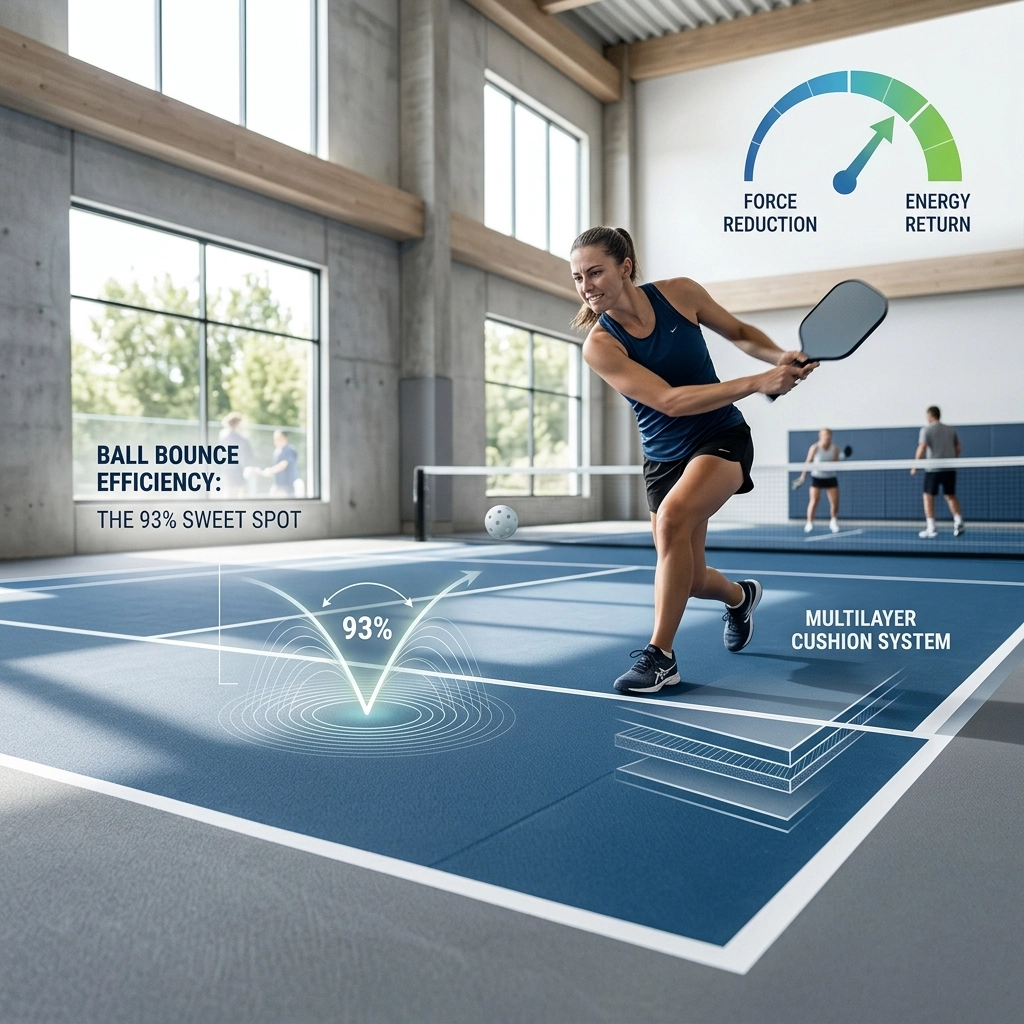
While casual players might assume that more bounce is always better, industry experts and sports scientists have identified a specific "sweet spot" for performance flooring: 93%. This figure represents more than just a number; it is the precise intersection of high-level ball response and long-term joint protection. Understanding why this percentage is the gold standard requires a look at physics, biomechanics, and the unique dynamics of pickleball play.
To understand what 93% means, we must first establish the baseline. In the world of sports surface engineering, concrete or asphalt is treated as the benchmark for a 100% bounce rate. Because concrete is a rigid, non-porous, and non-elastic material, it returns almost all the kinetic energy of a falling ball back into the rebound.
In simple terms, the ball bounce rate measures how much energy is returned when a ball strikes the surface. When testing these surfaces, engineers use a controlled drop test:
At first glance, a loss of seven centimetres might seem like a disadvantage. However, in the context of a fast-paced game like pickleball, that 7% energy "loss" is actually a deliberate design feature that transforms a hard slab into a professional-grade athletic surface.

Playing on a surface with a 100% bounce rate: typically raw concrete or old-school asphalt: presents two major challenges: unforgiving impact and erratic ball behavior.
When an athlete moves across a 100% rigid surface, their body absorbs 100% of the shock. Every sprint, sudden stop, and lateral lunge sends Ground Reaction Forces (GRF) directly up through the ankles, knees, and hips. Over time, this leads to chronic fatigue, shin splints, and increased risk of acute injury. A surface that gives nothing back to the ball also gives nothing back to the player in terms of cushion.
Pickleball is a game of "dinks" and delicate net play. On a 100% bounce surface, the ball can become "lively" to a fault. The plastic, perforated ball used in pickleball reacts sharply to rigid surfaces, often resulting in high, floating bounces that sit up perfectly for an opponent’s overhead smash. By tempering the bounce slightly, the floor helps keep the game focused on skill and placement rather than raw rebound energy.
The transition to a 93% ball bounce rate is a calculated engineering trade-off. This level of performance is typically achieved through multi-layered modular flooring or specialized acrylic coatings with integrated cushion layers.
One of the primary requirements for competitive play is uniformity. A high-quality sports floor ensures that the bounce is the same in the corners as it is at the kitchen line. At 93%, the ball retains enough energy to feel "true." Players don't have to adjust their swing mechanics or move their feet differently than they would on a traditional court. The ball remains responsive, allowing for the fast-paced volleys and quick-fire exchanges that define the sport.
The 7% of energy that doesn't return to the ball is instead absorbed by the flooring system. This is known as Force Reduction. Modern sports surfaces are designed with a specific level of "give." This micro-deformation happens in milliseconds, but it is enough to significantly dampen the impact on a player's skeletal system.
Key Benefits of 93% Energy Return:

If some absorption is good, why not add more? If we were to drop the bounce rate to 85% or lower, we would enter the territory of "dead" surfaces. On a floor with insufficient energy return, the ball feels heavy. It dies on the court, forcing players to dig deeper for every shot and fundamentally changing the physics of the game.
A 93% rate is considered the "Sweet Spot" because it is virtually indistinguishable from concrete in terms of player perception of ball speed, yet it provides a massive leap forward in comfort. It strikes the perfect balance where the ball performs like it’s on a professional stadium court, but the player’s body feels like it’s on a cushioned track.
Achieving a consistent 93% rating involves sophisticated material science. High-end indoor and outdoor sports floors utilize several layers to manage energy:
This layered approach ensures that the "skin" of the court remains firm enough for the ball to bounce accurately, while the "skeleton" of the court provides the necessary flex for the athlete.
Pickleball has seen an explosion in popularity across all age groups, particularly among older adults who appreciate the lower cardiovascular strain compared to tennis. However, because the court is smaller and the game is faster, the number of "starts and stops" is actually higher per minute of play.
For the "Power Player" or the "Weekend Warrior," the surface is the most important piece of equipment. You can change your paddle or your shoes, but you cannot change the floor once the game has started. Investing in or choosing facilities with a 93% bounce rate is a commitment to player longevity. It allows for a more sustainable hobby, reducing the "recovery time" needed between sessions.
When specifying flooring for a new pickleball facility or a backyard court conversion, it is essential to look for certified test results. Professional-grade surfaces should provide:
By focusing on these metrics, facility managers can ensure they are providing a surface that attracts serious players and protects casual ones.

The science of the bounce is about more than just how high a ball goes; it is about managing energy for the benefit of both the game and the athlete.
In the end, a 93% ball bounce rate represents the pinnacle of modern sports engineering. It delivers a surface that performs very close to concrete in terms of speed and accuracy, but with the added comfort and reduced impact required for high-performance play. For the serious pickleball enthusiast, it is the only surface that truly makes sense.


